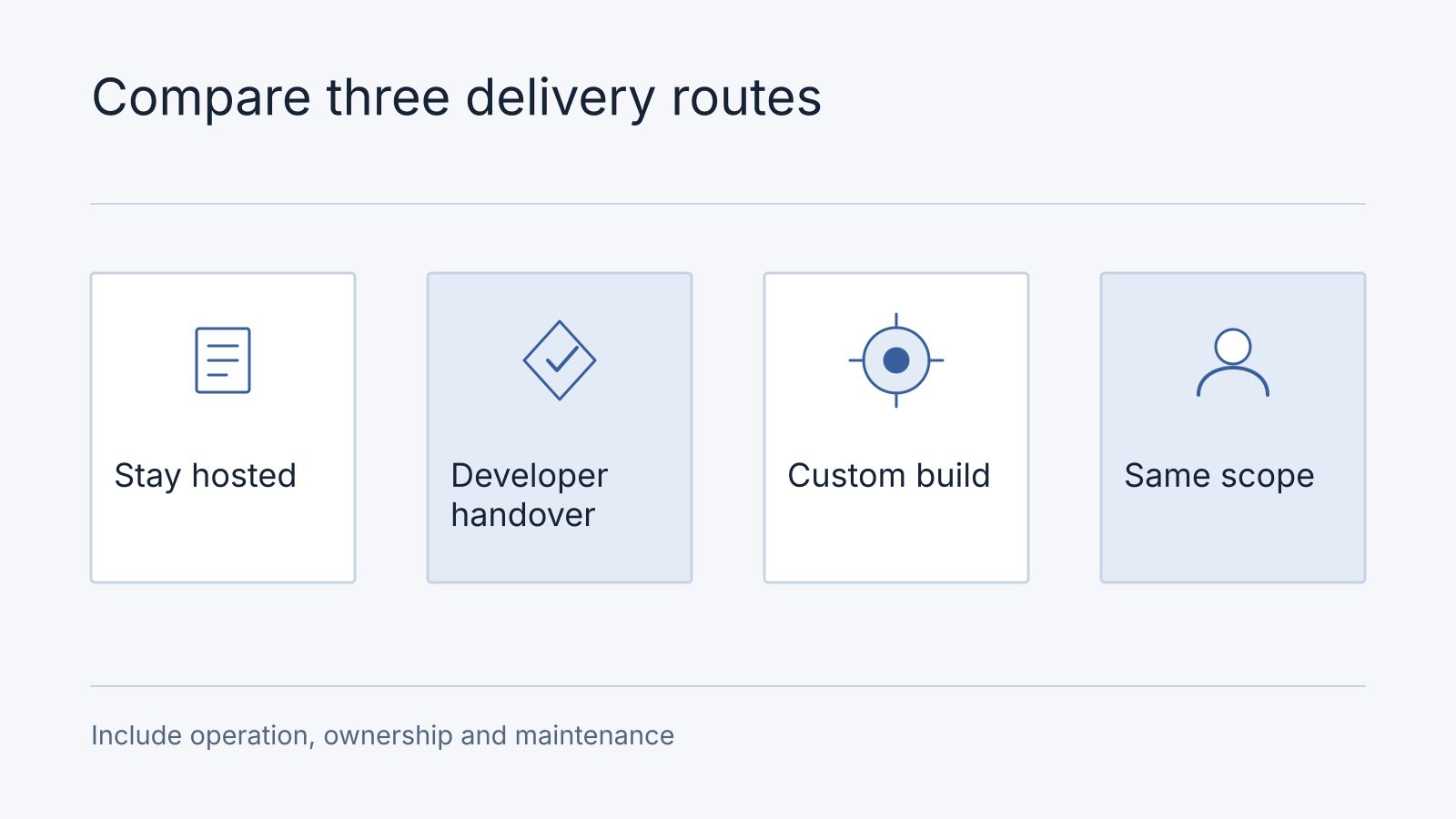
If you have built a website or application with Manus, you can keep using its managed environment, ask a developer to prepare the existing build for another environment, or commission a new build. The lowest subscription price does not identify the least expensive complete route. Compare the same required functionality, operating responsibilities and time period for every option.
This is a planning guide, not a Nodesify client case study. The application example below is hypothetical. Its architecture and worksheet show what to inspect; they are not a quotation, customer deployment, measured saving or promise that a Manus application can be moved unchanged. Check current Nodesify pricing and payment terms for our published offers. Manus terms were reviewed on 13 September 2026 and should be checked again before a purchase decision.
Three routes to a usable system
| Route | What to include in the comparison | Key uncertainty |
|---|---|---|
| Keep building and hosting with Manus | Subscription, build usage, live application usage, integrations, support and your operating time | Whether the current environment meets security, ownership and workflow needs |
| Retain useful code and move its operation | Technical assessment, replacement services, data transfer, deployment, validation and ongoing support | Which dependencies can actually be separated from the platform |
| Commission a custom build | Discovery, implementation, acceptance, infrastructure, support and later changes | Whether a rebuild solves a requirement the existing build cannot meet |
A working preview is useful evidence of intended behaviour. It does not establish that permissions, backups, payment flows or incident recovery are production-ready. Ask for a scoped assessment before comparing a migration quote with a new-build quote.
Check what Manus charges and exports
Manus distinguishes its subscription from the WebDev balance used by deployed applications. Hosting, database use, AI features and integrations can contribute to live costs. Its documentation also distinguishes custom-domain requirements from hosting on a Manus-provided domain. Confirm the current WebDev billing terms and the charges shown in your own account.
Manus describes a code-package export option in its code and domain guidance. Exporting source files is different from operating the application independently. Map authentication, database, file storage, AI calls, secrets, scheduled jobs and deployment settings before assuming a host change is straightforward.
Hypothetical handover example
Imagine a training application with staff accounts, company-specific records, uploaded files and AI-assisted report drafting. This is an illustrative design exercise, not a Nodesify customer project or delivered demo. A team assessing it would ask:
| Area | Evidence to request | Possible handover work |
|---|---|---|
| Identity | User roles, login flow and account ownership | Replace or reconnect authentication and test company boundaries |
| Data | Schema, exports, retention rules and sample records | Migrate and reconcile records if the chosen destination requires it |
| Files | Storage location, access policy and export method | Transfer files and verify references and permissions |
| AI | Provider, prompts, usage and data flow | Reconnect the feature and budget for model usage |
| Operation | Domain, deployment process, backups and monitoring | Set up the destination, recovery process and handover |
The assessment might show that keeping the current platform is sensible. It might also reveal a requirement that justifies a migration or rebuild. The table identifies questions; it does not assert that every Manus application uses the same services or needs every replacement task.
Build a 12- and 24-month cost worksheet
Use the same workload and acceptance criteria across routes. For each option, fill in actual quotes and bills rather than copying a market average:
| Cost or responsibility | Keep Manus | Handover | Custom build |
|---|---|---|---|
| Upfront discovery and implementation | Your build time and any paid help | Assessment, changes, transfer and validation | Discovery, design, build and acceptance |
| Recurring platform and infrastructure | Subscription and deployed-app usage | Hosting, storage, database and third-party services | Hosting, storage, database and third-party services |
| Support and change work | Platform support plus application owner | Named owner and agreed support scope | Named owner and agreed support scope |
| Internal operating time | Content, account and incident work | The same duties, plus migration coordination | The same duties, plus project acceptance |
For each row, record the billing period, currency, tax treatment, included usage, overage rules and source of the figure. A normal month should be separated from a one-off building spike. Then calculate:
Total cost over the chosen period = upfront work + recurring charges + usage charges + support + additional changes + internal operating time.
A payback calculation is meaningful only when comparable routes deliver the same required result and a recurring net saving is supported by real bills. A shared installation does not have a fixed cost at every customer count; transactions, concurrency, storage and AI use can change its bill. Do not promise a two-month payback or extrapolate a per-company cost without actual usage evidence.
Choose the route from the requirement
Keep the existing environment when it meets the operating needs and the full bill is acceptable. Assess a handover when the prototype is useful but ownership, integrations or deployment need to change. Consider a custom build when the desired workflow or operating model cannot be achieved economically with the existing implementation. For a marketing website, compare editing, forms, analytics, content and maintenance rather than using a training application as a price benchmark; our website platform comparison covers that decision.
Compare twelve and twenty-four months explicitly
This is invented MYR arithmetic, not Manus pricing or a Nodesify quotation. Suppose staying requires MYR 1,000 of fixes and MYR 300/month including operation: 12 months costs MYR 4,600, 24 months MYR 8,200. Moving costs MYR 5,000 plus MYR 300 parallel running and MYR 200/month: 12 months MYR 7,700, 24 months MYR 10,100. With equal required functionality and support, staying wins both periods; the MYR 4,300 extra upfront cost takes 43 months to recover at MYR 100/month net savings. Changes, taxes and exit work are excluded here and must be added to real quotes.
Retaining exported frontend code may still require replacing builder-managed authentication or data access. Before pricing that change, demonstrate sign-in, password recovery, permissions and stored-record migration in the destination. Code ownership alone cannot settle these dependencies. Use the hosting worksheet and cost guide with actual invoices.
Frequently Asked Questions
Can we keep the domain and avoid downtime during a move?
Plan domain control, certificate/DNS changes, final data transfer and rollback around the actual system. Do not promise uninterrupted service before rehearsing the cutover and resolving concurrent writes.
Should we migrate if the current platform meets our needs?
Include staying as a serious option. Request an architecture audit only when you need evidence about costs, limits or handover; the recommendation may be to retain the platform.
Can Nodesify assess an application built in Manus?
Yes. Share the required workflows, available export, current usage breakdown and intended operating arrangement. An architecture audit can establish which parts can stay and which dependencies affect a quote.
Does exporting the code remove every platform dependency?
No. Check how identity, data, files, AI services and deployment work in the destination environment. Export availability and migration effort are separate questions.
Is self-hosting always cheaper?
No. Include setup, infrastructure, usage, maintenance and the time needed to run it. A managed environment may be the more economical choice for a small workload.
Bring the application and the bill
Bring a demonstration, a redacted recent usage breakdown, the required customer journey and a list of systems the application connects to. Identify who will own accounts and support after launch. If the need is a new marketing site, start with website development. For an existing application, use an architecture audit to scope the decision before committing to a migration or rebuild.