Enterprise software procurement should establish whether a supplier can deliver and operate the required system under clear commercial and technical responsibilities. A local address, a polished proposal or a low rate is useful context, but none is a substitute for evidence.
Define the procurement baseline
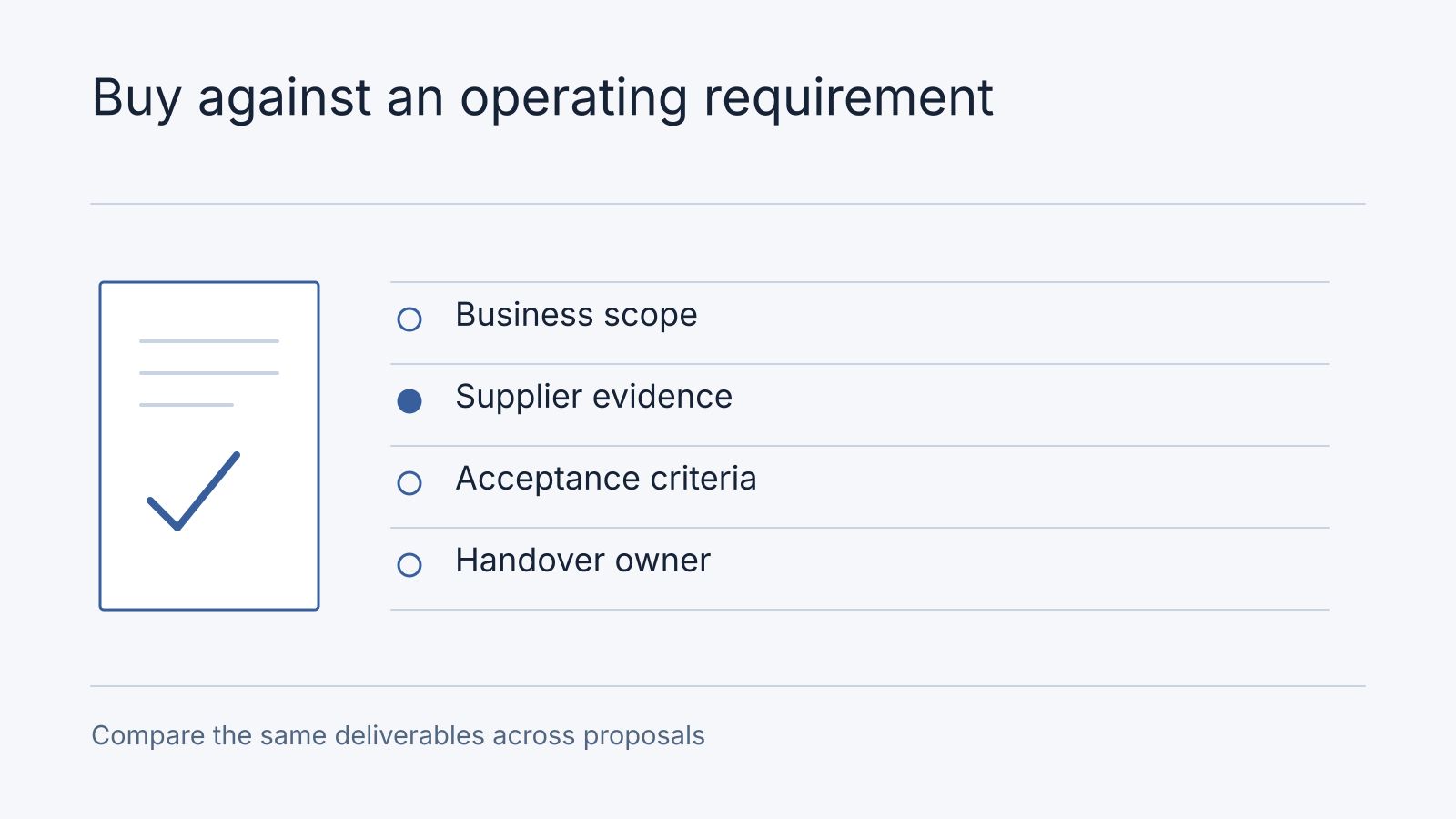
Describe the users, workflows, integrations and constraints. Identify the business owner and the people authorised to accept deliverables. Distinguish confirmed requirements from assumptions that still need investigation.
Ask suppliers to identify exclusions and dependencies, including access to existing systems and decisions your team must make. A fixed price has limited meaning when each proposal assumes a different scope.
Request evidence that matches the work
| Area | Evidence to request |
|---|---|
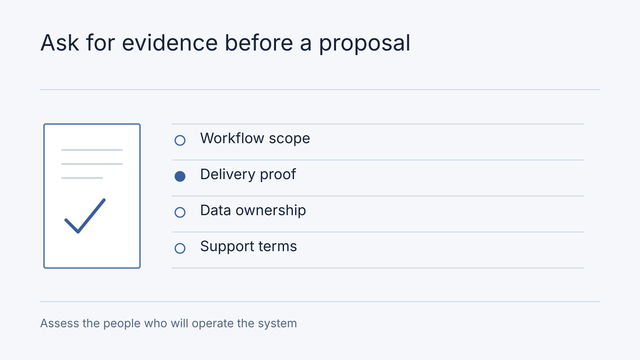
| Delivery | Relevant implementation examples and the proposed team’s responsibilities |
| Architecture | Key integration choices, limitations and operating assumptions |
| Data handling | Processing locations, subprocessors, access and retention arrangements |
| Operations | Monitoring, recovery, support coverage and incident escalation |
| Handover | Code and account ownership, documentation and knowledge transfer |
Verify certifications by their current certificate and scope where relevant. A supplier saying it follows a standard does not establish independent certification or guarantee that every delivered system complies with it.
Allocate responsibilities in the agreement
Hiring a Malaysian supplier does not automatically transfer a customer’s statutory responsibilities or eliminate liability. Offshore engagement does not automatically mean there is no enforceable responsibility either. Assess the actual agreement, applicable law, processing roles and practical enforcement with suitable advice.
Specify confidentiality, intellectual property, subcontracting, security, acceptance, changes and termination. Clarify how data and system access will be returned or removed when the engagement ends.
Do not infer tax treatment from an MYR-denominated invoice. Ask the supplier to state the applicable taxes and the basis of the quote rather than assuming currency determines SST treatment.
Compare lifecycle costs
Include subscriptions, infrastructure, support, internal coordination and future changes. A discovery or architecture phase can reduce uncertainty, but it is not risk-free and does not guarantee that later delivery will match an early estimate. Free proposals are not inherently poor, and paid discovery is not inherently good.
Request current written commercial terms for any audit, implementation credit or support package. Historical or unverified offer amounts should not drive a procurement decision.
Reconcile the scope before applying milestones
An illustrative procurement record has three routes: a stable, demonstrated requirement goes to an implementation quote; unknown integration access goes to a bounded investigation; conflicting business rules go back to the process owner before either. Record the output and stop decision for the investigation so “discovery” does not become an undefined extra phase.
If an agreed implementation total is P, the published 40/40/20 structure represents 0.4P, 0.4P and 0.2P at the contract’s stated milestones. If discovery was separately paid, state whether P includes, excludes or credits it; do not silently count it twice. The actual agreement controls the deliverables, acceptance and payment timing.
For arithmetic only, a fictional RM20,000 agreed total produces RM8,000 / RM8,000 / RM4,000 milestones. If the agreement explicitly credits RM2,000 already paid for discovery within that total and against the first milestone, the first milestone has RM6,000 left to pay and the total remaining balance is RM18,000. This is not a quotation or an automatic credit entitlement.
Frequently asked questions
What belongs in a first-year comparison?
Include implementation, recurring infrastructure/licences, support coverage, expected change allowance, internal operating effort and exit work. Ask each supplier to identify excluded amounts and assumptions rather than combining them into a misleading total.
Does delivery include ongoing care?
Only the agreed support and maintenance scope. Record incident ownership, coverage hours, included changes and renewal before handover. Use the delivery checklist and cost comparison as procurement attachments.
Apply the current Nodesify buying approach
Use the same evidence request for every shortlisted supplier. This illustrative procurement sheet can be copied into a request for proposal; it is not a record of a Nodesify customer tender.
| Buyer question | Evidence to request | Who checks it |
|---|---|---|
| What is included? | Scope, exclusions, acceptance examples and change process | Business owner |
| Who owns accounts and data? | Repository, hosting, export and handover terms | IT and procurement |
| How will a failure be handled? | Support hours, escalation, recovery responsibilities and costs | Operations |
| What is the complete cost? | Milestones, third-party charges, tax and ongoing support | Finance |
Score documented answers against your actual requirements. A polished presentation, local address or generic certification claim cannot substitute for evidence relevant to the system being bought.
Start with a free fit call. For uncertain workflows, the optional Blueprint + Clickable Prototype produces agreed screens, roles, workflow mapping, integration findings, acceptance criteria and a delivery estimate. It is distinct from an architecture audit of existing technology and from a coded R&D proof of concept. Well-specified work can proceed directly to a scoped proposal.
A focused Zen-based system combines foundation delivery with agreed business modules. The current pricing page publishes its starting price and example planning band. That band is for bounded workflows, not a complete ERP or an upper limit for migration, integrations or native mobile work.
For fixed-scope builds, the payment schedule is 40% at scope approval and kickoff, 40% when agreed staging workflows meet acceptance criteria, and 20% at production rollout and handover. Paid discovery counts once within the complete total and against the first milestone. Ask for the complete total and remaining payments in one schedule so the discovery fee is neither added twice nor credited twice.
Distinguish included first-year care from later annual hosting/basic maintenance, optional monthly technical support and additional work. Standard WordPress/WooCommerce and Zen with business modules include agreed first-year hosting/basic maintenance and four total consultation hours for the year, not a monthly engineering allowance. Later annual hosting/basic maintenance is independently quoted; optional monthly technical support excludes server fees. Specify taxes, third-party bills, response targets, unused-hour treatment and written change approval. Client data remains yours; custom-module rights are contract-specific, while reusable Zen components and third-party software retain their licences.
Use an architecture audit when a specific integration, migration or operational uncertainty needs resolution. Its deliverables and acceptance criteria should be clear enough to assess independently of the eventual implementation supplier.
For a hypothetical AI-built application, our Manus versus custom development cost comparison separates upfront work, operating costs and the evidence needed to claim savings.