An AI-built app can continue costing money after you stop editing it. Hosting, stored information, email delivery and AI requests from users may all generate recurring charges. To understand the bill, list the services your app uses and match each charge to actual activity.
There is no useful universal hosting price for every AI-built app. A business information page and a document-processing application consume different resources. This checklist helps a nontechnical owner compare equivalent requirements. Provider documentation was reviewed on 22 September 2026; use current invoices and terms for a purchase decision.
What are you paying to run?
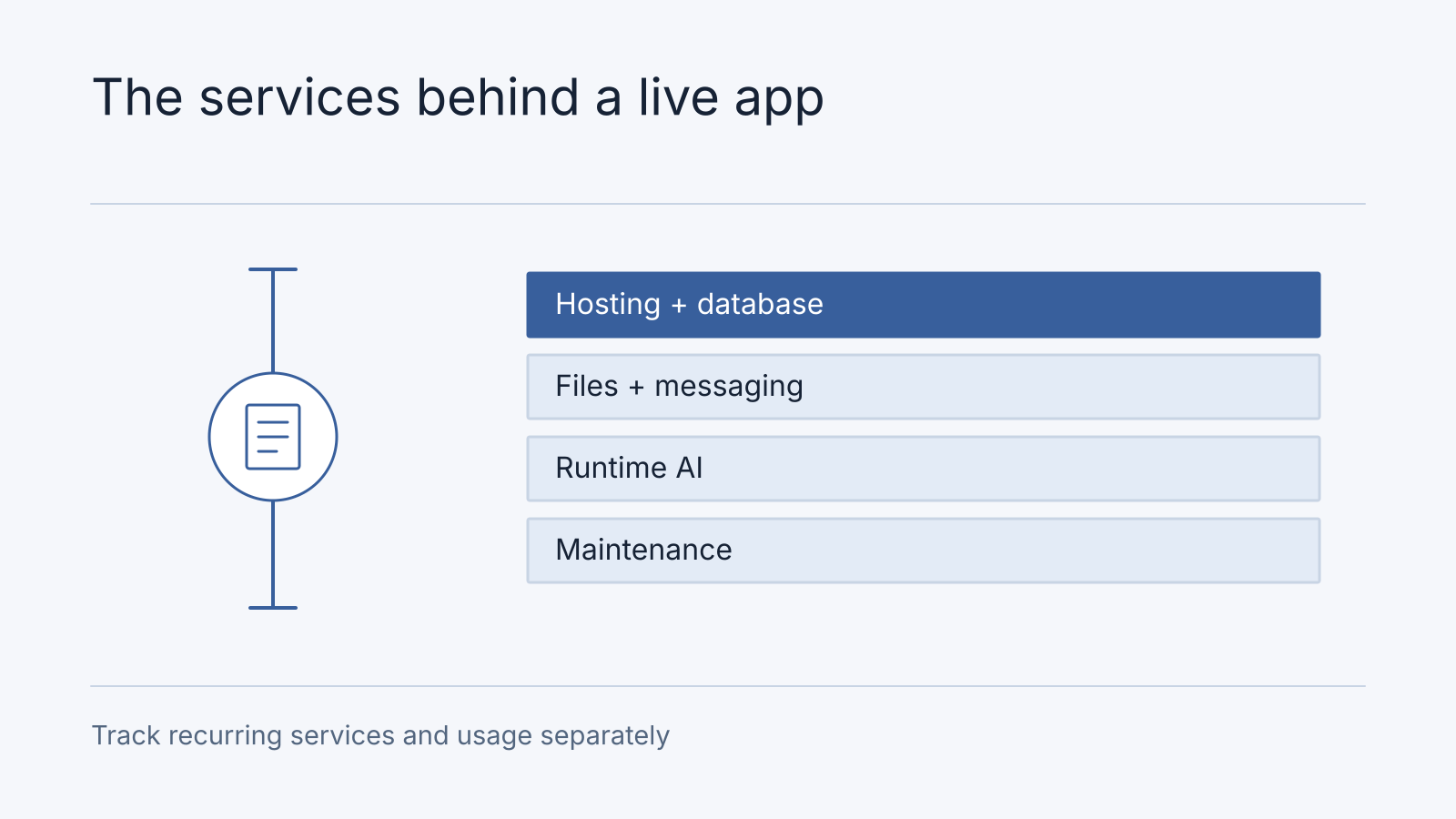
Ask your builder or developer for a plain-language service inventory. Include services billed outside the builder account.
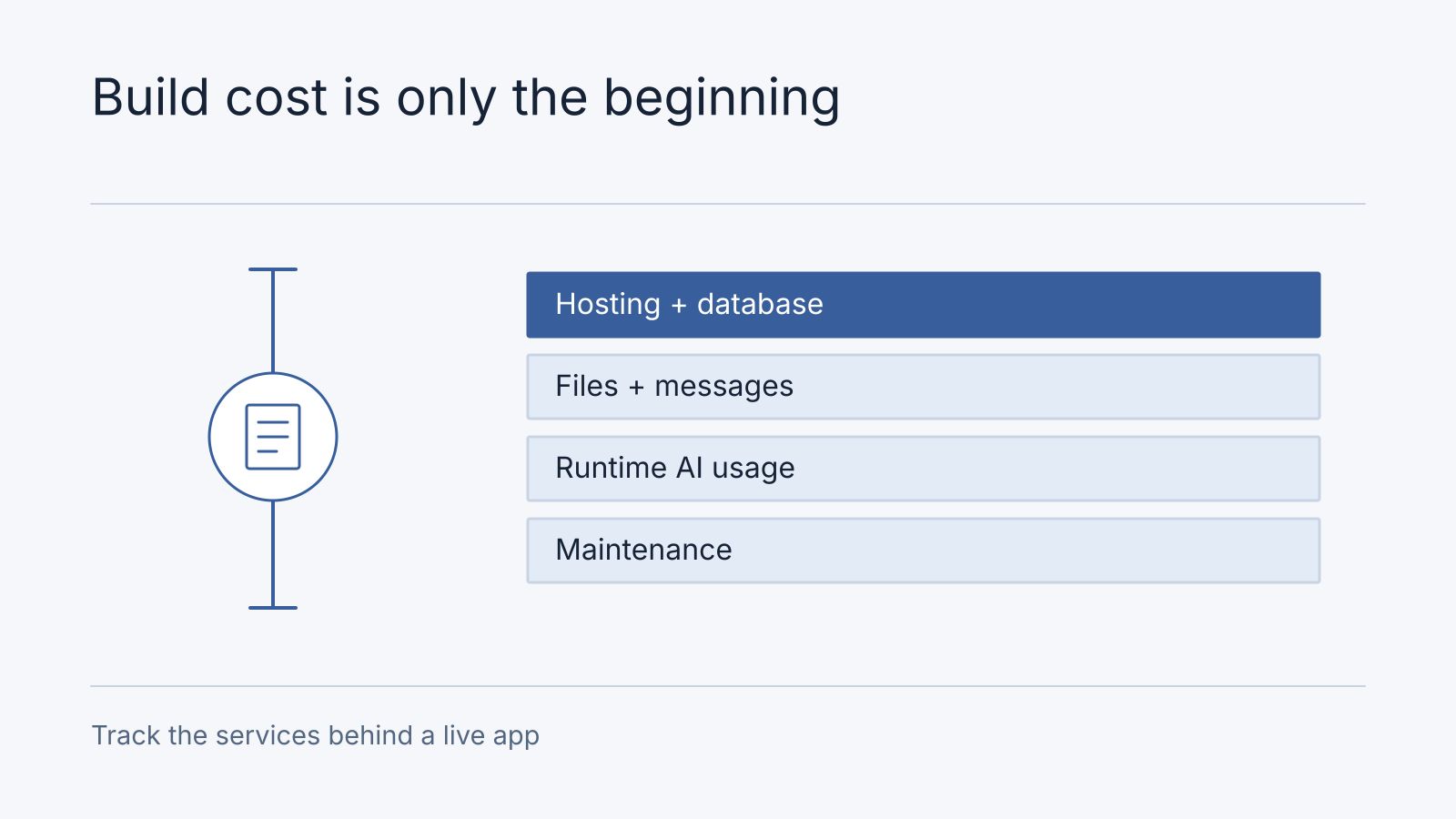
| Cost area | What it does | What can increase the bill |
|---|---|---|
| Hosting | Delivers pages and runs application work | Visits, processing and background jobs |
| Database | Saves structured records | Storage, queries and provisioned capacity |
| File storage | Keeps uploads and downloads | File size, retention and download traffic |
| Authentication | Signs users in and manages access | Provider pricing and verification messages |
| Email or SMS | Sends confirmations and notifications | Message volume, destinations and attachments |
| Runtime AI | Generates answers or processes documents for users | Request count, input size and chosen models |
| Domain | Gives the app its address | Renewal terms and optional extras |
| Maintenance | Keeps the implementation usable | Updates, incidents and changes in scope |
These are categories to investigate, not a claim that every provider bills them separately. Lovable’s credit documentation, for example, describes a shared balance covering building, chat, Cloud and AI gateway usage. Your worksheet should separate activities even if your invoice combines them.
Build a worksheet from evidence
Inspect the illustrative invoice extract: RM100 hosting + 20 GB-month × RM0.50 + three email batches × RM2 = RM116 before any actual tax treatment. Every rate and line is invented, the document is not payable, and no supplier invoice or saving is claimed. Use actual redacted billing units and totals for a real review.
For each service, record the account owner, billing currency, fixed charge, included allowance, extra-usage rate and renewal date. Add whether the account has a spending alert, an enforced cap, automatic top-ups or a service pause when credit runs out. These controls have different consequences.
| Worksheet field | Where to find the answer |
|---|---|
| Current monthly payment | Invoice and billing history |
| Usage included in that payment | Current plan terms |
| Activity beyond the allowance | Usage dashboard |
| Extra charges and top-ups | Billing settings and transaction history |
| What happens at the limit | Provider documentation or support confirmation |
| Who responds if service stops | Your operating agreement |
Do not assume that an alert stops charges. Do not assume that setting a cap keeps the app available. Agree which consequence the business prefers and who receives the notification.
Use a representative period that includes normal customer activity. A week spent generating the application may not resemble a normal month after launch. Conversely, a quiet prototype does not establish the cost of a public launch.
Estimate activity before estimating price
For an app that summarises documents, start with a workload calculation. An illustrative scenario of 40 customers uploading five documents each month creates 200 uploads. If each upload creates one summary, there are 200 initial AI requests before retries, regenerations or additional features.
Then record average document length, file size and retention. Two hundred one-page files and two hundred scanned manuals are different workloads. Use the relevant provider’s units and your measured pilot usage to estimate cost. This scenario is arithmetic for planning, not a capacity or price claim.
Create a normal case and a busier case using your own assumptions. Include requests from staff, repeated clicks and background work where they occur. If the projected cost is uncomfortable, simplify the feature before inviting more users.
Reduce waste where it occurs
Look for unused paid services, abandoned deployments, unnecessary duplicate processing and files kept without a business reason. Before removing anything, confirm whether a live workflow or retention requirement depends on it.
For AI features, ask your implementer whether the app can reuse an existing result when the input has not changed, limit oversized submissions and prevent accidental repeated requests. These changes need appropriate permissions and freshness rules. Reusing an answer must not expose another customer’s information.
If the spending comes from editing rather than live use, follow the AI builder credit guide. Moving the hosting will not resolve an unclear project brief.
Compare staying with moving
Exporting source code and operating an app elsewhere are different tasks. Lovable’s hosting and ownership guidance describes export and external-hosting options, alongside responsibilities that transfer to the owner. Check the actual database, authentication, storage, integrations and deployment setup for your app.
Compare both options over the same period:
Cost to stay = required fixes + current platform and usage charges + support and future changes.
Cost to move = assessment and migration + destination services + support and future changes + transition work.
Include any period when both environments run, the work of verifying transferred records and the cost of maintaining the destination. A lower infrastructure invoice can be offset by additional operating work.
Our Manus handover planning guide uses a hypothetical application to show which dependencies and costs to inspect. It does not claim that migration saves money for every builder or workload.
Prepare a handover that protects the business
Before a move, identify the source repository, service accounts, domain controls and export process. Document the records and files that must remain available. Ask for a recovery plan and an agreed method to confirm that sign-in, permissions, forms and notifications work after the change.
Transfer access through appropriate account invitations or an agreed secure process. A spreadsheet of passwords is not a suitable project handover. Agree who owns the ongoing bills and who responds when an external service changes.
A completed budget and a migration that does not pay back
This synthetic example uses invented MYR rates, not provider prices or a Nodesify offer. Normal activity is 200 uploads plus 20 retries; a peak month is 600 uploads plus 60 retries. Assume 2 MB per upload and six months’ retention: normal retained files reach 2.4 GB; six consecutive peak months reach 7.2 GB. Count retained storage separately from requests.
| Illustrative monthly line | Normal | Peak | Calculation |
|---|---|---|---|
| Hosting and database allowance | 80 | 80 | Fixed invented allowance |
| AI processing | 22 | 66 | 220 or 660 requests × MYR 0.10 |
| File storage | 2.40 | 7.20 | Retained GB × MYR 1 |
| Notifications | 4.40 | 13.20 | One per request × MYR 0.02 |
| Operator time | 100 | 200 | 2 or 4 hours × MYR 50 internal planning value |
| Total | 208.80 | 366.40 | Excludes taxes, domain and new features |
Suppose moving costs MYR 2,000 plus MYR 200 for parallel operation and verification. A destination saves MYR 80/month on infrastructure but adds two operator hours valued at MYR 50/hour. The net change is MYR 20/month more, so there is no break-even. Even a genuine net saving of MYR 100/month takes 22 months to recover the transition amount. Retain the managed platform if the verified requirements fit and this tradeoff is acceptable.
Copy the completed and blank hosting worksheet. For an architecture review, supply redacted invoice line items, units, dates and the account owner, with customer identifiers and payment details removed. Agree a dependency map, verified cost drivers, stay/move recommendation and unresolved values as outputs; see the sample report.
Frequently Asked Questions
What happens to customers when a spending cap is reached?
The affected provider may reject requests or pause a service. Record the actual documented behaviour and rehearse the customer message, manual fallback and restart owner. An alert alone does not enforce a cap.
Who owns subscriptions after handover?
Name a business account owner and billing contact for every dependency. Transfer access and verify recovery before removing the previous operator; cancellation depends on whether the service is still used.
Will my app be free to run when I finish building it?
Not necessarily. Running costs depend on the services and usage, even when you make no further edits. Check the live application bill separately from development activity.
Is self-hosting always cheaper?
No. Compare infrastructure, migration, maintenance and operating time for the same requirements. A managed service may remain economical for a small app or a team without an operations owner.
Does owning the source code mean I can cancel every subscription?
No. The source may call external services for sign-in, data, files or AI. Establish how those dependencies will operate before cancelling anything.
What should I send a developer to investigate a large bill?
Send a redacted usage breakdown, the billing period, recent changes and the workflows users perform. Do not include passwords, API keys or unneeded customer information.
Review costs before committing to a move
Before discussing a migration, fill in one row per billed service: account owner, current monthly charge, billing unit, included allowance, recent peak and cancellation dependency. Mark any value you cannot verify as unknown. A builder subscription, deployed AI requests and a third-party email service may appear on different invoices even when they support one application. This worksheet is a planning aid, not a record of Nodesify customer savings.
Use the AI building budget guide to put operating costs into the full project budget. If you need help identifying dependencies and avoidable usage, request an architecture audit with your service inventory and recent bills.