Workflow & Approvals
Route requests to the right people and track each decision. We define approval stages, escalation rules, exceptions, and delegated approvals around your operating process.
Enterprise Application Development
Connect the people, records, and decisions that run your business. We build enterprise applications around your workflows, either independently or on the Nodesify Zen foundation.
Sample scope in English
Your team is tracking requests, approvals and status across spreadsheets or email. Start with one workflow and the people who own it.
Use a standard website for public information. Compare an independent application with Zen when roles, records and dashboards are central.Compare the options
Illustrative first release: a requester submits a purchase request, an approver checks it, a rejected request returns with a reason, and an approved record appears in the status report. Accounting posting remains a later decision.
Acceptance example. A requester cannot approve their own request when that rule is agreed. A rejected request retains its reason and the approved report matches the accepted records.
Read the sample scope, acceptance and handover recordsCompare existing architecture, reusable dashboard needs, workflow constraints, source and dependency licences, and the team that will maintain the application. The choice does not imply a guaranteed saving.
Agree repository access, licences, documentation, environments and a handover review in the proposal. Reusable and third-party components retain their applicable terms.
Record who can change a rule, its effective date and the treatment of requests already in progress. The proposal should distinguish configurable rules from changes that require development, review and a separate estimate.
Agree source records, field mappings, duplicate handling and reconciliation totals before migration or integration. Name the person who resolves exceptions and approves the result. Accounting posting and historical cleanup are included only when the proposal lists them.
Specify the events to record, actor and timestamp fields, export format, access roles and retention period. Agree deletion, backup retention and export checks with the operating owner. An audit trail does not by itself establish compliance, and unlimited storage or retention is not assumed.
An enterprise application supports the work inside your organization. It can bring together an approval process, an operations portal, or connected business modules. You can start with one workflow without replacing your enterprise resource planning (ERP) system.
Start with the work you need to improve. Your proposal defines the modules, users, data, and integrations needed to deliver it.
Route requests to the right people and track each decision. We define approval stages, escalation rules, exceptions, and delegated approvals around your operating process.
Manage customers, orders, inventory, or project records in a shared application. We agree validation, record ownership, and lifecycle rules before building the screens and business logic.
Give your team the information it needs to make decisions. We define report calculations, source data, filters, and exports so each report has clear definitions and reliable inputs.
Give staff access based on their responsibilities. We define authentication, permissions, sensitive fields, and audit requirements for your application and its operating environment.
Connect supported accounting, customer relationship management (CRM), ERP, or other systems. We confirm API access, data direction, error handling, and third-party charges before committing to an integration.
Move existing records into the new application with agreed data cleanup, mapping, trial imports, and acceptance checks. Your proposal defines the deployment documentation and team training included in the handover.
We choose the implementation approach after reviewing your workflows, existing systems, and long-term operating needs. Nodesify Zen is one option when its reusable foundation fits your project.
Build an application with architecture and business logic selected for your requirements. This approach can suit an existing technology environment, specialized workflows, or constraints that do not fit a reusable dashboard foundation.
Use Nodesify Zen's reusable dashboard foundation where it fits. We configure the foundation and build the agreed business modules around it. Zen is optional and commercially licensed. A complete ERP requires a separate project scope.
Explore the Zen Foundation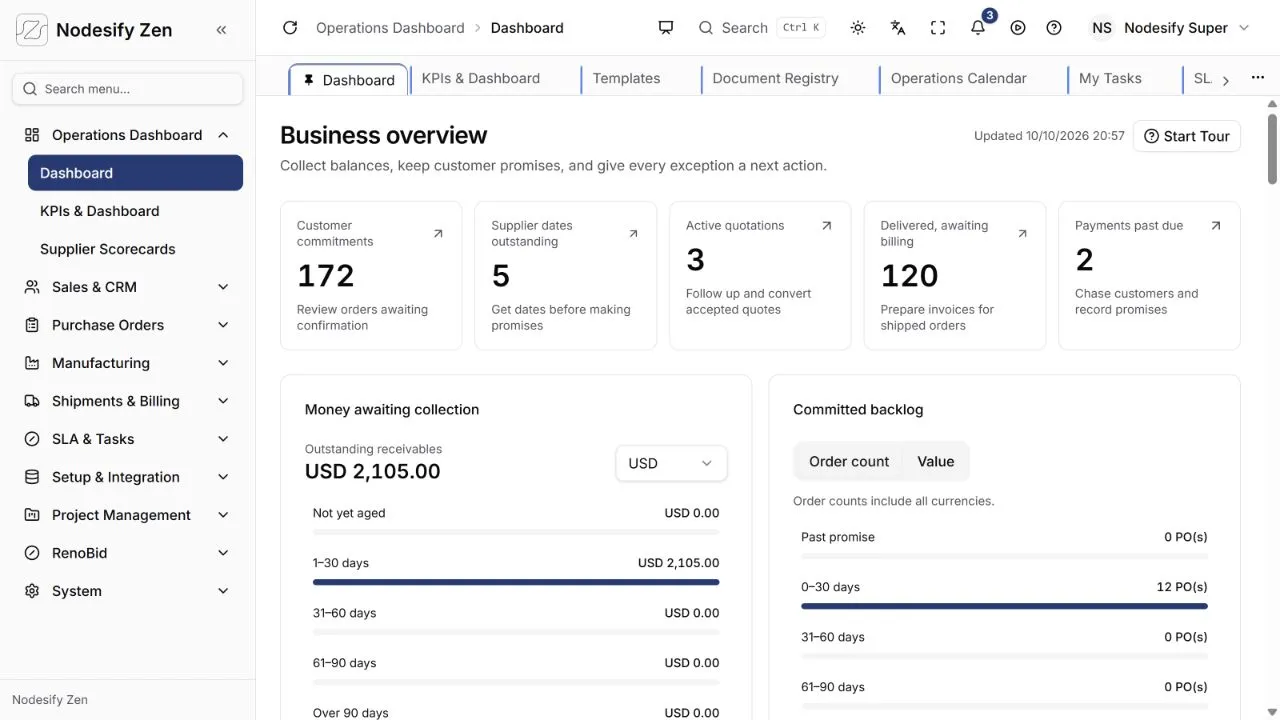
Review who uses the application, the decisions they make, and the records they need. Identify the first complete workflow, system constraints, and operating responsibilities. Discovery is scoped separately when uncertainty needs investigation.
Review who uses the application, the decisions they make, and the records they need. Identify the first complete workflow, system constraints, and operating responsibilities. Discovery is scoped separately when uncertainty needs investigation.
Define modules, interfaces, permissions, and acceptance criteria. Choose independent development or Zen based on fit. Confirm assumptions, exclusions, and milestones before implementation starts.
Define modules, interfaces, permissions, and acceptance criteria. Choose independent development or Zen based on fit. Confirm assumptions, exclusions, and milestones before implementation starts.
Review working features at agreed milestones. Check business rules with the people who use them. Changes outside the agreed scope are assessed and quoted before they become delivery commitments.
Review working features at agreed milestones. Check business rules with the people who use them. Changes outside the agreed scope are assessed and quoted before they become delivery commitments.
Complete agreed acceptance checks, prepare deployment, and train the designated team. Record source access, licenses, documentation, and maintenance responsibilities so your team knows how to operate the application.
Complete agreed acceptance checks, prepare deployment, and train the designated team. Record source access, licenses, documentation, and maintenance responsibilities so your team knows how to operate the application.
Your quote reflects the business modules, users, data volumes, integrations, reporting, migration, training, and delivery risks involved. A reusable foundation fee covers the foundation, not the complete application.
View Pricing & Engagement OptionsYour business data remains yours. We agree rights to custom deliverables, source access, and deployment documentation in the contract. Zen and third-party components retain their applicable licenses.
Confirm hosting, monitoring, backups, maintenance, and incident responsibilities before launch. Your proposal documents coverage and renewal costs. New features and additional data work have a separate scope.
Tell us where work gets delayed, duplicated, or difficult to track. We will help you define a practical first workflow and assess the right development approach.
Discuss Your Application