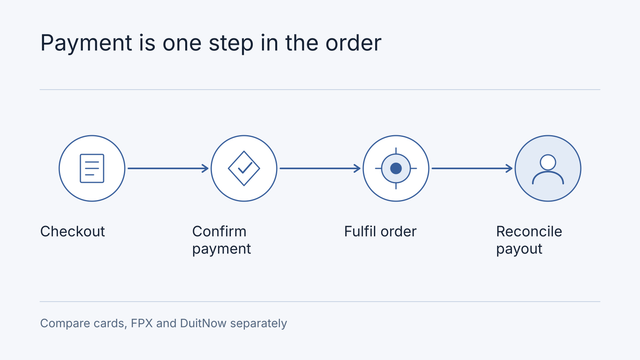
A Malaysian e-commerce quotation should cover the complete journey from selecting a product to reconciling the payment. A checkout screen and a payment gateway connection leave important questions unanswered: when is stock reserved, who handles refunds, and how does finance match orders to money received?
Use this checklist to prepare one brief for every supplier. It is a planning worksheet, not a delivered client case study or a payment-provider endorsement. For payment-method eligibility and fee comparisons, start with our Malaysia payment gateway guide; this article defines the work you are buying after that shortlist.
Describe one order from start to finish
Write a short example using your own product, delivery area and customer type. For a hypothetical store: a buyer selects a size, enters a delivery address, chooses a payment method, receives confirmation and later asks to return one item. Name the person or system responsible at each step.
Then record exceptions. An order placed without available stock, an incomplete address and a payment still awaiting confirmation need agreed outcomes. Otherwise, each supplier may quote a different version of the same store.
| Brief field | What to record |
|---|---|
| Catalogue | Product types, variants, stock source and content-entry owner |
| Customers | Guest checkout, accounts, business buyers and required languages |
| Delivery | Service areas, rate rules, fulfilment owner and tracking requirements |
| Payments | Required methods, merchant-account status and provider shortlist |
| Order operations | Cancellation, returns, refunds and staff permissions |
| Existing systems | Inventory, accounting, shipping and customer-service connections |
Mark each requirement as essential for launch, deferred or unresolved. For unresolved integrations, provide the available documentation and request a defined investigation deliverable before accepting an implementation estimate.
Separate merchant onboarding from development
Agree who creates and controls the merchant account, supplies verification information and confirms enabled methods. Treat provider approval and bank-account setup as project dependencies. Ask the developer to explain what can proceed while access is pending and which milestone requires it.
Do not place passwords, secret keys or customer records in a quotation email. Share a redacted account-status summary first, then use an agreed access process during delivery. Account control and the right to configure an integration are separate responsibilities.
Ask for payment outcomes, not just a checkout demo
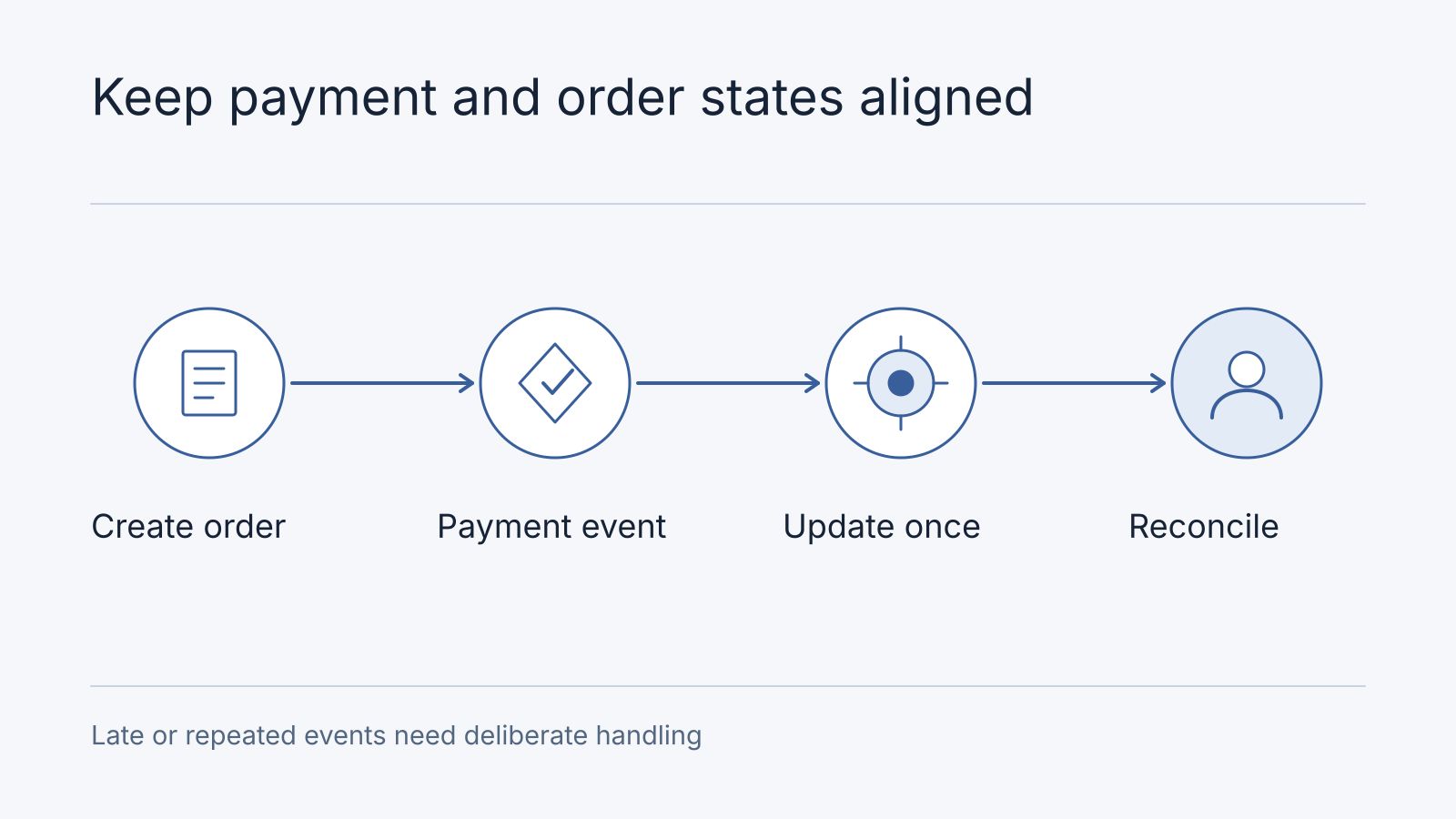
Payment confirmation may arrive separately from the customer’s browser return. For example, Stripe’s webhook documentation describes server notifications for payment events, signature verification and handling duplicate events. The appropriate implementation must follow the chosen provider’s documentation; a successful browser redirect alone should not be your acceptance criterion.
Give suppliers this business worksheet and ask how each outcome will be demonstrated:
| Scenario | Outcome to agree |
|---|---|
| Buyer pays and closes the browser | The order reaches its verified payment state |
| Payment notification repeats | One order and one fulfilment action result |
| Payment fails or remains pending | Customer messaging and stock rules remain consistent |
| Staff requests a partial refund | Refund status and order balance are traceable |
| Payment succeeds but fulfilment fails | Operations can identify and resolve the affected order |
| Several orders share a payout | Finance can connect orders, fees, refunds and bank receipt |
These are proposed acceptance outcomes. They are not claims that every gateway supplies these workflows without implementation work.
For a digital-product example, read how we approach reliable document delivery in ResumeForU. The case study connects purchase rights, generated files, and access recovery in a Nodesify-owned product.
Compare the complete quotation
Request separate line items for storefront work, payment integration, operational integrations, catalogue preparation, migration, launch and ongoing care. Ask whether the quote includes a staff administration view, customer emails, reconciliation exports and instructions for resolving failed orders.
List recurring hosting, plugin and provider charges separately from implementation. Record the currency, billing owner, renewal terms and exclusions. Use Nodesify’s current pricing as the commercial reference; a provider’s transaction rate is not the cost of delivering the store.
Define acceptance around an agreed order journey and its exceptions. Record who approves a release, how open defects are classified, and how requested changes affect scope. A fixed figure is only comparable when these assumptions match.
Compare the same partial-return journey
Here is a synthetic apparel order brief: two items, one shipping fee, one successful payment; one item is later returned. Finance approves the partial refund, the store updates the returned line without cancelling the retained item, and the settlement reconciliation shows original charge, refunded amount and provider fees separately. The customer sees the refund state actually confirmed by the provider. Define who handles a pending or rejected refund.
Compare two proposals against that journey. “Checkout integration” that omits partial refunds, duplicate events and settlement exports is narrower than a proposal including them. Ask both suppliers to mark each requirement included, excluded or dependent on provider approval. Acceptance should show the same order through payment, fulfilment, partial return and reconciliation—not separate screenshots that cannot be linked.
Frequently asked questions
Can development guarantee merchant approval or settlement timing?
No. The gateway or acquiring arrangement controls its approval and commercial process. Assign the merchant application to the business owner and record approval as a launch dependency.
What if the gateway lacks a sandbox feature we need?
Record the limitation, seek provider confirmation and agree a controlled verification approach before promising delivery. Send this brief with your scope enquiry, including the unresolved feature.
Prepare a useful project enquiry
Download the combined payment project brief, including late confirmation, partial return, settlement and payout reconciliation. The filled records are fictional; unresolved provider capabilities remain unverified.
For an existing store, use our DuitNow plugin versus custom integration walkthrough to identify the connector gap before commissioning code. If the project also includes e-Invoice submission, the MyInvois connector investigation separates payment, accounting, validation, and exception ownership.
Send your store URL or catalogue sample, target customers, required payment methods, existing-system list and proposed launch constraints. Include the completed worksheet and name the business owner who can decide delivery and refund rules.
A conventional store can begin with our WordPress development service. A checkout connected to a custom operational system may need website development and a separate integration scope. Review the portfolio for relevant published work, then contact Nodesify with your brief so the proposal can identify deliverables, dependencies and operating responsibilities.