To choose a payment gateway in Malaysia, compare the payment methods your customers need, the fee on your usual order value, and when you can use the money. FPX and DuitNow suit different checkout flows from a stored-card subscription. A low transaction fee is useful only when the provider supports your merchant account and the way you sell.
Pricing sources and the payment-flow guidance linked below were reviewed on October 16, 2026. Confirm your account’s current terms before signing. The calculations are planning examples, not a merchant quote or a Nodesify client result.
The Stripe, HitPay, and PayPal fee sources were rechecked on October 22, 2026. Start with the shortlist below, then ask each provider to confirm the exact collection flow and account terms. For a store that already works, compare the maintained plugin before pricing a custom integration.
Quick Fee Comparison for a Malaysian Sale
For an illustrative RM50 payment using the published rates below, HitPay FPX costs RM1.30 and Stripe domestic FPX costs RM2.50. HitPay DuitNow costs RM0.60 for the same amount. These are different payment methods and provider terms, not an overall ranking: confirm that your account can offer the method your customers will actually use.
For subscriptions, check whether the exact payment method supports automatic renewals before comparing fees. A provider offering a subscription product does not mean FPX or every DuitNow flow can collect recurring payments. The tables below cover fees, method eligibility, settlement and integration work separately.
Which Payment Gateway Fits Your Business?
Start with the collection flow. For local orders, compare FPX, DuitNow, and cards at your usual basket value. For subscriptions, ask for a demonstration of renewal, failed-payment recovery, and cancellation using the exact method and provider you plan to enable. For overseas sales, include conversion charges and settlement currency.
| Business need | What to compare | Evidence to request |
|---|---|---|
| SME selling locally | FPX, DuitNow, cards, payment links and the fixed charge on small orders | Enabled methods for your account and a fee schedule for each channel |
| SaaS or memberships | Recurring billing, renewal failures, cancellation and invoices | A working subscription flow with the payment method you intend to use |
| Cross-border sales | Customer currencies, accepted methods, conversion costs and settlement currency | Charges for a representative overseas payment and refund |
| Larger or multi-channel operation | Reconciliation, reporting, support and negotiated terms | Sample settlement reports and an integration scope covering all channels |
Which Providers Should You Compare for FPX and DuitNow?
Use these as starting points for evaluation. They do not establish that a provider will approve your business or enable every advertised method.
| Provider | Start your evaluation here | Confirm before committing |
|---|---|---|
| Stripe | A custom online checkout using cards or FPX, with a separate review of subscription billing | Method eligibility, Billing charges, international-card fees, and currency conversion |
| HitPay | A local collection flow using the card, FPX, or DuitNow rates published for your sales channel | Online versus in-person pricing, plugin support, and the exact recurring methods enabled |
| PayPal | A checkout where customers want to pay through PayPal | Commercial transaction category, received currency, fixed fee, and withdrawal costs |
| Adyen | A comparison of several payment methods under one integration | Processing fee plus each method’s fee, account eligibility, and any separate product costs |
| Fiuu | A provider proposal for your required Malaysian payment channels | Your agreement’s channel fees, payout terms, plugin version, and support responsibilities |
If your platform already has a maintained integration, check its supported provider and payment methods before commissioning a custom connector. Ask who owns the merchant account and who maintains the integration when the platform or gateway changes.
For an FPX shortlist, Stripe and HitPay publish rates for the method in the fee sources below. For DuitNow, HitPay publishes a rate, but ask which online or QR flow its integration enables for your account. Do not assume a provider in this table offers every method just because it serves Malaysian merchants.
A Completed Supplier Brief for a Local Online Store
This fictional brief shows how a merchant can compare proposals on the same requirement. It is not a provider approval, implementation quote, or delivered customer project.
| Brief item | Illustrative requirement | Evidence requested from each supplier |
|---|---|---|
| Store | Existing WooCommerce shop selling physical goods in MYR | Maintained plugin version and supported store configuration |
| Volume | 300 domestic orders a month at RM50 each | Method-specific fee calculation using the same volume and basket |
| Collection | One-time FPX and domestic-card checkout, with DuitNow evaluated separately | Exact enabled methods, merchant eligibility, and the DuitNow product name |
| Order outcome | Paid orders update even if the customer closes the browser | Verified callback flow and one fulfillment for repeated notifications |
| Finance | Match orders, refunds, fees, and bank payouts | A sample report with identifiers finance can reconcile |
| Ownership | Merchant owns the gateway account and authorizes supplier access | Named support owner, access permissions, and handover responsibilities |
Select on demonstrated fit first, then compare the full cost among providers that meet the requirement. If an existing shop loses payment confirmations or cannot reconcile payouts, use the sample architecture audit report to define the evidence a review should produce. A new checkout needs an implementation brief rather than an assumed need to rebuild the whole store.
Published Pricing and Its Limits
| Provider | Published information to use in a comparison |
|---|---|
| Stripe Malaysia | Standard domestic cards and FPX: 3% + RM1; additional charges can apply for international cards and currency conversion |
| PayPal Malaysia | Standard domestic commercial transactions: 3.90% + RM2 when received in MYR. The general international category lists 4.40% + the currency’s fixed fee |
| HitPay Malaysia | Published online rates: domestic cards 1.2% + RM1, FPX 1.8% + RM0.40, and DuitNow 1.2%. Other channels and methods have their own rates |
| Adyen | A processing fee plus a payment-method fee. Compare the Malaysian method and any separately priced products |
| Fiuu | Obtain the applicable fee schedule and channel terms for your agreement |
Sources: Stripe pricing, PayPal merchant fees, HitPay pricing, Adyen pricing, and Fiuu Malaysian terms.
PayPal’s fixed fee depends on currency, and rates differ by transaction category. Do not replace the applicable international table with an assumed universal surcharge. Likewise, HitPay’s FPX and DuitNow rates do not describe every supported method. No provider is always the cheapest at every volume and transaction mix.
What Do the Fees Mean for an Order?
Apply the percentage and fixed fee together. These illustrative calculations use the published rates above and exclude taxes, refunds, disputes, currency conversion and negotiated pricing. They compare specific methods, not equivalent bundles of provider features.
| Method and published rate | Fee on RM50 | Fee on RM200 |
|---|---|---|
| Stripe domestic card or FPX: 3% + RM1 | RM2.50 | RM7.00 |
| HitPay online domestic card: 1.2% + RM1 | RM1.60 | RM3.40 |
| HitPay FPX: 1.8% + RM0.40 | RM1.30 | RM4.00 |
| HitPay DuitNow: 1.2% | RM0.60 | RM2.40 |
| PayPal domestic commercial payment received in MYR: 3.90% + RM2 | RM3.95 | RM9.80 |
The calculation is order value × percentage fee + fixed fee. For example, RM50 × 1.8% + RM0.40 = RM1.30. The fixed charge has more impact on small baskets: Stripe’s RM2.50 fee on RM50 is 5% of the sale, while RM7 on RM200 is 3.5%.
Example Monthly Budget With a Payment Mix
Suppose a shop receives 300 domestic online orders of RM50 each: 200 paid by FPX and 100 by domestic card. At the published HitPay rates above, processing fees would be:
- FPX: 200 × RM1.30 = RM260.
- Domestic cards: 100 × RM1.60 = RM160.
- Total: RM420 on RM15,000 of sales, before other applicable costs.
Keep a separate line for platform subscriptions, paid plugins, integration work, refunds, disputes, conversion, and support. This example holds the order value and method mix constant. It does not predict checkout conversion or prove which provider produces the highest net revenue.
For your own estimate, use the expected payment count and average basket for each method. A customer who needs to pay by card may not switch to a bank-payment method just because it costs the merchant less.
Verify Methods and Settlement
Check required payment methods against your merchant country, product, and account. For FPX, Stripe’s method documentation requires a Business Registration Number to process charges and receive payouts. Confirm onboarding requirements before commissioning the checkout. A published fee is not evidence that your account can already accept the method.
DuitNow QR, online banking and wallet checkout, and automatic collection are different integration requirements. Confirm the product and participating banks or wallets your provider enables. A DuitNow logo does not establish that every flow is available.
Obtain written payout schedules, reserve conditions, refund treatment and dispute charges. Avoid assuming that every account receives next-business-day settlement or identical cross-border functionality.
Can FPX or DuitNow Collect SaaS Subscriptions?
Check recurring support for the exact provider, method and integration. A provider offering subscriptions does not mean every one of its payment methods supports automatic renewals. For example, Stripe’s FPX Checkout documentation supports one-time line items, not recurring subscription plans.
For DuitNow, ask which product and collection flow the provider supports. QR acceptance alone is not evidence of automatic recurring billing. Distinguish a customer authorizing each monthly payment from a supported automatic debit arrangement. Check renewal failures, access expiry, refunds, and cancellation before choosing a SaaS billing integration.
Choose the Collection Flow Before the Provider
| Checkout requirement | Starting point | What the merchant must verify |
|---|---|---|
| A customer approves each online order | FPX or a supported DuitNow online banking/wallet flow | Redirect return, final payment status, expiry and supported customer banks |
| A customer scans a merchant QR | DuitNow QR | Whether a transaction-specific amount and reference can be reconciled automatically |
| A customer authorizes future bank or wallet collections | A supported DuitNow Consent and AutoDebit integration | Consent creation, revocation, collection limits and failure handling |
| A subscription uses a stored card | A gateway’s recurring-card and billing integration | Authentication, failed renewals, cancellation and the separate billing-product fees |
PayNet distinguishes one-time online banking/wallet payments from saved-payment flows using Consent and AutoDebit in its DuitNow Pay user journey. Availability through a particular gateway still needs confirmation. Do not treat a DuitNow logo or QR feature as proof that every flow in this table is enabled.
Check When Revenue Becomes Usable Cash
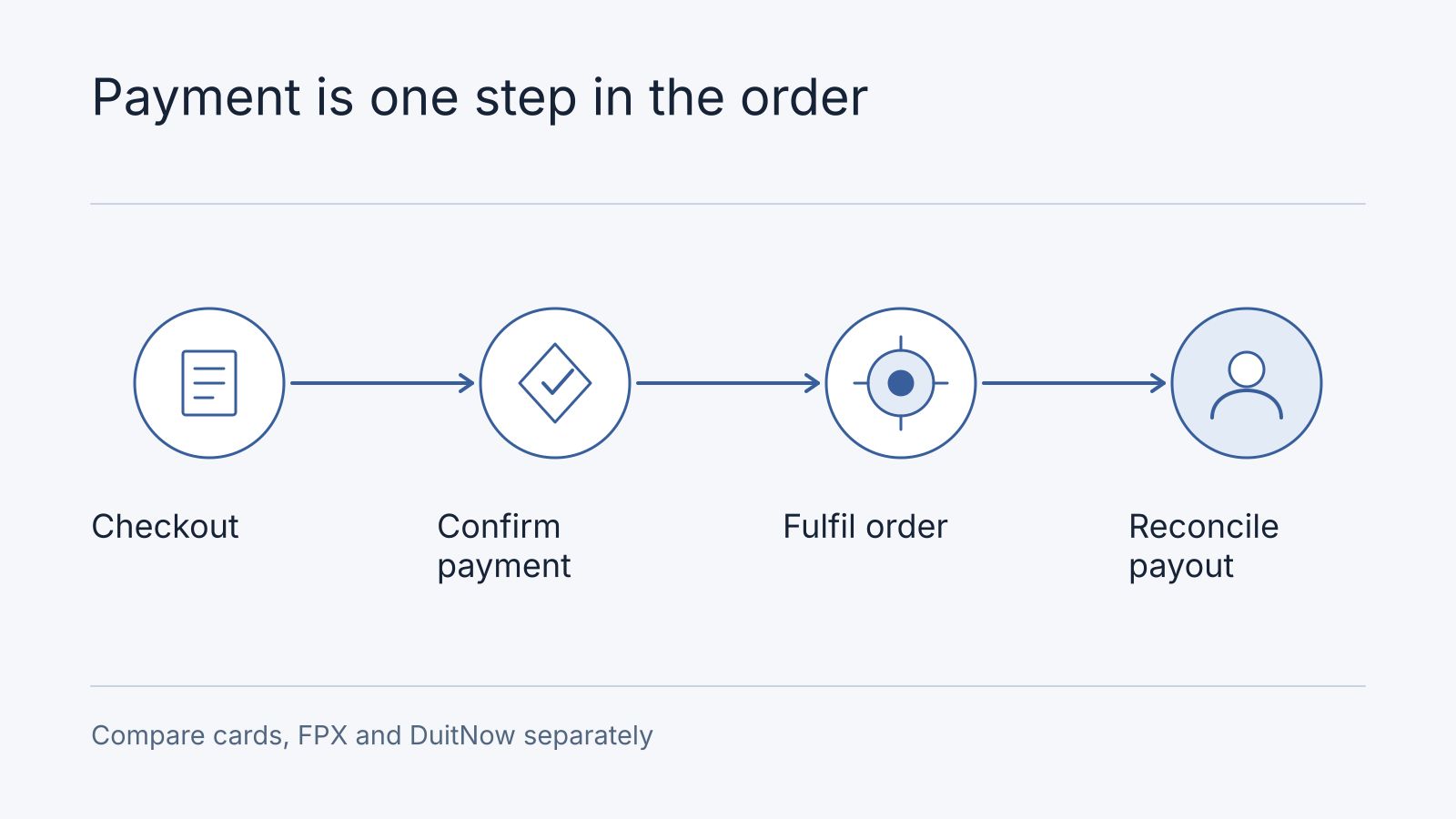
Payment confirmation, funds becoming available in the gateway balance, and arrival in your bank account are separate milestones. Stripe’s payout documentation distinguishes settlement timing from the payout schedule; changing the schedule does not make pending funds available sooner.
Ask each shortlisted provider to walk through one normal payment, a Friday or public-holiday payment, a refund and a disputed payment. Record the following in the proposal:
- Initial payout delay and the normal availability period for each method.
- Payout frequency, cutoff times, bank processing and any minimum balance.
- Reserve or hold conditions and how refunds reduce the available balance.
- The report that connects order ID, gateway transaction, fees and bank payout.
For example, a merchant paying suppliers before a bank payout arrives needs working capital even if the gateway has already confirmed the sale. Compare that cash-flow requirement as well as the headline transaction fee.
Evaluate the Integration
Adding DuitNow to an Existing Store
Ask the provider to confirm your merchant eligibility, the exact DuitNow flow, and the supported plugin or API before pricing custom work. A maintained store connector may cover the requirement. Custom code is justified by an identified gap, such as linking payment confirmation to an internal order system.
Our DuitNow plugin versus custom integration guide walks through that decision using one order, including delayed confirmation, refunds, and reconciliation. It focuses on implementation after provider selection. PayNet’s merchant onboarding guidance directs merchants through a registered acquirer or third-party acquirer, so do not assume developer documentation grants direct network access.
Confirm the Complete Order Outcome
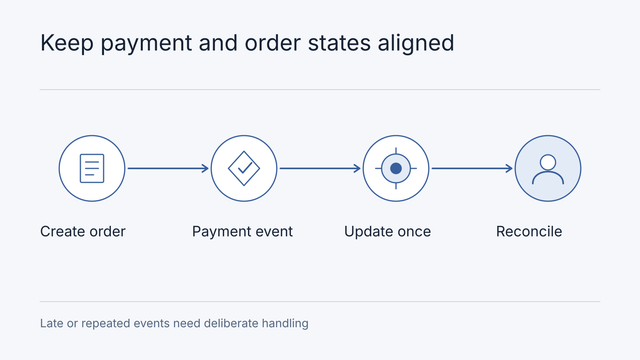
Model the cost of representative baskets, including fixed fees. Verify payment confirmation, webhook authentication, duplicate-event handling and reconciliation. A browser returning to a success page should not be the only evidence that an order was paid.
Prefer provider-supported payment collection and tokenization where appropriate to reduce exposure to card data. PCI obligations and personal-data obligations are distinct; a gateway integration does not automatically discharge both. Decide whether a second gateway justifies its reconciliation and maintenance costs rather than treating multiple gateways as mandatory.
Ask for an implementation scope covering payment states, refunds, reporting and ongoing support as well as checkout design.
Use our Malaysia e-commerce project and quotation checklist to turn your gateway shortlist into a supplier brief covering stock, order operations, payment acceptance and account ownership. Its worksheets help compare implementation scope separately from provider fees.
Use a short acceptance checklist before launch:
| Scenario to demonstrate | Expected business outcome |
|---|---|
| Customer pays but closes the browser before returning | Verified server-side confirmation still updates the order |
| Provider retries a notification | The same payment creates one fulfilment action and one receipt |
| Customer abandons or fails authentication | The order remains unpaid and stock is released under the agreed rule |
| Refund is submitted or fails | The order shows the actual refund status and finance can trace the adjustment |
| A subscription renewal fails or consent is revoked | Access and customer notices follow the documented billing policy |
| A payout groups several orders | Finance can reconcile gross sales, refunds, fees and the net bank amount |
These are implementation acceptance criteria, not a claim that a provider supplies every business workflow automatically. Agree which party owns each check and how support investigates an order after launch.
If you are still choosing a commerce platform, compare WordPress, Webflow, Astro and Shopify alongside the payment requirements. Our website development service covers scoping a custom checkout. An architecture audit can review an existing system with payment-state or reconciliation problems.
Frequently Asked Questions
What does finance need to reconcile a payout?
Request stable links between order, payment, refund/adjustment, fee and payout references, with currency and gross/net amounts. Record timing differences and unresolved items rather than forcing the bank deposit to equal the day’s sales. Ask the actual provider for a sample report before selecting the integration.
Which costs remain after a refund?
Do not assume the original processing, conversion, platform or dispute charges are returned. Enter each provider’s current contractual treatment as included, retained, refunded or unconfirmed in the worksheet. No provider-specific refund-fee promise is made here; use the fee sources above and your merchant agreement.
Which Payment Gateway Is Cheapest in Malaysia?
There is no single cheapest provider for every business. At the published rates in this guide, a RM50 HitPay DuitNow payment costs RM0.60, an FPX payment costs RM1.30, and an online domestic-card payment costs RM1.60. Compare the same method and sales channel, then include your platform, refund, conversion, and support costs. Account eligibility and customer acceptance still matter.
Is DuitNow the Same as FPX?
No. FPX is an online bank-payment method. DuitNow includes different collection flows, such as QR, online banking and wallets, and Consent and AutoDebit. Ask your gateway which product it supports and how the payment is confirmed. A one-time checkout or QR feature does not establish automatic subscription support.
Can I Add a Gateway Without Rebuilding My Website?
Often, an existing platform integration or a hosted payment link can cover the collection step. Check whether it also updates your order records, inventory, refunds, and customer notices. A custom integration is worth scoping when those business requirements exceed what the maintained plugin or hosted flow provides.
Scope Your Payment Integration
Download the editable payment-mix and cost worksheet. The completed rows reproduce the article’s dated, hypothetical 200-FPX/100-card workload; they retain the method, published-rate source and review date. Other rows separate setup, plugin/platform renewals, refunds/disputes, conversion and working-capital timing. Blank amounts are unknown, not zero.
For the fictional WooCommerce shop, record each required capability before ranking prices: one-time FPX/card flow, maintained plugin, closed-browser confirmation, duplicate protection and payout reconciliation. An unsupported required method eliminates that configuration; an unverified merchant account or plugin stays pending. A new checkout needs a defined implementation brief. Review an existing checkout when payment state or reconciliation is already failing; neither situation automatically requires a platform rebuild.
Bring your current platform, merchant country, typical order value, monthly order volume, payment methods, and one-time or recurring billing requirements to a Strategy Session. Include any order-confirmation, refund, or payout-reconciliation problem you already have. We can use those inputs to define the integration scope and acceptance checks. Gateway approval and transaction fees remain with the payment provider.