A mobile app brief should define the first complete user journey and who will operate it after launch. A list of screens is useful, but it does not explain the backend, staff tools, failed actions or account ownership that suppliers need to price.
Use the worksheet below before requesting quotations. Our Singapore mobile app cost guide compares illustrative scope levels; this guide turns your chosen scope into reviewable deliverables. The examples here are hypothetical planning examples, not claims about delivered customer projects.
Define the first useful release
For a Malaysian project connected to an existing store, field-service workflow, or POS system, use our mobile app integration cost guide to separate backend dependencies and operating costs before filling in this brief.
Choose a user task with a clear beginning and end. For a hypothetical field-service app, that might be a technician receiving an assignment, recording work, attaching a photo and submitting it for office approval. Describe what the office must see and what happens when a submission fails.
Write the release boundary before choosing a framework. Mark every feature as included, deferred or requiring investigation. A smaller release can omit a later reporting dashboard; it still needs a coherent way to complete and manage its core task.
| Scope decision | Information to give suppliers |
|---|---|
| Users and roles | Customer, worker, manager and administrator permissions |
| Platforms | Required operating systems, device types and distribution route |
| Core journey | Actions, decisions, saved data and completion outcome |
| Backend | Existing API or new backend, administration and hosting owner |
| Integrations | Available documentation, access owner and sandbox availability |
| Connectivity | Which tasks must work without a connection and conflict rules |
| Notifications | Trigger, recipient, channel and outcome when delivery fails |
Separate a desired launch window from a committed release date. List decisions and external approvals that can affect the schedule, and ask suppliers to show those dependencies in their proposal.
Turn screen names into acceptance examples
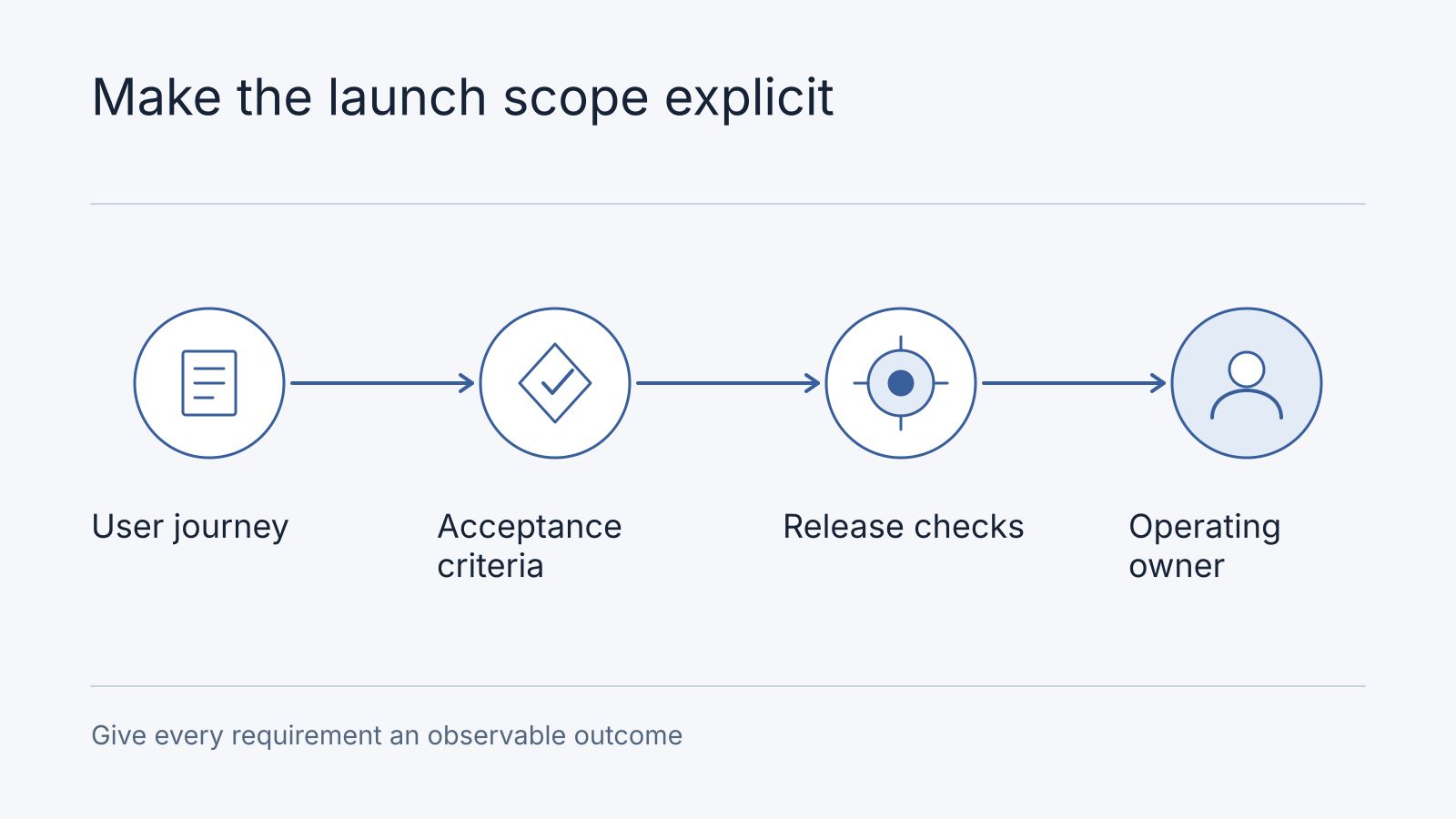
For each core journey, write a normal case, an error case and an access-boundary case. The business owner should be able to review these without reading code.
For the field-service example, a technician can submit an assigned job and the office can review it; an interrupted upload produces a clear retry path; a different technician cannot open that job’s private attachments. Decide how unfinished drafts, rejected submissions and reassigned jobs behave.
Ask suppliers to demonstrate the agreed outcomes on representative target devices. Specify who prepares sample data, who reviews the result and which unresolved items prevent acceptance. Screens that look complete are not evidence that an integration or permission rule works.
Request comparable quotation lines
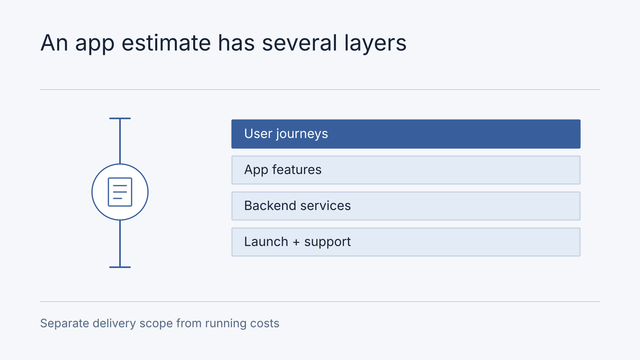
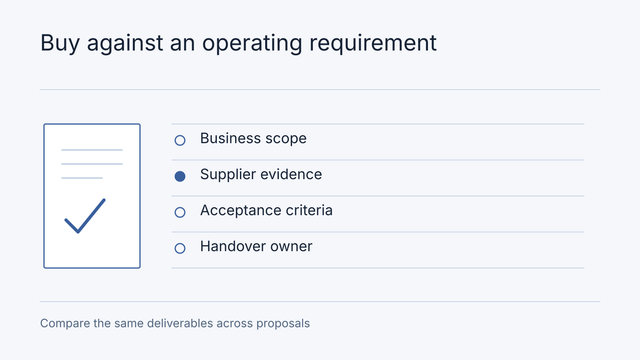
Ask each supplier to price the same release boundary. Separate product design, app implementation, backend, staff administration, integrations, migration, release preparation and handover. Identify third-party bills and the person who approves them.
Record the assumptions attached to each line. If the estimate assumes a working API but nobody has inspected it, ask for a bounded discovery step with findings and a revised scope. If the workflow itself is unclear, a prototype can clarify decisions before implementation.
Our pricing page carries current planning ranges and commercial terms. Request a written proposal for your actual scope, currency, dependencies and exclusions. Do not compare a mobile-only quote with one that also includes the business systems needed to operate it.
Assign account and launch ownership
Decide which organisation controls store accounts, repositories, hosting, signing access and external-service billing. Grant named roles rather than passing around a shared login. Apple’s developer account roles assign different permissions, including responsibilities held by the Account Holder; confirm the roles needed for the intended release process.
| Launch asset | Responsibility to name |
|---|---|
| Store accounts | Account owner, renewal owner and submission permissions |
| App listing | Copy, screenshots, support contact and policy information |
| Release build | Build instructions, signing access and version record |
| Backend | Deployment access, configuration and recovery instructions |
| User support | Enquiry channel, triage owner and escalation contact |
| Maintenance | Compatibility review, incident handling and change approval |
Ask the proposal to distinguish submission support from an approval promise. Agree how feedback is handled and which changes belong to the initial scope. Define what happens if the supplier relationship ends, including access removal and a reproducible build handover.
A filled scope exposes what a cheaper quote omits
Illustrative field-service brief: technician role, iOS/Android targets, assigned jobs from an existing scheduling API, offline completion, photos and supervisor review. Normal acceptance: an assigned job is completed and synced once. Error acceptance: reconnecting after a failed upload preserves the draft and avoids duplicate photos. Access acceptance: a technician cannot retrieve another team’s restricted job. The scheduling API and store account access are explicit dependencies.
Compare Proposal A, “six mobile screens”, with Proposal B, “app, sync queue, API adapter, supervisor review and release support”. Ask A to mark the missing backend, failure handling and release work included/excluded before comparing totals. The final brief needs account owner, signing/build access, submission owner, support route and reproducible release instructions.
Download the completed field-service scope and blank rows. Schedule by dependencies: approve the workflow and account ownership first; prove API/offline access before committing the integration; review the signed release and support handover before submission. Store feedback may introduce further work, so identify its approval and pricing owner rather than promising a universal launch date.
Frequently asked questions
Do we need public app-store distribution?
State the intended users and distribution route before selecting the delivery approach. Confirm the current platform requirements for that route; internal use is not automatically the same as a public consumer release.
Who should control signing and developer accounts?
The agreement should name the business owner and authorised roles, with recovery and access removal documented. Avoid a handover that depends on one supplier’s personal account. Use the handover guide.
Send a brief that supports a useful estimate
Prepare your core journey, role list, platform targets, existing-system inventory and acceptance examples. Include the business decision-maker, operational owner and desired release window. Share redacted examples first; agree secure access when the delivery scope is established.
Use our mobile development service to discuss the release, and review the portfolio for published work relevant to your needs. Contact Nodesify with the completed brief to request a scope that explains the build, launch dependencies and ownership after delivery.