The useful answer to “how much does a mobile app cost in Malaysia?” starts with the systems the app must connect to. Two apps with similar screens can need different amounts of work if one uses a documented backend and the other must replace spreadsheets, reconcile payments, or synchronize offline changes.
Nodesify prices custom mobile work against an agreed scope. Use our current pricing as the commercial reference and request a project estimate. The examples below are illustrative requirements, not client quotations, measured delivery times, or Malaysian market averages. We have not assigned ringgit figures to work that has not been estimated.
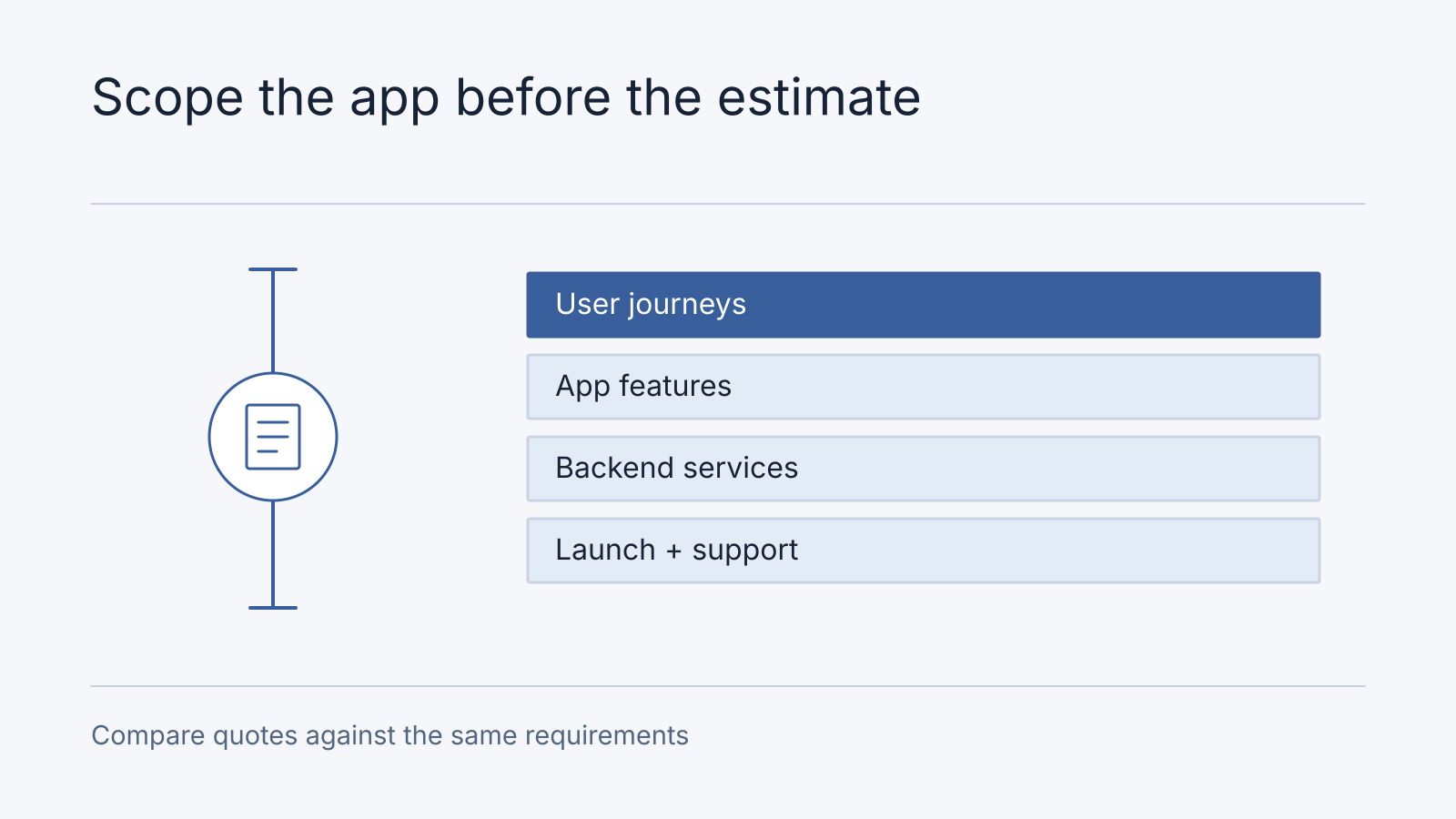
Our general app scope checklist defines the release brief. This article goes deeper into three integration decisions that change what suppliers must price.
Scenario One: Add an App to an Existing Store
Assume a Malaysian retailer already has a website, product catalog, and order administration. The first app lets customers browse, buy, and view order status. It does not introduce a second inventory system.
The first investigation is whether the existing store exposes the required product, customer, and order operations. Read access to products alone is insufficient. The supplier must establish how prices, stock, customer identity, and payment status stay consistent with the website.
| Quote line | Include | Separate decision |
|---|---|---|
| Store connection | Product retrieval, order creation, and status display | Whether existing APIs support all required operations |
| Customer access | Sign-in and access to the customer’s orders | Migration of existing identities |
| Checkout | One supported payment flow and order confirmation | Additional methods, subscriptions, or marketplace payouts |
| Operations | Existing staff order tools and failure visibility | Replacing the store administration system |
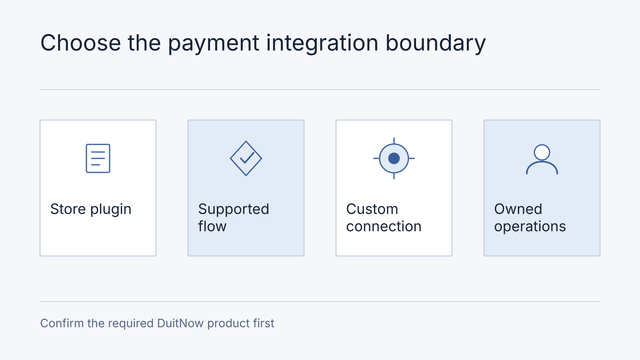
A maintained store integration can reduce implementation work when it covers the actual journey. Ask for evidence of that compatibility. Our DuitNow integration guide explains how to separate provider selection from custom connector work.
Scenario Two: Give Field Staff Offline Access
Assume technicians need to view assigned jobs, capture photos, and submit completed work. Reliable connectivity at every location is unknown. Price an online-only release and an offline-capable release as different scopes.
Offline work introduces decisions about what remains on the device, how uploads resume, and what happens when two people edit the same job. A visible “sync” button is not a complete specification.
Use one concrete example in the quote request: a technician completes a job without connectivity while the office changes its appointment time. Ask which version wins, what history is kept, and what staff see when the device reconnects. Also specify how a lost device affects access to locally stored information.
The estimate should separate the job API, device storage, synchronization rules, photo handling, and office exception handling. If offline use is unnecessary, explicitly exclude it. If it is essential, reducing the number of screens will not remove that engineering work.
Scenario Three: Add a Loyalty App to a POS System
Assume a retailer wants members to view points and redeem rewards. The point-of-sale system already records purchases. Before pricing the app, establish whether the POS supplier permits the required access and whether it provides a supported development environment.
Price the points ledger and redemption controls as well as the customer interface. Define what happens after a returned purchase, an interrupted redemption, or two simultaneous attempts to spend the same points. Identify which system is authoritative for the balance.
This scenario may need paid access from the POS supplier, data cleanup, and operational changes at the counter. Those are dependencies, not features the app developer can promise away. Request a bounded compatibility investigation if the API or commercial access is uncertain.
Build a Comparable Cost Sheet
Ask every supplier to fill in the same rows in MYR, identify any foreign-currency charges, and state whether applicable taxes are included. Do not compare a one-time implementation figure with another supplier’s total operating budget.
| Cost bucket | What the quotation should state |
|---|---|
| Investigation | Deliverable, assumptions resolved, and whether the fee is separate |
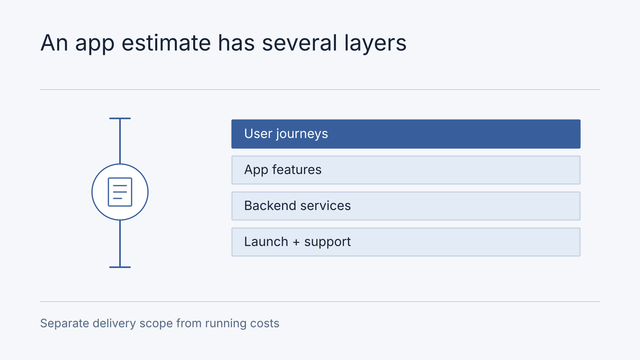
| App delivery | Platforms, journeys, accessibility scope, and release work |
| Backend and integration | APIs, data mapping, migration, administration, and failure handling |
| External services | Account owner, billing currency, usage assumptions, and renewal terms |
| Operation | Hosting, monitoring, support coverage, and included maintenance |
| Future changes | How scope changes are approved and estimated |
Calculate first-year cost as one-time delivery plus first-year recurring charges plus usage-based charges at your stated workload. Keep unresolved items visible instead of inserting zero. Request a second usage scenario if the business expects meaningful growth.
Our published ResumeForU implementation investigation illustrates why payment and delivery need separate states and recovery paths. It is evidence of that engineering concern, not a mobile-app pricing benchmark.
Complete the integration decision before filling a price cell
These synthetic records turn the three scenarios into fundable next steps:
| Scenario | Verified input in the example | Unresolved cost driver | First decision |
|---|---|---|---|
| Existing store | Catalogue export available | Payment/session API and refund behaviour | Prove one end-to-end order before quoting the app |
| Field service | Required offline form agreed | Conflict resolution and attachment sync | Prototype offline completion and reconnection |
| Loyalty | POS is the balance authority | Supported API, fees and reversal events | Obtain access terms and evaluate redemption integrity |
Do not substitute zero for the unresolved integration line. For invented planning figures, MYR 20,000 app work + MYR 8,000 backend/integration + MYR 500/month operation gives MYR 34,000 first year, excluding investigation, third-party fees, taxes and changes. This is arithmetic demonstrating scope separation, not a Nodesify price range. Replace every line with a quote and record which dependency can change it.
Frequently asked questions
Could a responsive website or PWA meet the need?
Evaluate it against required offline behaviour, device access, distribution and customer journey. A store app is not automatically necessary for viewing a catalogue or sending an enquiry.
What if the POS or store supplier does not provide the required API?
Treat that as a scope decision: change the workflow, obtain an approved interface or stop the integration. Bring the dependency record to mobile development; do not ask a screen-count estimate to resolve it.
Decide What to Fund First
Choose the smallest release that completes the business task and handles its material failure cases. For the store, that might be one reliable purchase flow. For field service, it may require offline completion from day one. For loyalty, it may be the POS connection and redemption ledger before a polished member app.
Use our mobile development service to review the engagement, then contact Nodesify with your existing-system list, one complete user journey, and the integration questions still unanswered. That gives us a basis for a scoped quotation rather than a price guessed from screen count.