Choose an AI development partner by the evidence they can produce for your workflow, the boundaries they can explain and the system they can hand over. A persuasive demonstration or a long list of model names is not enough.
For buyers in Malaysia and Singapore, location can affect working hours and onsite availability. It does not establish technical quality, data handling or ownership. Assess those explicitly.
Give every supplier the same brief
A useful brief describes the current process and desired outcome before naming a technology.
Include the process owner, eligible users, input examples, authoritative sources, connected systems, expected volume and prohibited actions. Explain how staff handle exceptions today.
For example: “Prepare delivery-policy replies for support staff, using our approved policy collection. Staff approve every reply. Do not change orders, issue refunds or retrieve another customer’s records.”
State which inputs are available now and which require investigation. If access to an ERP sandbox is unresolved, suppliers should price and schedule it as a dependency rather than quietly assuming it will exist.
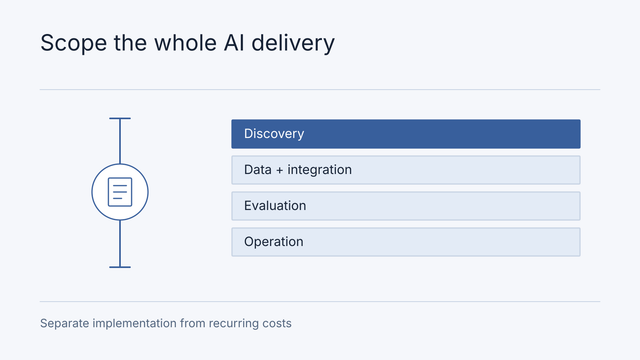
Use the AI budgeting guide to request comparable implementation and recurring-cost lines.
Ask for a demonstration using your cases
Provide redacted or synthetic examples through an approved channel. Include difficult cases, not just common questions:
- A clear request supported by an approved source.
- A question the available sources cannot answer.
- Contradictory or outdated source material.
- An attempt to retrieve another user’s information.
- An instruction embedded in a document to bypass the workflow.
- An unavailable integration or repeated submission.
Ask the supplier to show sources, retrieved information, proposed actions and failure handling. If the system produces the wrong result, ask how the team diagnoses it and what evidence would establish a fix.
Separate genuine delivered work from prototypes and illustrative examples. A supplier can discuss a confidential engagement without disclosing a customer’s data, but should describe their own role and what can be verified. Never treat an unsupported logo wall as proof.
Compare proposals using evidence
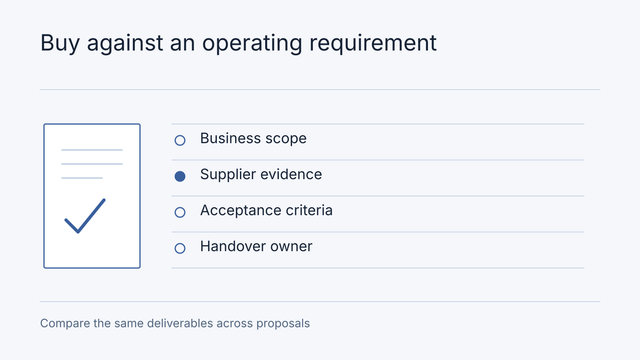
| Area | Evidence to request | Warning sign |
|---|---|---|
| Scope | Deliverables, exclusions and acceptance cases | “End-to-end AI” with no bounded workflow |
| Integration | API assumptions, permissions and failure handling | Shared administrator credentials |
| Evaluation | Representative cases and documented errors | Only a curated happy-path demonstration |
| Data handling | Data flow, retention, subprocessors and deletion responsibilities | “Fully compliant” without explaining the processing |
| Operation | Monitoring, escalation, support hours and named owner | No plan after launch |
| Handover | Accounts, documentation, source rights and export procedures | Supplier controls everything with no agreed exit route |
A scorecard helps record evidence, but some issues are mandatory gates. A serious access-control weakness should not be offset by attractive design or a lower price.
The enterprise procurement guide covers broader purchasing decisions. This article adds the evaluation and data-flow questions specific to AI delivery.
Make ownership precise
“You own the system” can conceal several different rights. Ask the contract to distinguish:
- Your business data and configuration.
- Custom code and its repository.
- Supplier background libraries and reusable components.
- Third-party software and model licences.
- Cloud accounts, domains, integrations and billing.
- Prompts, evaluation cases and operational documentation.
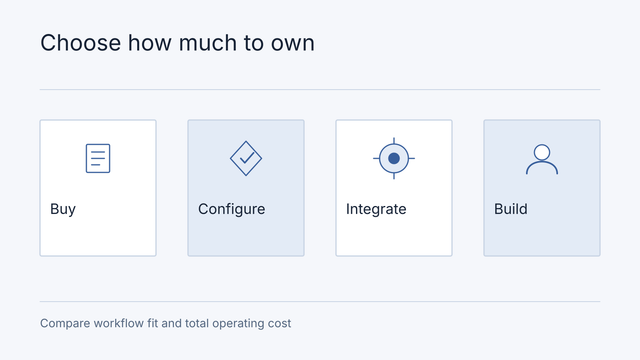
Agree licences for components you do not own and how you can continue operating them. Identify subscriptions that cannot be transferred and the replacement work that would be necessary.
Prefer business-controlled production accounts with individual access for the supplier. Plan credential rotation and access removal at handover. Do not make staff dependent on a developer’s personal account.
Review the actual data flow
Ask where data travels during ingestion, retrieval, inference, logging, backups and support. Include external services used for evaluation and troubleshooting. A hosting-region claim alone does not describe all processing.
Request the stated retention controls, contractual terms and deletion procedure for each relevant provider. Check who can access production traces and whether sensitive values are minimised.
For Malaysia, our third-party cloud vendor and PDPA guide identifies questions to investigate. For Singapore, consult PDPC’s AI advisory guidelines within their stated scope. Procurement evidence supports review; it is not a blanket legal guarantee.
Define acceptance and change control
Name who approves release and what they inspect. Agree the representative sample, launch-blocking failures and required operational controls before implementation.
Separate a defect in the agreed scope from a new requirement. A newly added language, data source or transaction type may need fresh evaluation and delivery work. The proposal should explain how such changes are estimated and approved.
Ask for a rollout and reversal plan. A system that writes records needs an action history, duplicate handling and a clear way to suspend further writes. Reversing an external action may require manual remediation; it is not always a simple switch.
Request a concrete handover package
The package should include access inventory, deployment instructions, environment settings, data-flow diagram, evaluation cases, known limitations, monitoring instructions and support contacts. Secrets belong in a controlled secret-management system, not pasted into a document.
Have a business representative confirm that the company can access its accounts and documentation. Where the contract grants source access, verify that the repository and build instructions are usable by the receiving team.
Nodesify offers architecture audits and maintenance and support. Apply the same evidence requirements when considering our services.
Make two proposals answer the same brief
Download the filled evidence brief. Its supplied, unverified and failed-gate rows are fictional examples; replace them with your own observations before comparing proposals.
Illustrative brief: “Classify incoming service requests and prepare a CRM draft. Support lead approves every write. Begin with 50 redacted examples; success requires correct required fields, no duplicate drafts and a visible queue when the CRM fails. API access is unconfirmed.” Proposal A offers a chatbot without CRM access; Proposal B offers an access investigation followed by a conditional integration scope. They are different deliverables, so their headline totals are not comparable yet.
Label evidence honestly: a live owned product demonstrates a bounded public journey; a synthetic demo demonstrates the specified sample; a written claim is unverified until shown. Nodesify-owned Zen, Lumo and ResumeForU are live product examples, not proof of your integration, capacity or compliance requirements. Ask which relevant boundary can be demonstrated and which requires investigation.
Frequently asked questions
Can discovery be paid, and must we commit to the build?
Define its deliverable, fee and stop point separately. A useful discovery output lets you decide whether to proceed; identify any later credit explicitly rather than assuming it.
How do confidentiality and subcontracting affect the choice?
Agree who may access material, which named organisations participate and how access is removed. Start with synthetic or redacted samples and disclose sensitive material only through the agreed process. Put the responsibilities into the delivery record.
Should we choose a local supplier?
Local availability can help with workshops and working hours. Confirm who will actually do the work, where they operate and what onsite availability includes.
Is a proof of concept enough to award the full project?
It can answer a bounded feasibility question. It should also expose unresolved production work: permissions, integration reliability, operational ownership and acceptance evaluation.
What is the most useful first procurement document?
A one-page workflow brief with examples, data boundaries and success criteria. It makes proposals easier to compare and makes vague promises easier to spot.