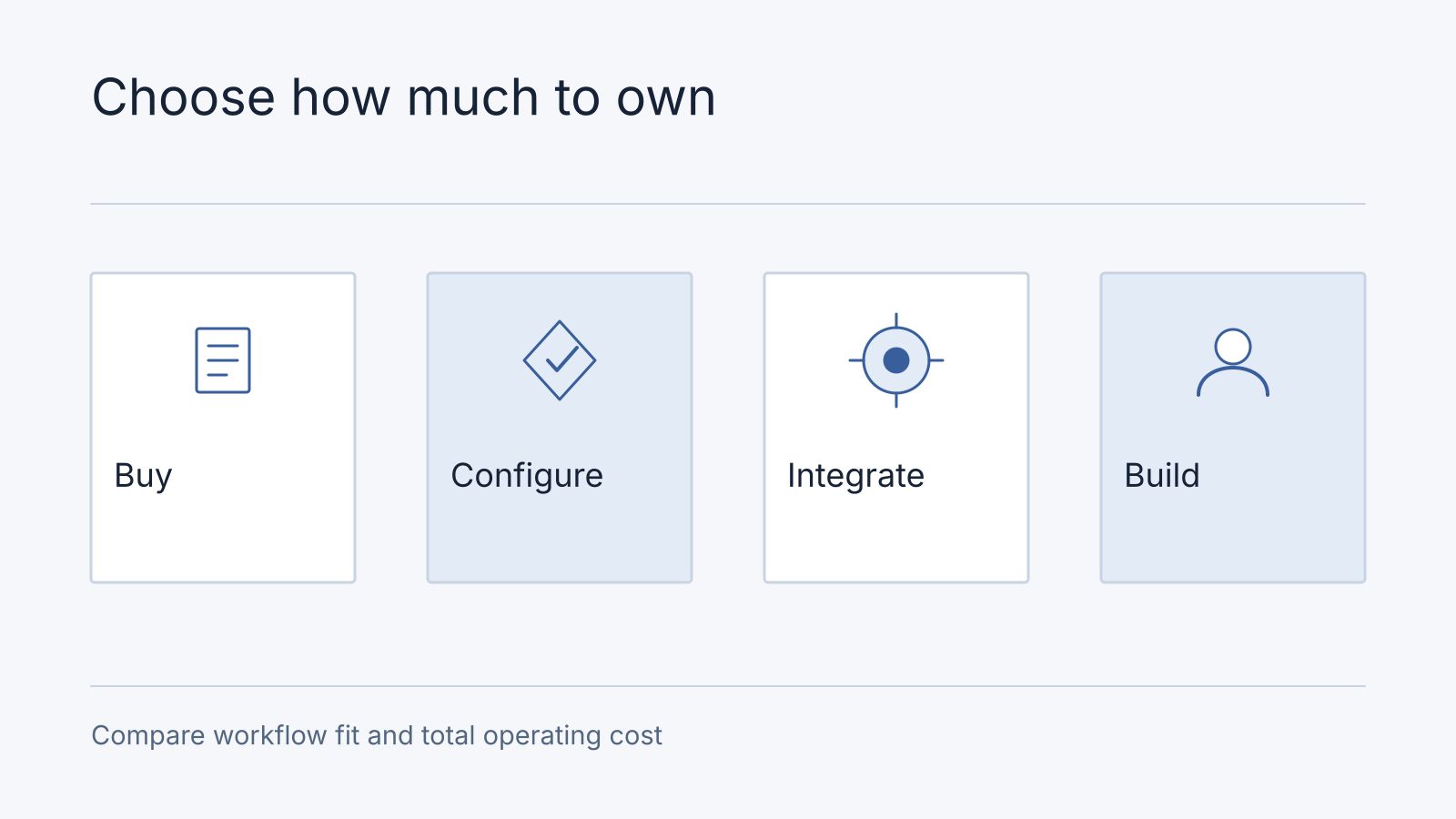
Start with the smallest implementation that meets the workflow. An existing product may solve the task through configuration. Sometimes the right answer is a small integration around that product. Custom AI becomes useful when important requirements remain unmet and you can operate what you build.
For Malaysian and Singaporean businesses, local language, systems and data requirements deserve explicit evaluation. They do not automatically make custom development necessary.
Four options, rather than two
| Option | Appropriate when | What you still need to do |
|---|---|---|
| Buy an existing product | Its supported workflow and controls fit the requirement | Evaluate it, configure access and assign an owner |
| Configure an existing platform | Knowledge sources, rules and channels can be adapted without new application code | Maintain sources, permissions and acceptance cases |
| Integrate existing products | The main gap is moving information between supported systems | Build reliable mapping, error handling and approval steps |
| Build a custom application | Essential behaviour or controls cannot be delivered by the other options | Own application delivery, evaluation, operation and future changes |
A hybrid approach is common: purchase a model or extraction service, then build only the workflow and controls that are specific to your business. “Custom” does not require training your own foundation model.
Decompose the requirement
Consider a fictional distributor that wants an assistant to answer product questions and prepare quotations.
Separate the requirement into capabilities:
| Capability | Question to investigate |
|---|---|
| Product answers | Can an existing tool retrieve approved catalogue information with sources? |
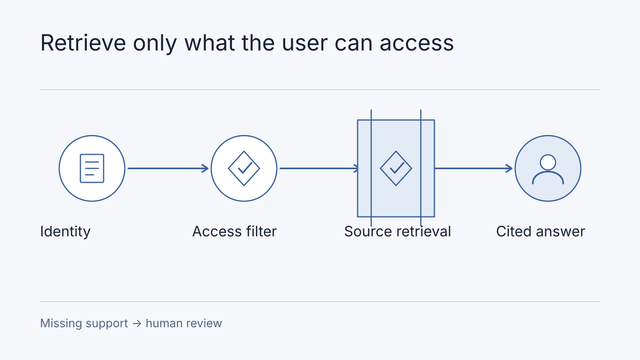
| Customer access | Can it restrict account-specific data to authorised users? |
| Quote preparation | Can supported APIs produce a draft without issuing it? |
| Pricing validation | Can fixed business rules enforce the correct approved price? |
| Staff approval | Can a reviewer inspect and approve the exact proposed quote? |
| Multilingual messages | Does it pass representative language and mixed-language cases? |
| Audit and exit | Can the company inspect actions and export necessary records? |
If an existing tool satisfies the first, second and sixth rows, there may be no reason to rebuild them. If quotation approval is the missing part, investigate a bounded integration before commissioning an entire assistant.
Do not let an AI model improvise customer entitlements or approved prices. Those belong in authoritative systems and deterministic validation.
Try the existing capability first
Check the products you already pay for. Helpdesks, document systems and workflow platforms may have supported functions that meet the requirement.
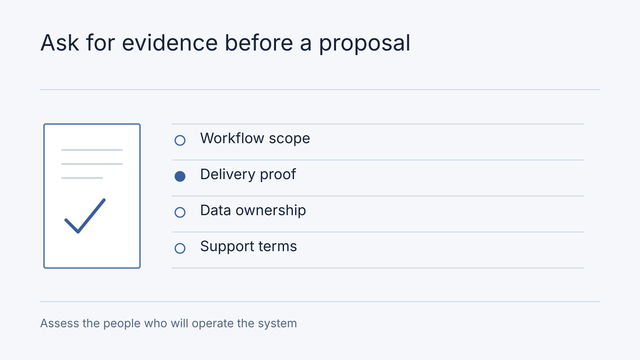
Confirm capabilities from current documentation and a representative trial. Ask about plan restrictions, API access, tenancy boundaries, data retention, supported exports and required add-ons. A feature label such as “enterprise search” does not establish that its permission model matches your organisation.
Use the same evaluation cases for the existing product and a proposed custom solution. Otherwise you may compare a mature product’s difficult cases with a custom prototype’s curated demonstration.
Our multilingual evaluation guide provides support examples. The RAG implementation guide covers source and retrieval evaluation.
Identify genuine reasons to build
Custom work may be justified when a required approval flow is unavailable, several systems must participate in one controlled transaction, the interface must expose evidence the product hides, or access boundaries cannot be expressed reliably.
Document the unmet requirement and the evidence. “We want our own AI” is a preference, not yet a delivery case.
Before building, verify that necessary APIs, licences and data access exist. Custom code cannot legitimately overcome a third-party system’s unsupported interface or contractual restriction.
Also ask whether a modest process change removes the gap. Standardising a form or cleaning a policy collection can be more useful than adding another software layer.
Compare cost over a stated period
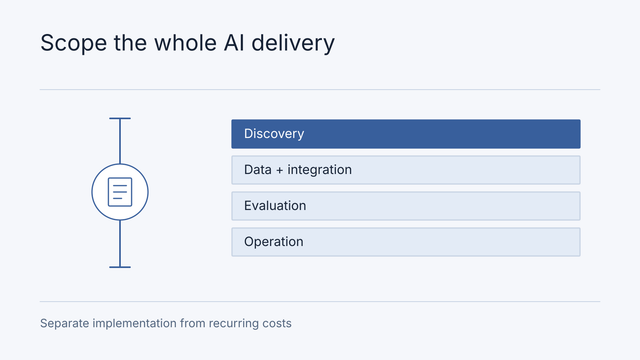
Use a planning horizon that reflects your actual decision, and include:
- Licences or subscriptions.
- Setup, configuration and data preparation.
- Integrations and evaluation.
- Model usage and infrastructure.
- Staff review and source maintenance.
- Supplier support or internal engineering.
- Migration, export and exit work.
Do not treat internal staff time as free, or assume that custom development removes provider charges. Custom applications often still consume paid APIs and managed services.
The implementation-cost guide includes a worksheet for separate setup and recurring lines. Keep quotes in their stated currencies and record any conversion assumptions.
Check the operating burden
Someone must own failed integrations, changed policies, provider updates, permissions and unusual model outputs. Assign this owner before choosing the delivery approach.
An existing product reduces some application maintenance, but your team still owns configuration and its use. A custom application gives more control over behaviour while bringing more responsibility for its operation.
For assistants that perform actions, review the updated IMDA framework for Agentic AI. Use the guidance to inform boundaries and oversight; adopting a product does not transfer accountability for your workflow.
Make a decision with an exit condition
Write a short decision record: required capabilities, options evaluated, unresolved gaps, cost assumptions, accountable owner and the evidence supporting the choice.
Define what would make you revisit it. Examples include a required connector becoming available, a material increase in review effort or a new access boundary. Avoid speculative platform work for possible future needs.
A research and development engagement is useful when one material uncertainty prevents the decision. Give it a specific question and a decision-ready output.
Finish the distributor’s decision record
For the fictional distributor, assume a trial demonstrates approved catalogue answers and the required language cases. The decision is to buy/configure those capabilities. Quote approval remains a gap: investigate a supported API that creates a draft for the named reviewer. Customer-specific pricing and access remain unresolved until the authoritative source and permissions are demonstrated. The recommendation is conditional integration around the product, not a complete custom assistant or automatic quote issuance.
Use the unmet-requirement worksheet: business action, current capability, observed gap, process-change alternative, API/licence dependency, owner and evidence required. A manual staff approval may be an acceptable first release while API access is investigated. Only fund the custom part that the decision record justifies.
Frequently asked questions
What if a new connector removes the gap?
Reevaluate the same acceptance cases and operating cost. If the maintained connector meets them, avoid or retire unnecessary custom work after a controlled transition; preserve required records and responsibilities.
How do we compare a product and a prototype fairly?
Use the same inputs, failure cases, permissions and evidence rules. Mark missing features and human work in both. Bring one unmet requirement and the current tool’s evidence to R&D, rather than starting with a request to build an entire AI platform.
Does custom AI mean training a model?
No. A custom application can use an existing model while implementing your permissions, integrations, interface and approval workflow.
Can an off-the-shelf assistant work in Bahasa Melayu and Chinese?
It may, but evaluate your own messages and policies. A supported-language list is not evidence that a particular business workflow passes.
When is an integration preferable to a full rebuild?
When the existing product already handles the core task and the remaining gap is a bounded connection or approval step that supported interfaces can deliver.