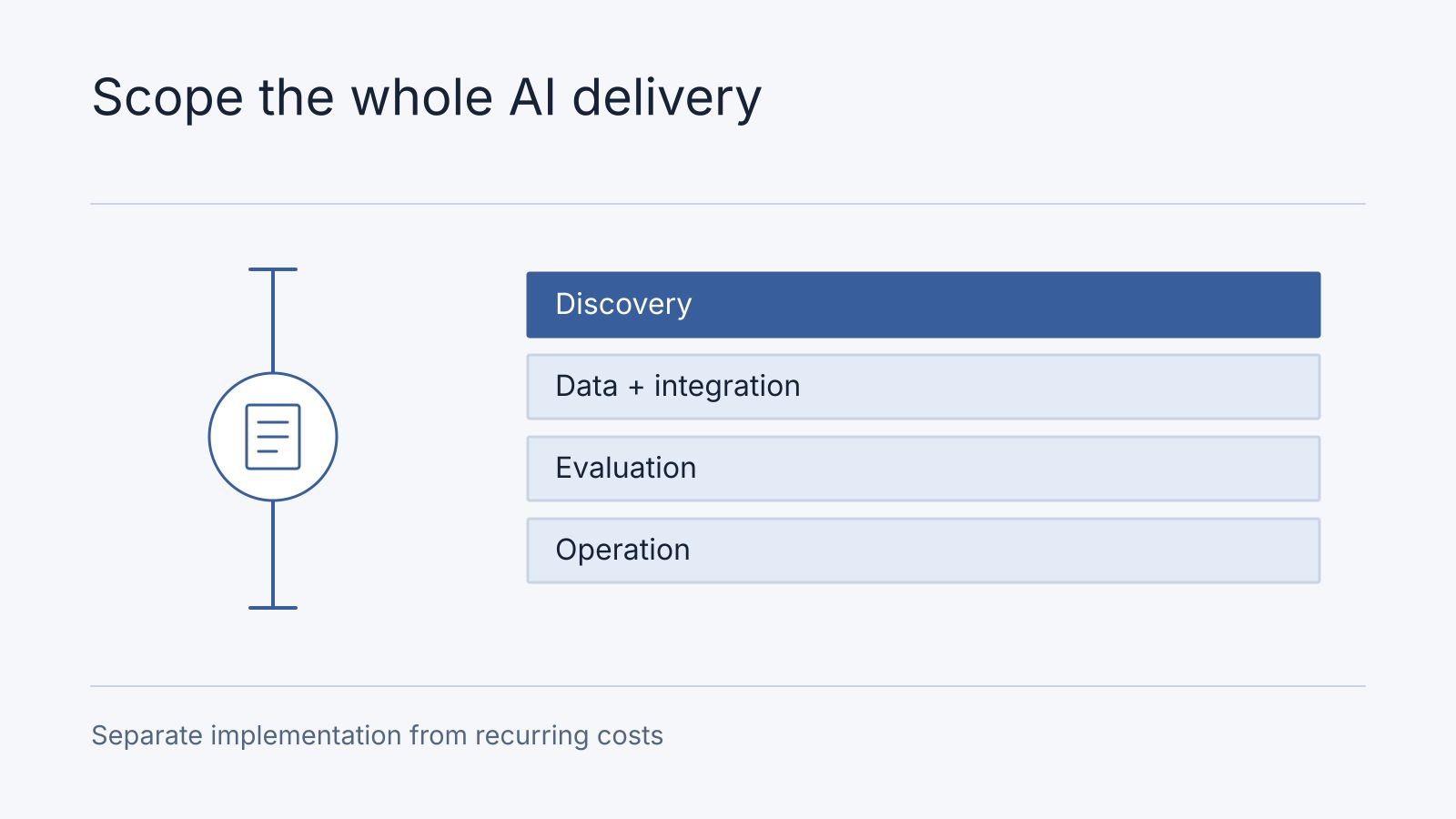
An AI implementation budget should describe a workflow, its boundaries and its running costs. “Build an AI assistant” is too broad to price: an internal document search tool, a customer-facing assistant and a system that changes operational records carry different delivery work and responsibilities.
For businesses in Malaysia and Singapore, prepare comparable quotes in a stated currency, then separate initial implementation, monthly operation and future changes. This guide offers three illustrative scopes and a budgeting worksheet. It does not provide supplier quotations or claim a market-average price.
Three scopes to compare
| Example scope | First release | Explicit boundary | Main cost drivers |
|---|---|---|---|
| Internal document assistant | Staff ask questions against approved operating procedures; answers link to source passages | Read-only access to one document collection; no customer records | Document cleanup, permissions, retrieval evaluation and source updates |
| Customer support assistant | Draft answers for staff using an approved product and returns policy | Human approval before sending; no refunds or account changes | Channel integration, language evaluation, escalation and conversation retention |
| Workflow automation | Classify incoming requests and prepare a record in an existing system | A staff member approves every write | API access, field mapping, duplicate handling, audit history and exception queues |
These are alternative starting scopes, not three mandatory project phases. A team with inconsistent source documents may need preparation before any of them is useful. A team with a stable helpdesk and approved answers may need configuration rather than custom development.
For the document scope, budget for who may see each passage, how revisions replace old versions and what happens when no source supports an answer. Our RAG implementation guide explains these decisions.
For customer support, language coverage changes the evaluation workload. “Supports Chinese” does not establish how the assistant handles your catalogue names, refund conditions or mixed-language messages. Use the multilingual support evaluation guide to define acceptance cases.
For workflow automation, the expensive part may be reliable integration rather than the model. An unavailable API, missing sandbox or undocumented approval process should appear as a dependency in the quote.
Separate setup, operation and change
Ask suppliers to return the same breakdown:
Download the AI budget worksheet (CSV) to capture scope, currency, one-time and recurring charges, usage limits and responsibility. Amounts are deliberately blank: fill them with your supplier’s actual quotation rather than treating this template as a price list.
| Budget line | What the quote should identify | Your amount |
|---|---|---|
| Discovery and process mapping | Named workflow, data owners, access boundaries and acceptance criteria | RM _ or SGD _ |
| Data preparation | Collections, formats, cleanup responsibility and excluded material | RM _ or SGD _ |
| Implementation and integration | Systems, channels, authentication and environments | RM _ or SGD _ |
| Evaluation and rollout | Representative cases, staff review and staged release | RM _ or SGD _ |
| Monthly infrastructure and usage | Hosting, model consumption, storage, monitoring and workflow runs | RM _ or SGD _ per month |
| Monthly support | Coverage hours, response commitments and included work | RM _ or SGD _ per month |
| Future changes | Rates or fixed scopes for new channels, policies and integrations | RM _ or SGD _ |
Use one currency per quote. If you compare an RM quote with an SGD quote, record the exchange-rate source and date, and preserve the original amounts. Show taxes, payment fees and third-party subscriptions separately where applicable. A conversion does not make two different scopes comparable.
The Nodesify pricing page is the place to check current published service prices. A tailored AI implementation still needs a defined scope.
Estimate usage from the workflow
A basic model-cost calculation is:
Monthly model cost = input usage × input rate + output usage × output rate + other billable model operations.
Match usage units to the provider’s units. If rates are per million tokens, divide token counts by one million before multiplying. Include retrieved passages, repeated conversation context, retries and tool responses in input estimates. Check whether caching, batch processing or a particular deployment mode changes the rate. Provider catalogues such as Amazon Bedrock pricing distinguish models and pricing modes; a single “AI cost per message” is not universal.
Consider a fictional support team receiving 2,000 eligible conversations per month. If a pilot observes an average of three model calls per conversation, the estimate starts at 6,000 calls, before retries. Measure tokens per call from representative conversations rather than assuming that a message always has the same length.
This example is workload arithmetic, not a price quotation or a predicted saving. Add channel fees, search, storage and hosting separately. Our AI app hosting checklist covers operating categories.
Count the human work too
Track review time, corrections, source maintenance and escalation. An assistant that drafts quickly but creates extensive checking work may produce little benefit.
Compare the current process with the proposed process using the same unit:
Monthly time benefit = eligible items × (current handling minutes − new handling and review minutes).
For illustration, 500 requests with a measured reduction from eight minutes to five minutes represent 1,500 minutes of potential time capacity. That is not automatically a cash saving: staff may use the time for other work, and some requests may remain ineligible.
Do not count every incoming item if only a subset fits the workflow. Record exclusions and seasonal peaks.
Make the proposal reviewable
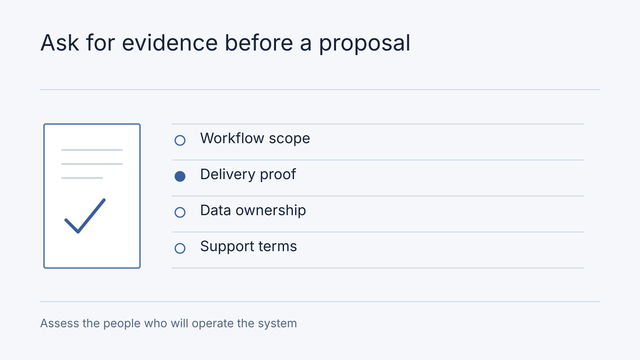
Before approving a budget, request the named deliverables, acceptance sample, rollout decision, monthly usage assumptions and change process. Include who owns accounts and credentials, which subscriptions you pay directly and what happens if the supplier relationship ends.
A small research and development engagement can establish feasibility when document quality or integration access remains uncertain. It should end with evidence and a decision, not an indefinite experiment.
Complete the arithmetic before comparing quotes
All figures here are invented MYR planning inputs, not Nodesify prices or market averages. For 6,000 calls, assume 1,000 input and 200 output tokens per call: 6 million input and 1.2 million output tokens. At hypothetical MYR 2 and MYR 8 per million respectively, model usage is MYR 21.60. A 10% retry allowance makes it MYR 23.76. Add assumed hosting/search of MYR 120 and channel fees of MYR 60. Reviewing 2,000 conversations for one minute each takes 33.33 hours; at an internal planning value of MYR 30/hour that is MYR 1,000. Total: MYR 1,203.76/month, before support, tax and changes. Replace every assumption with observed usage or a current quote.
| Synthetic first-year comparison | Proposal A | Proposal B |
|---|---|---|
| Setup, including named discovery | MYR 8,000 | MYR 12,000 |
| Monthly operation, review and support | MYR 1,800 | MYR 1,200 |
| Agreed change and exit allowance | MYR 2,000 | MYR 2,000 |
| First-year total | MYR 31,600 | MYR 28,400 |
The cheaper setup loses this comparison only if the lower recurring effort in B is demonstrated on the same workload. Keep unverified efficiencies as unknown. Use the cost preparation guide and attach these assumptions to the existing blank budget CSV.
Frequently asked questions
Is a pilot budget the production budget?
No. State the pilot’s sample, access boundary and stop decision. Price production integration, monitoring, support and rollout separately. R&D is useful when an unresolved capability could change the implementation choice.
Who pays subscriptions and how are milestones agreed?
Identify the business-owned provider accounts and supplier-managed fees separately. Link payment milestones to agreed deliverables and acceptance, and identify any discovery already paid so it is not counted twice.
Can we estimate an AI project from the number of employees?
Employee count can indicate potential users, but it does not define integrations, permissions, document quality or transaction volume. Estimate the actual workflow and its usage.
Is a subscription always cheaper than custom AI?
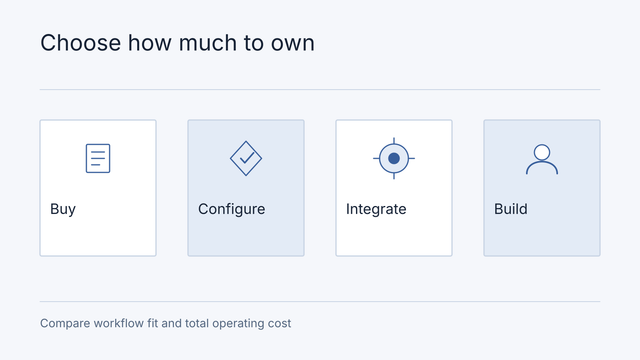
Compare total cost over a stated period, including licences, configuration, integration, evaluation, support and exit costs. Use our build-versus-buy guide before assuming that custom work is necessary.
What should we bring to a scoping conversation?
Bring a process map, redacted examples, current handling times, system owners, expected volume and the actions that require approval. These inputs make a quote substantially more useful than a broad request to “add AI”.