A business chatbot is software that talks to customers or staff through a website, messaging channel or application. It can answer questions, collect information and route a request to the right person. A useful chatbot solves a specific problem, such as helping a customer find a delivery policy or gathering enough detail for a quotation.
For a small business in Singapore or Malaysia, the first question is where conversations get stuck. If staff repeatedly answer the same questions, a chatbot may help. If customers need individual advice or your policies change without being documented, improve that process before automating it.
Chatbot, AI chatbot or AI agent?
| Approach | How it works | Suitable starting point |
|---|---|---|
| Rule-based chatbot | Follows buttons and predefined branches | Opening hours, appointment requests and simple routing |
| AI chatbot | Generates responses using approved knowledge and instructions | Questions phrased in different ways, product explanations and support triage |
| AI agent | Uses tools to take steps in connected systems | Checking an order or preparing a CRM update within defined permissions |
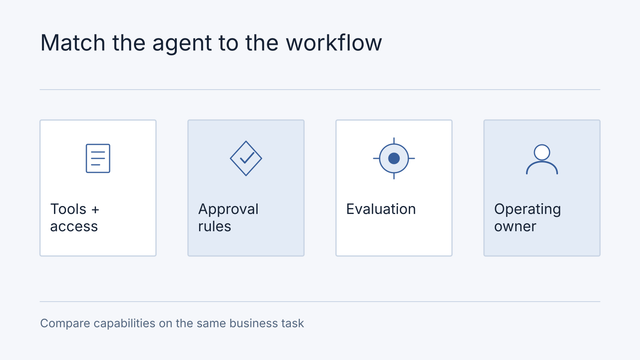
An AI answer and a completed business action are different outcomes. A bot explaining a refund policy should not automatically approve refunds. Choose the smallest amount of access that completes the intended task.
Four useful business chatbot use cases
Customer questions. Answer questions from approved product pages, delivery policies and support articles. Show a source link when useful. Escalate when the answer is missing or ambiguous.
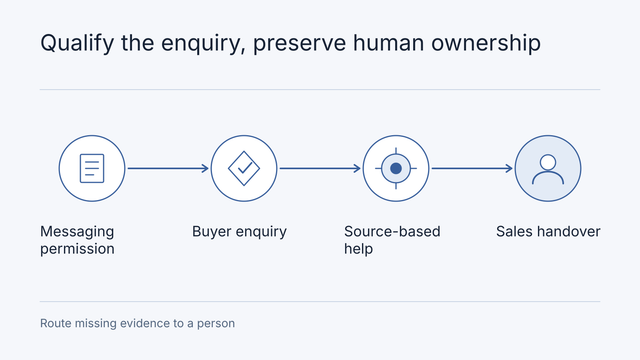
Lead qualification. Ask what the customer needs, their expected timeline and a preferred contact method. Save the answers once and assign an owner. Explain why you need personal information before requesting it.
Appointment requests. Collect the service and preferred time. Confirm availability through the booking system rather than inventing a slot. Make cancellation and rescheduling straightforward.
Support triage. Identify the product, capture the problem and create a ticket. Preserve the conversation so the customer does not have to repeat everything to a person.
These are illustrative workflows, not claims about Nodesify client results. Pick one workflow for the first release and measure it against your current process.
Example: an enquiry assistant for a service business
Imagine a visitor asking, “Can you build a booking website?” The assistant can explain the published service, ask how bookings work today and collect requirements for a human review.
- Answer from approved service information.
- Ask which services need booking and whether online payment is required.
- Explain the next step and ask permission to collect contact details.
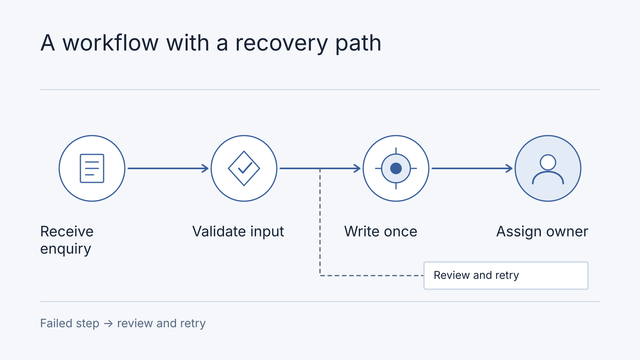
- Create one enquiry record with a unique submission identifier.
- Assign the enquiry to a team member and show a confirmation.
- Offer a direct human contact option throughout the conversation.
The assistant should not promise a delivery date, binding price or integration that the team has not approved. If a CRM write fails, it should report the failure and offer another contact route.
What does a business chatbot cost?
Estimate setup and ongoing operations separately. The channel subscription or model bill is only one part of the budget.
| Cost component | What determines it |
|---|---|
| Knowledge preparation | Quality of existing documents, policy ownership and translation review |
| Implementation | Conversation design, channel setup, CRM connections and identity checks |
| Usage | Conversations, model calls, retrieved documents and provider limits |
| Channel charges | The selected platform’s current messaging and subscription terms |
| Maintenance | Updating answers, reviewing failures, renewing credentials and responding to incidents |
Use a sample of real, anonymized conversations to estimate usage. Count every model call in a conversation, including retries and tool follow-ups. Calculate cost per successfully resolved enquiry, alongside the time staff spend reviewing and correcting answers.
For example, OpenAI’s API pricing documentation separates model input and output charges and lists additional tool charges. Use the current rates for your selected model and tools rather than assuming a flat price per conversation. This is one provider example, not a requirement to use OpenAI.
For WhatsApp, consult the official Business Platform pricing page and linked rate cards for your recipient markets and message categories. Keep any integration supplier’s subscription or markup separate from Meta’s charges. Check applicable exemptions and effective dates before estimating a monthly bill.
There is no reliable universal price for a business chatbot. Request a scoped estimate that names the channels, integrations, conversation volume and support responsibilities. Avoid comparing a basic FAQ widget with a system that changes customer records as if they were the same purchase.
Website or WhatsApp first?
Start on the channel your customers already use. A website widget fits visitors researching services. A messaging integration can fit ongoing conversations, but requires checking the provider’s current account, template, consent and charging rules.
The WhatsApp Business Messaging Policy sets requirements for permitted messaging, templates and customer expectations. It also requires clear escalation paths when using automation during the customer-service window. Our recommendation is to make the human-support route visible from the start and preserve the conversation during handoff. Recheck the policy before implementation because platform requirements can change.
Use a shared approved knowledge base if you support both. Assign ownership of updates so a customer does not receive conflicting answers across channels. Our WhatsApp AI agents guide explores the sales workflow in more detail.
Prepare the information before connecting tools
Document your services, exclusions, opening hours, delivery rules and escalation contacts. Give each document an owner and review date. Remove obsolete or conflicting instructions before the chatbot can retrieve them.
For multilingual customers, review answers in the languages you intend to support. Translation alone does not establish that a policy applies in another market. Have the assistant ask for clarification when currency, service area or delivery location matters.
Map where messages and attachments travel, how long they are retained and which staff can access them. Review the applicable privacy requirements with the responsible adviser. A chatbot product does not establish compliance by itself.
For Singapore, the PDPC publishes guidance on personal data in AI recommendation and decision systems, including guidance for third-party developers. Its stated scope is recommendation and decision systems, so it should not be treated as a chatbot-specific certification or a complete checklist for every deployment.
For Malaysia, start with the regulator’s personal data protection principles and Act 709 resources. Confirm the current requirements and amendments for your processing activities. Have the responsible adviser review notices, collection purposes, supplier access, retention and cross-border processing for the actual implementation.
Launch with measurable boundaries
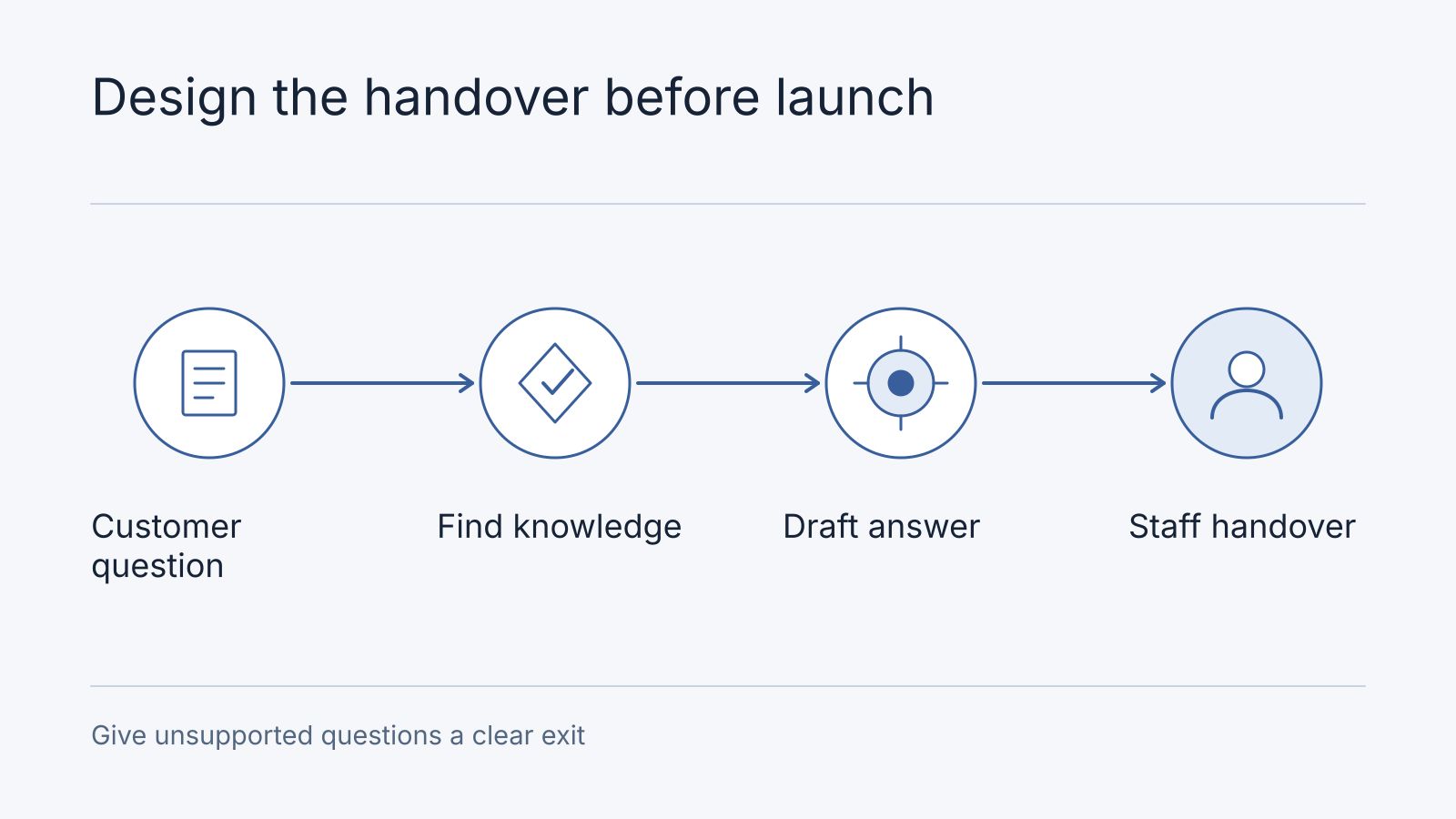
Before launch, try routine questions, unavailable information, conflicting policies and failed integrations. Check that a visitor can reach a person and that duplicate events do not create duplicate leads.
Track answer accuracy, completed enquiries, successful human handoffs, correction time and cost per resolved conversation. A conversation ending does not prove the customer was helped. Review a sample of outcomes with your support team.
Start with approved answers and enquiry collection. Add authenticated actions only when the workflow needs them and the team can monitor and recover failures. For connecting the result to other systems, see our n8n workflow guide.
Follow a conversation through staff takeover
Illustrative exchange: customer asks “Can I return an opened item?” The assistant quotes the approved policy and asks for the order reference. The customer reports damage, so the assistant hands over with the question, policy version, provided reference and unresolved decision. Staff approve the actual remedy. If the CRM is unavailable, the conversation stays visibly pending; the assistant must not claim that a case was created.
A first-launch brief can be only one page: website channel, English and Malay sample questions, approved delivery/returns sources, support-hours message, named support lead and no refund/account-changing actions. Acceptance includes an unsupported question, mixed-language wording, unavailable staff and failed case creation. Standard knowledge-based support may fit the packaged product; CRM writes, routing rules and custom operational actions need their own confirmed integration scope.
Frequently asked questions
Who covers enquiries outside staff hours?
Publish the actual staffed hours and expected follow-up route. The assistant may collect a request, but it should not promise an immediate human response that the team cannot provide.
What should we bring to a demonstration?
Bring approved answers, two exceptions and the desired handover queue. Ask to see the complete handover and failure path, then use the buyer guide to decide between product setup and custom workflow work.
Can a chatbot replace customer support?
It can handle bounded, repeatable questions and collect information. Keep people responsible for complaints, exceptions and commitments that require judgment.
Can it answer from our website?
Yes, with an appropriate retrieval setup. Review which pages are included and how changes reach the knowledge base. Public availability does not mean every page is suitable as an answer source.
What should our first chatbot do?
Choose the repeated enquiry with the clearest approved answer and a useful next step. Expand after you can demonstrate accurate answers, reliable handoffs and manageable operating costs.
Plan your first business chatbot
For provider selection, read our AI chatbot comparison in Malaysia. Compare the total operating budget with the WhatsApp chatbot pricing checklist, then choose between AI answers and fixed rules for your first workflow.
Bring your most common questions, current support documents and the systems that receive enquiries. Talk to Nodesify about a scoped chatbot workflow with clear ownership, integration boundaries and launch criteria.
Sources and editorial scope
Sources reviewed on 11 October 2026 are linked beside the claims they support. Provider documentation establishes provider rules and charging structures. Regulator resources identify the relevant privacy guidance. The workflow examples, selection advice and launch measurements are Nodesify’s editorial recommendations, not measured client outcomes or legal conclusions. Check current provider terms before implementation.