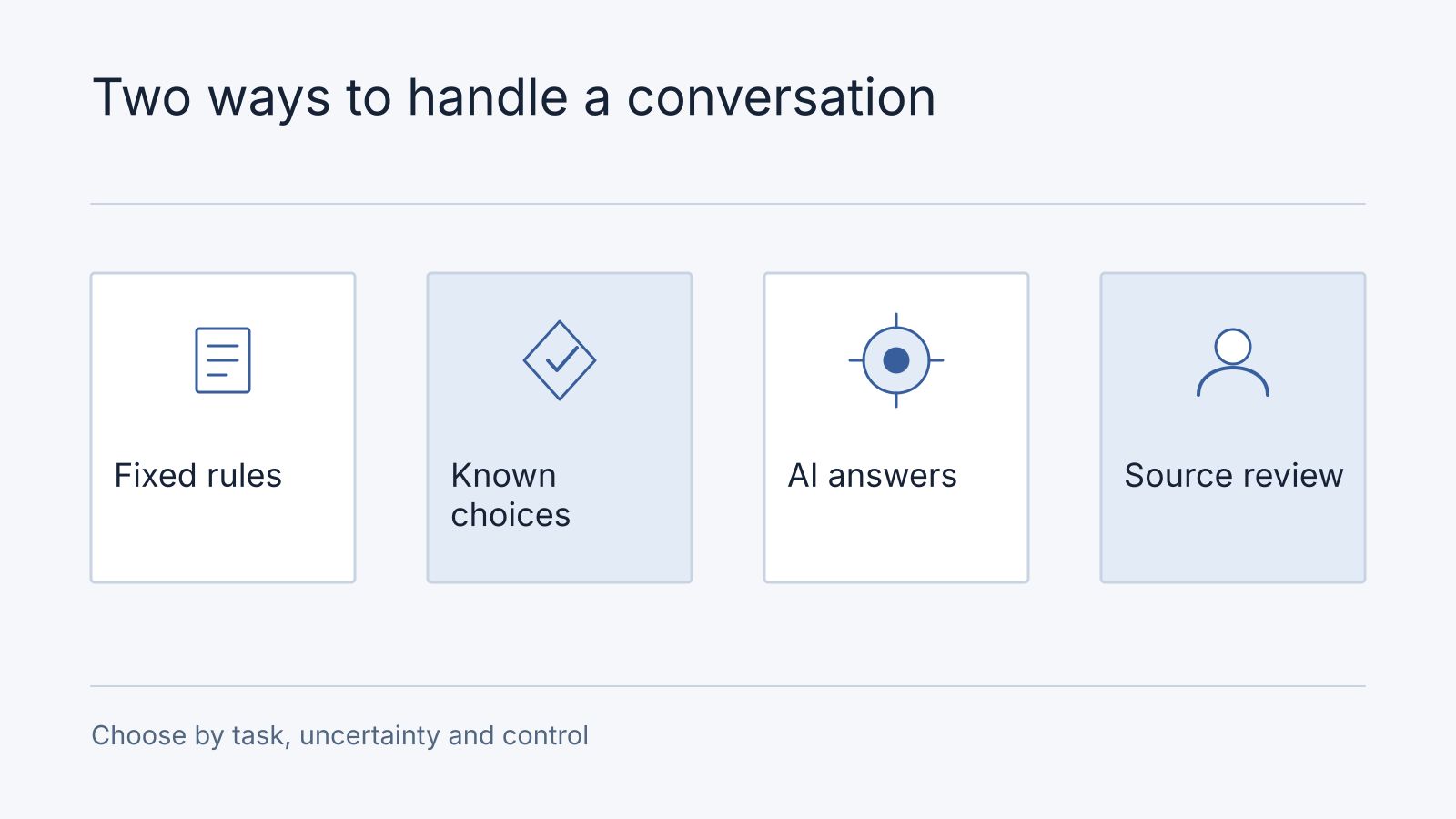
Choose a rule-based chatbot when customers need a predictable sequence of choices. Consider an AI chatbot when they ask varied questions that need answers from approved business information. Many workflows benefit from both: AI explains the options, while a controlled form or staff member handles the decision.
The choice is separate from the channel. Either approach can appear on a website or a messaging service where the selected implementation supports it. Nodesify develops Lumo, so examples below explain its intended scope without claiming that AI is always the better purchase.
Compare the Two Approaches
| Question | Rule-Based Chatbot | AI Chatbot |
|---|---|---|
| How does it respond? | Uses predefined messages and branches | Generates an answer from instructions and available knowledge |
| What input fits well? | Buttons, clear categories, and fixed fields | Questions phrased in different ways |
| What needs maintenance? | Branches, conditions, and canned messages | Approved knowledge, instructions, and answer review |
| What can go wrong? | A missing branch or a confusing sequence | An unsupported, incorrect, or ambiguous answer |
| Does it complete transactions? | Only with the required connection and controls | Only with the required connection and controls |
| When should staff take over? | When the flow cannot handle the case | When knowledge or authority is insufficient |
Neither approach becomes a business integration by itself. A chatbot can describe a refund policy without having authority to approve a refund. Checking an order requires a suitable system connection and appropriate customer verification.
When Rules Are the Better Starting Point
A fixed flow is useful when you know the few choices the customer must make. For example, a visitor can choose a department, select a service, and submit a preferred contact time. The business knows which fields are required and where the request goes.
Use rules for decisions where exact conditions matter. Collecting consent, validating a date, and requiring staff approval should have clear behavior. A small menu can be easier to operate than an AI system when there is little need for open-ended conversation.
The maintenance burden grows when every new question needs another branch. Review abandoned flows and requests that fall outside the menu. If people repeatedly type questions that the flow cannot understand, the business may need a better knowledge-answering layer or clearer information on the page.
When AI Answers Can Help
AI can help when customers ask similar questions using different language. A retailer may receive “Is this suitable for outdoors?”, “Can I leave it in the rain?”, and “Is it weather resistant?” The useful answer must come from approved product information, rather than an assumption based on the product name.
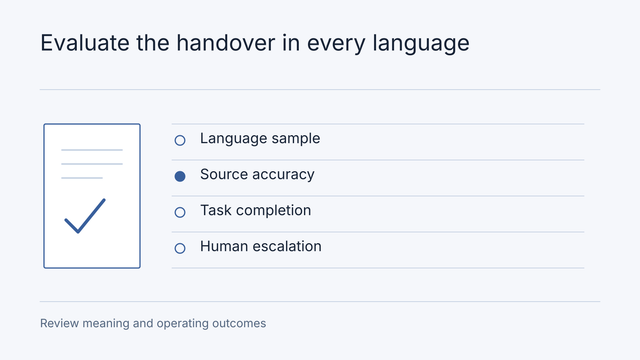
For a Malaysian business, include Malay, English, Chinese, and mixed-language examples appropriate to your customers. Ask reviewers to check meaning, product names, quantities, and policy conditions. Our multilingual evaluation guide explains how to prepare acceptance cases.
AI adds responsibilities: maintain accurate source information, review mistakes, and decide when the system must stop answering. If the business cannot supply a reliable policy or catalog, resolve that information gap before automating its explanation.
Combine Flexible Answers With Controlled Actions
An illustrative service inquiry can follow this pattern:
- AI explains the service using approved information.
- A structured form collects the required project details.
- Staff reviews scope, availability, and price.
- The business issues the approved proposal through its normal process.
This separates explanation from authority. It avoids treating a plausible AI estimate as a binding quotation. If the business later connects quotation software, define the permitted actions, approval rules, and failure handling as part of that integration.
What This Means for Lumo
Lumo focuses on answers from approved business information and staff handover on its agreed website and eligible WhatsApp channels. It is designed for repeated customer questions, with assisted preparation and acceptance before activation.
In standard scope, staff confirms live stock, final prices, discounts, payments, orders, and refunds. Lumo is not a replacement for an approved transaction process. Broadcast campaigns and transaction automation are outside that package. Ask for a guided pilot using your own catalog and the questions staff answers today.
Compare Maintenance and Cost
Estimate the time needed to keep either system useful. Rules need branch changes when products or policies change. AI needs approved content updates and checks that answers remain consistent. Both need someone responsible for unresolved inquiries.
For AI, ask how usage is counted and how limits behave. For rules, ask whether automation runs, staff seats, or channel messages are charged. Use our Malaysia chatbot comparison for provider options and the pricing guide for total-cost planning.
Compare Outcomes Before Expanding
Prepare the same representative inquiries for both approaches. Record correct answers, completed requests, staff escalations, and customer effort. Include missing information and cases where the answer must be “a person needs to confirm this.”
Use a rule-based approach if it completes the required process clearly and economically. Add AI where flexible questions create enough value to justify knowledge maintenance and oversight. Expand connected actions only after the basic conversation and handover work reliably.
Compare the same enquiry three ways
Illustrative enquiry: “My order arrived yesterday with a broken lid. Can you replace just that part?” A menu can collect order reference and damage category but may force the customer through irrelevant options. An AI answer can explain an approved damaged-item policy but must not invent eligibility. A hybrid collects the reference, explains the policy and sends the photos and request to a staff member; it does not approve a replacement itself. With no order reference, all three should ask for the missing information rather than guess.
Choose rules when choices and outcomes are fixed. Add AI answers when wording varies but approved knowledge is reliable. Use a hybrid when conversation needs flexibility but actions require controlled steps. Prepare knowledge first when policies conflict. For an illustrative ten-branch change, compare ten separately maintained menus with one approved policy plus ten branch exceptions: count actual update and review hours for both designs. Centralised AI knowledge is not automatically cheaper if exceptions dominate.
Frequently Asked Questions
Can we keep our menu bot, and what happens when AI is unsure?
Keep working menu steps and evaluate an answer layer separately. Define when the assistant asks a clarification, cites a policy or transfers to staff. Uncertainty must not grant action authority.
Is preparing our knowledge included in setup?
Confirm this in the selected product or service scope. Bring five common questions, two exceptions and the approved answers to a sample-question review; agree cleanup, approval and ongoing update ownership before comparing fees.
Is AI Always Better Than a Rule-Based Chatbot?
No. Fixed choices can be more suitable for a short, predictable process. AI is useful when varied questions need answers from maintained business knowledge.
Can Both Approaches Be Used on WhatsApp?
Yes, when the chosen implementation supports the channel and account requirements. WhatsApp is a channel, not a particular chatbot technology.
Can an AI Chatbot Issue a Final Quote?
Only where a separately verified workflow provides the pricing rules and approval authority. Lumo’s standard scope leaves final pricing decisions with staff.
Explore Lumo or discuss your first customer-support workflow with Nodesify.