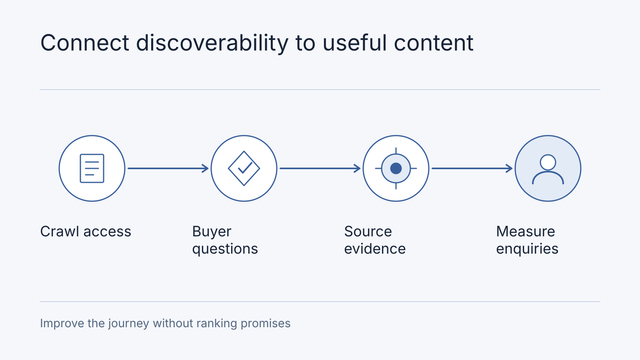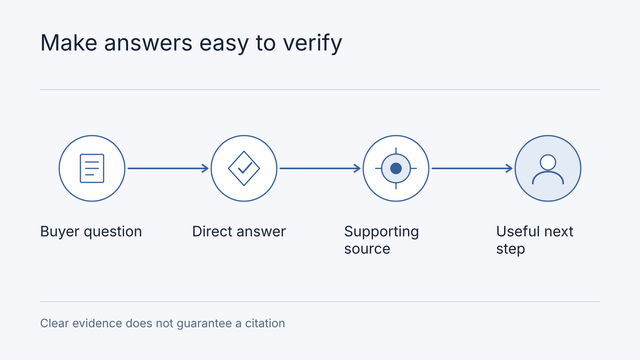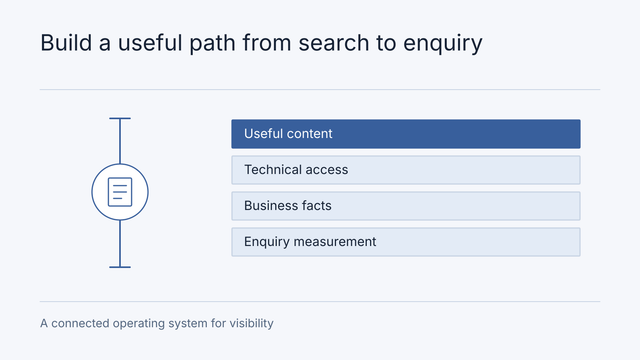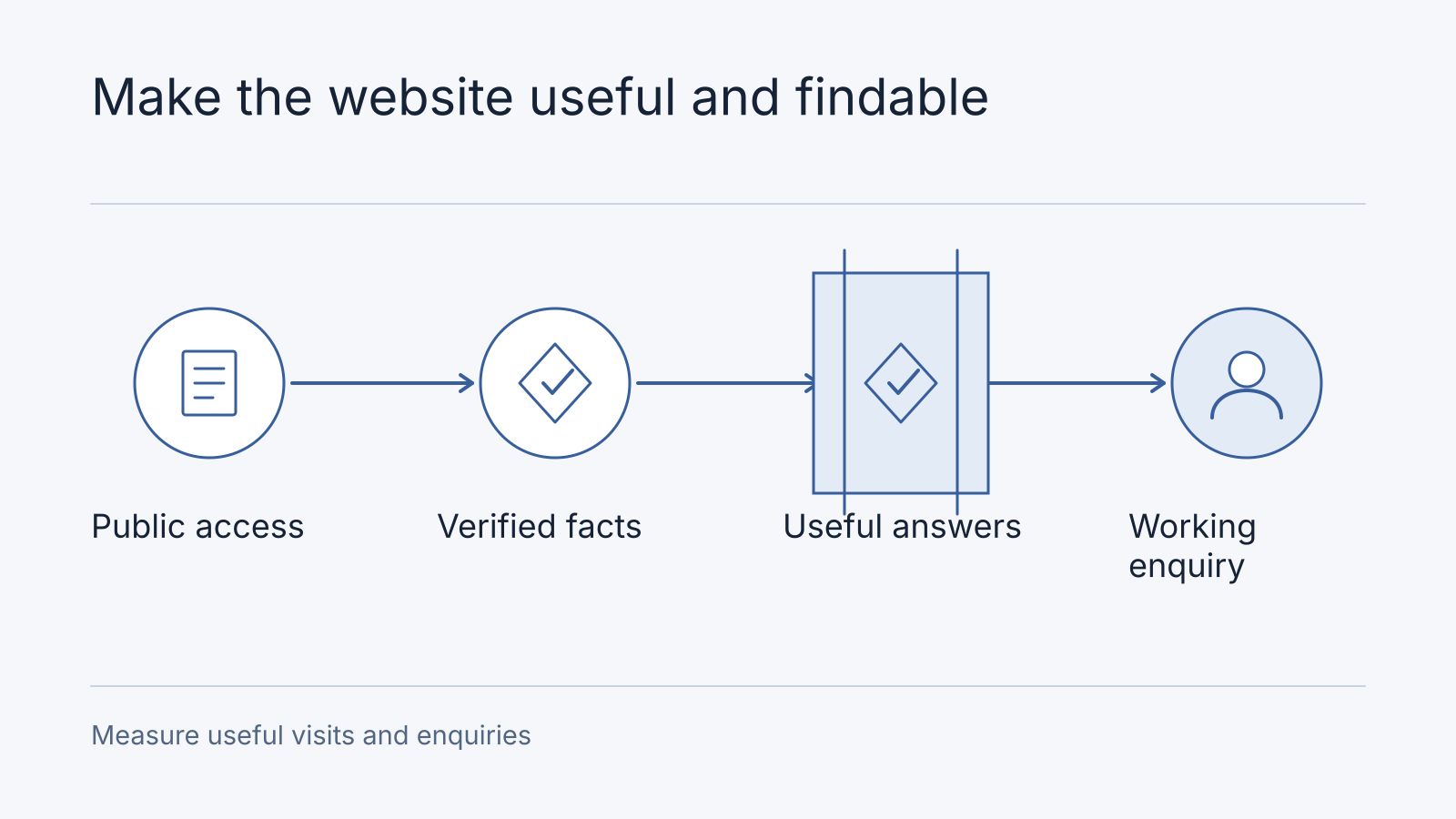
An AI-built website needs the same basic attention as any other business website: accessible public pages, accurate information, useful answers and a working enquiry journey. Start there before buying a service promising automatic visibility in Google or AI answers.
SEO means search engine optimisation. AEO, or answer engine optimisation, describes work intended to help content answer questions. GEO, or generative engine optimisation, describes work aimed at visibility in generated answers. These labels overlap; they do not create a separate shortcut to discovery.
This checklist is for a nontechnical owner preparing an AI-generated business website for launch. Sources were reviewed on 22 September 2026. The checks are practical editorial and launch guidance, not a promise of rankings or citations.
Confirm that the public website is actually public
Open the final domain in a private browser window. Visit important pages directly, not only through the builder preview. Check that a visitor can read the service details and contact you without signing into the builder.
Ask the person publishing the website to verify:
- Public pages return successfully and are not blocked from indexing unintentionally.
- The preferred domain is used consistently, with redirects from alternate versions.
- Important pages have their own meaningful URLs and descriptive internal links.
- The sitemap lists the intended public pages.
- Private dashboards, customer records and preview environments remain private.
A robots.txt rule controls crawling; it is not an access-control mechanism for private information. Keep the public marketing website and authenticated application boundaries clear.
Use Search Console to inspect representative public URLs after launch. A page loading in your browser does not by itself establish that a search engine has indexed it.
Replace invented copy with business facts
AI-generated drafts sometimes contain convincing details the business never supplied. Read every claim before publishing: customer counts, years of experience, testimonials, certifications, prices, office locations and service guarantees.
For each service page, supply information only your business can confirm. Explain who the service suits, what is included, what the customer must provide, what changes the scope and how to begin. Add an approved example if you have one; label an illustrative scenario as such.
Google’s guidance on generative AI content emphasises accuracy, quality and relevance. Generating many pages without adding value can fall under its scaled-content-abuse policy. An AI writing tool does not remove the need for editorial responsibility.
For a business serving Malaysia or Singapore, describe the areas and languages you actually support. Do not create dozens of near-identical city pages that imply offices or delivery capabilities you do not have.
Answer the questions that precede an enquiry
Choose questions from real sales conversations, support requests and customer uncertainty. Different services need different answers. A cleaning customer may ask what is included; a software buyer may ask who owns the code and what happens after launch.
Use a direct answer, then add the qualifications needed to make it accurate. For example:
Can I keep the website I built with AI?
A developer can assess which parts can be retained. The answer depends on the source export, connected services and required changes. Provide a demonstration and service list before requesting a migration quote.
Place this answer near the relevant service information. Do not repeat the same generic FAQ on every page. Link to a deeper guide when the reader needs more detail, such as our AI app hosting checklist.
A useful page should help a person decide what to do next even if they never encounter it in an AI answer.
Give each page a clear purpose and title
Use a distinct main heading and page title that describe the actual subject. Write a description that summarises what the visitor will learn. Check that the builder has not left every page titled “Home” or used the project name as all metadata.
| Page | Useful purpose | Evidence to include |
|---|---|---|
| Service page | Explain an offering and its fit | Scope, process and meaningful limitations |
| Cost guide | Explain what affects the total | Assumptions, inclusions and exclusions |
| Case study | Show what happened in a particular project | Context, work completed and supported outcomes |
| How-to guide | Help someone finish a task | Steps, decisions and a completion check |
Use headings to organise the explanation, descriptive links to connect related pages and image descriptions where images convey information. Review the phone experience: essential information should remain readable and the enquiry form should be usable.
Check current AI search eligibility without buying special markup
Google’s current generative AI search guide says pages must be indexed and eligible for a search snippet, and the site must be included in generative AI features through Search Console. Meeting these conditions does not guarantee inclusion.
The same guidance says there is no special schema required and Google Search does not use llms.txt for visibility. Check the current controls and documentation instead of treating an “AI optimisation file” as the launch deliverable. Other search and assistant products have their own policies; a Google setting does not configure them all.
If your template produces structured data, ask the implementer to confirm it matches the visible business, author and article information. Do not invent ratings or reviews to fill a template. FAQs are useful when they answer real questions; their presence is not a guarantee of a special search display.
Measure enquiries alongside discovery
Record the launch date and the pages you changed. Track completed enquiries and agree what counts as a relevant lead. Confirm that an apparent form success corresponds to a received submission.
Use Search Console for search performance and its available generative AI reporting. Record identifiable AI referrals in your analytics, while recognising that referral data is incomplete. For occasional manual observations, save the question, product, date and cited URL. One favourable answer is an observation, not a stable ranking.
Review what visitors do after arriving. If the page attracts the wrong enquiries, its explanation or targeting may need attention. If visitors cannot submit the form, generating more articles is unlikely to solve that problem.
For a wider measurement discussion, read our SEO and GEO improvement guide and AEO guide for businesses.
Turn launch checks into owned decisions
Consider a fictional local repair business. “Innovative solutions for all your needs” becomes: “Book an inspection for commercial refrigeration in the listed service area. The visit includes diagnosis and a written repair estimate; parts and emergency attendance are quoted separately. Send the appliance type, location and fault description.” Publish only boundaries the business actually approves. A real service photo or named qualification requires its own evidence; generated copy is not evidence.
| Illustrative check | Owner and result | Required action |
|---|---|---|
| Enquiry form | Operations: submission appears successful but no ticket arrives | Block enquiry launch; inspect delivery, replay a synthetic request, confirm ticket and acknowledgement |
| Service area | Business owner: three locations confirmed | Publish only those locations; remove generated coverage claims |
| Old URLs | Website owner: two useful URLs changed | Map each to its relevant replacement and verify the destination |
A form repair is complete when a synthetic enquiry reaches the assigned person and the customer sees the correct confirmation, including the failure path. Keep that evidence with the release record. For definitions and measurement, continue to the SEO/GEO guide and AEO guide.
Bring the URL, builder, failed journey and desired outcome to a review. Request a technical audit for uncertain rendering or access; website work for agreed page/form repairs; and a separately defined measurement scope for ongoing visibility. A URL review should return observed issues, evidence, priorities and access still needed—not a ranking guarantee.
Frequently Asked Questions
Must repairs change my domain, URLs or builder?
No. First establish whether the current builder can meet the acceptance criteria. Preserve working URLs and domain ownership where possible; document redirects for necessary changes. Move platforms only when a verified limitation justifies the migration and operating work.
Can an AI-built website appear in search results?
Yes. The building method does not replace the need for crawlable pages, useful information and technical eligibility. Confirm the published result rather than relying on the builder’s preview.
Do I need a separate page for every version of a question?
No. Put closely related questions together when that helps the reader. Create a separate page when it serves a distinct need with enough useful information of its own.
Should I publish AI-written articles every day?
Choose a pace you can review and maintain. Each article should contribute useful information and accurate claims. Publishing frequency alone does not establish value or visibility.
Can someone guarantee that AI assistants will recommend my business?
No reliable guarantee follows from adding content or markup. Evaluate a supplier by the specific work, evidence and reporting it provides, and distinguish observed citations from business enquiries.
Prioritise the next useful improvement
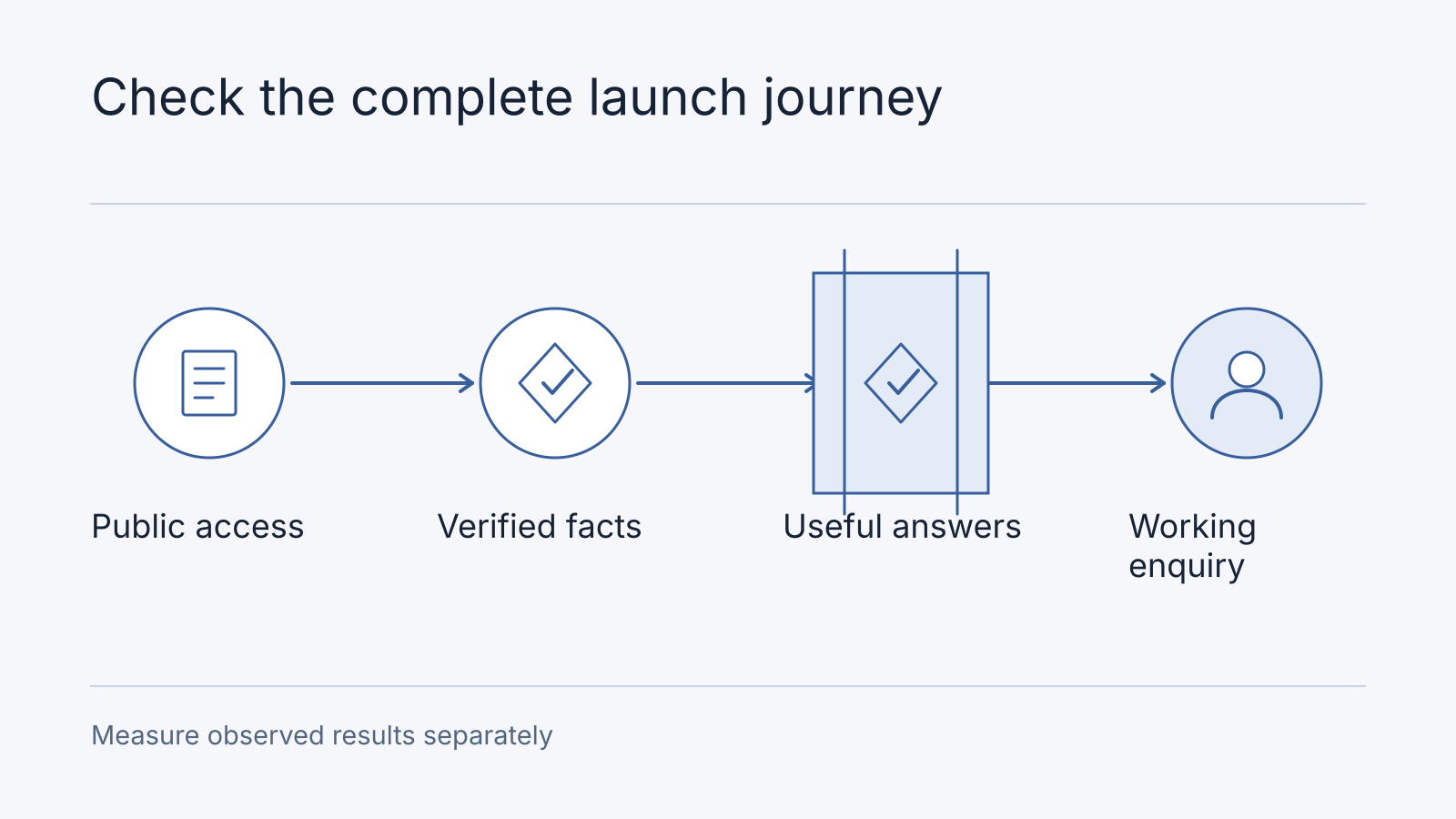
Use this illustrative launch check for a service page: open its public URL without a builder login, read the title as a potential buyer, verify every price and credential against business records, submit the enquiry form, and note where the confirmation arrives. Record the observed result and owner for each step. A page that passes an automated SEO scan but sends enquiries nowhere still has a business problem. This example is a review method, not a Nodesify client outcome.
Start with access problems, inaccurate claims and broken enquiry paths. Then improve the pages that explain your most important services. Use the AI building cost guide to keep extra tools and content work within scope, or contact Nodesify with your URL and the customer questions your site needs to answer.