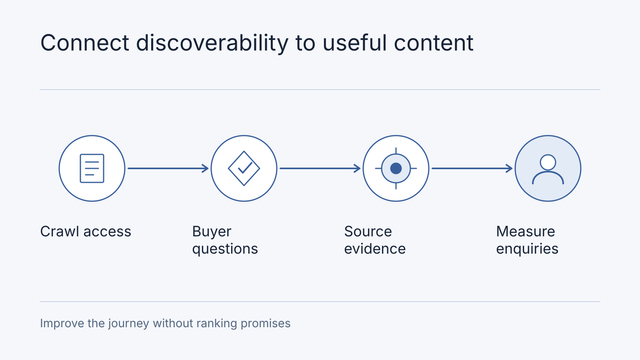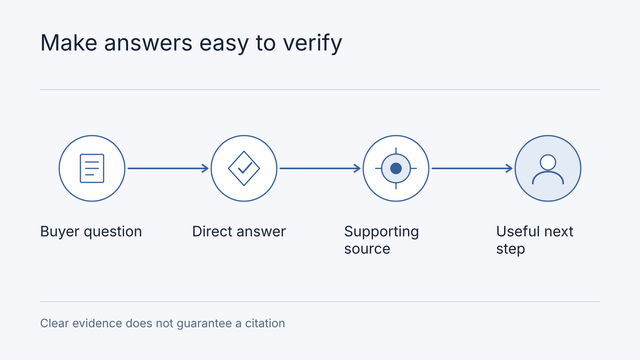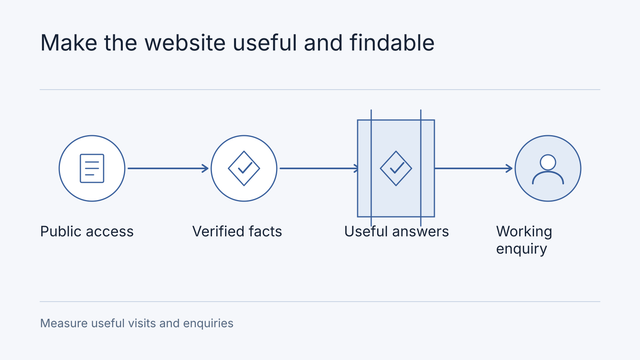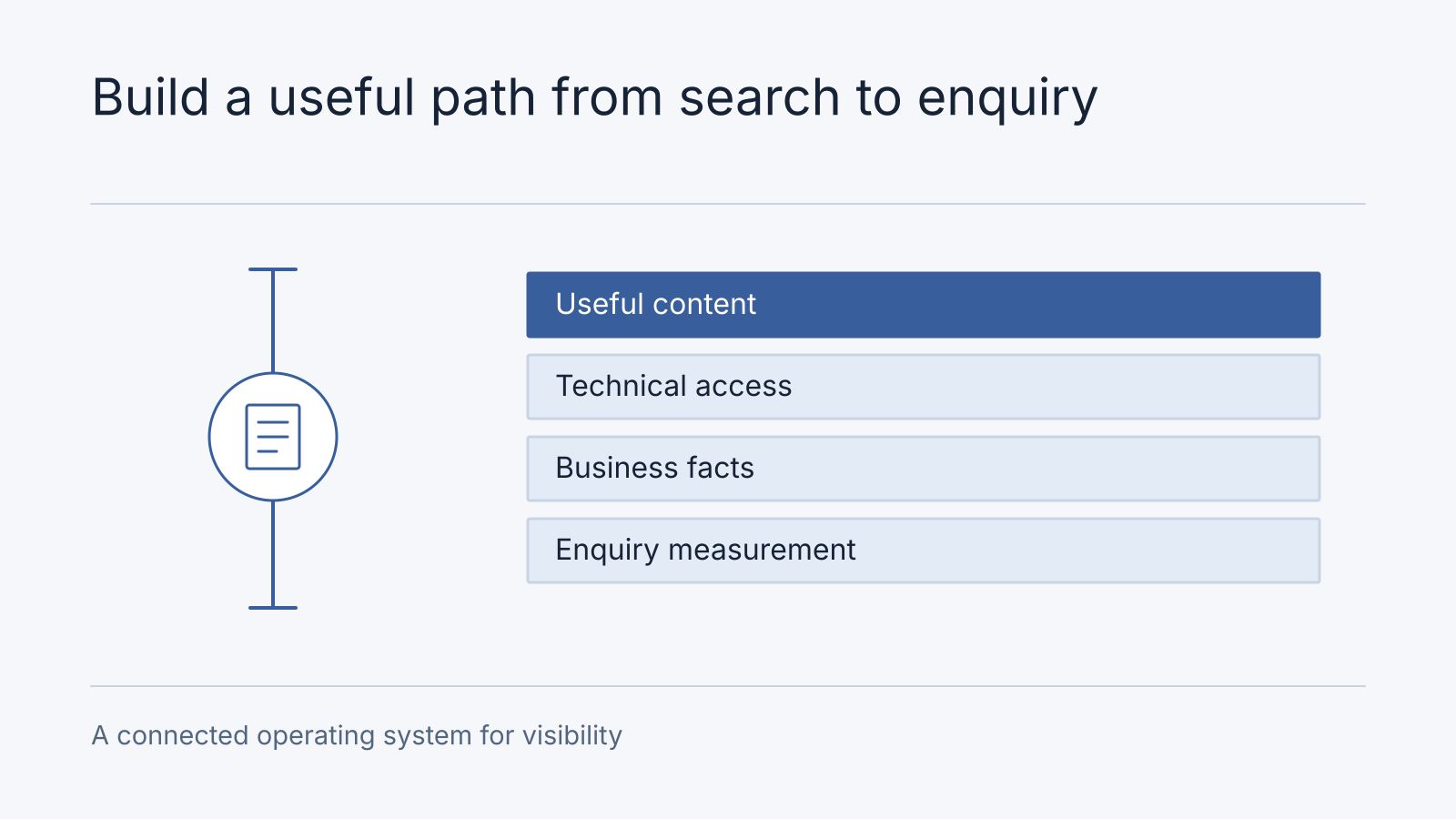
Visibility architecture is how we describe the relationship between a website’s content, navigation, technical delivery, and measurement. For a Malaysian SME, its purpose is practical: help prospective customers find the right service, understand the offer, and make an informed enquiry.
It is a way to organise website work, not a separate ranking system or a guarantee of AI recommendations. Google says SEO remains relevant to its generative AI features, and special AI markup is not required. Google’s AI search guidance is a useful reference when evaluating claims in a proposal.
Start with a business outcome
Choose an outcome your team can recognise, such as enquiries for a particular service in an area you actually cover. Describe what makes an enquiry suitable: the requested service, budget fit, or delivery requirements.
Then map the customer journey. A visitor should be able to move from a relevant guide to a service explanation, understand the commercial scope, and reach a working contact method. A higher traffic total is not enough if those visitors cannot decide whether the service fits.
Four areas to include in the scope
1. Content and evidence
Explain what you deliver, who it suits, the limits of the engagement, and what the buyer must supply. Make any price assumptions explicit. Use approved project examples with dates, constraints, and evidence of results where available.
For multilingual audiences, decide which pages need reviewed local content and who will maintain it. Avoid creating many nearly identical location pages that do not add useful service information.
2. Discovery and navigation
List the priority service pages and inspect how visitors reach them. Review indexing directives, canonical URLs, sitemaps, redirects, and internal links. Each proposed fix should name the affected page or shared component and show the observed issue.
Crawler settings should distinguish purposes. OpenAI documents separate controls for OAI-SearchBot, which supports search, and GPTBot, which relates to model training. Allowing one does not require allowing the other. See OpenAI’s crawler documentation.
3. Page delivery and enquiry flow
Inspect the actual pages your buyers use on mobile and desktop. Look for oversized media, delayed content, layout movement, inaccessible controls, and form failures. Identify whether hosting, templates, third-party scripts, or content are responsible before recommending a replacement platform.
A rebuild should address a documented constraint. Retaining an existing CMS can be reasonable when it supports the required workflows and the identified faults can be repaired. The proposal should compare the scope, ownership, and maintenance implications of both choices.
4. Measurement and handover
Record a baseline, implementation dates, and the definition of a qualified enquiry. Agree who owns analytics, Search Console access, website administration, and reporting. Require a handover that explains ongoing content updates and technical responsibilities.
AI answer samples can supplement reporting when the question, date, product, and cited URL are recorded. They should not be presented as proof of universal visibility or a guaranteed future recommendation.
Compare proposals by what you receive
| Area | Evidence to request before approval |
|---|---|
| Diagnosis | Affected URLs, observed issues, and business impact |
| Content work | Pages to revise, information needed from you, and editorial review responsibility |
| Engineering | Specific changes, acceptance criteria, dependencies, and release plan |
| Commercial scope | Deliverables, exclusions, recurring charges, and change-request terms |
| Ownership | Account access, source code arrangements, and handover materials |
| Reporting | Baseline, measurement definitions, reporting interval, and limitations |
A supplier can commit to these deliverables. Rankings, inclusion in AI answers, and lead volume depend on factors beyond those deliverables and should not be represented as certain outcomes.
Keep company and privacy evidence separate from search promises
During procurement, request the contracting entity’s details, support terms, data-handling responsibilities, and relevant supporting records. Evaluate those against your procurement requirements. This article does not establish any supplier’s registration, tax status, or legal compliance, and those claims should not be used as a shortcut to promised search rankings.
Prepare for a useful first discussion
For a fictional equipment-maintenance site, complete the record instead of requesting generic visibility work:
| Audit field | Illustrative record |
|---|---|
| Buyer question | Does the inspection fee include replacement parts? |
| Page claim and source | Parts are quoted separately; supported by the business-approved service sheet |
| Service destination | Relevant inspection scope and exclusions, not the generic homepage |
| Enquiry completion | Synthetic form reaches the assigned operations inbox; initial delivery remains to be verified |
| Owner | Operations approves copy; website owner verifies delivery and tracking |
| Acceptance | Approved wording is visible, link reaches the correct scope and a synthetic enquiry is received |
This is an illustrative audit record, not a measured customer outcome. A failed delivery check remains open even when the page attracts traffic.
| Measurement step | Data source | Limit to record |
|---|---|---|
| Discoverability | Search Console or a dated answer observation | Does not establish a visit or enquiry |
| Useful service visit | Landing-page and service-page analytics | Consent, attribution and collection gaps may limit counts |
| Completed enquiry | Application/form receipt record | A submission may be spam, unsuitable or duplicated |
| Qualified enquiry | Named staff qualification record | Does not prove a sale or attribute causation to one edit |
Bring your website URL, priority services and markets, the enquiries you want to receive, known site problems, and any available reporting. Identify who can approve content and provide access when work starts. Share access through an agreed secure process rather than putting passwords into an enquiry form.
Read our practical SEO and GEO guide for the content and measurement checklist, or contact Nodesify to discuss an assessment scope. Ask for the proposed deliverables and commercial terms in writing before commissioning the work.
Frequently asked questions
Can we improve the current CMS instead of rebuilding?
Yes. Request evidence of a constraint before approving replacement. Content, links, form delivery or measurement may be repairable within the existing platform.
What belongs in an SEO/GEO delivery scope?
Named URLs, approved claims, technical changes, enquiry acceptance, measurement definitions and an operating owner. For an architecture review, specify a website/content/enquiry assessment; broader content production or implementation is separately agreed.