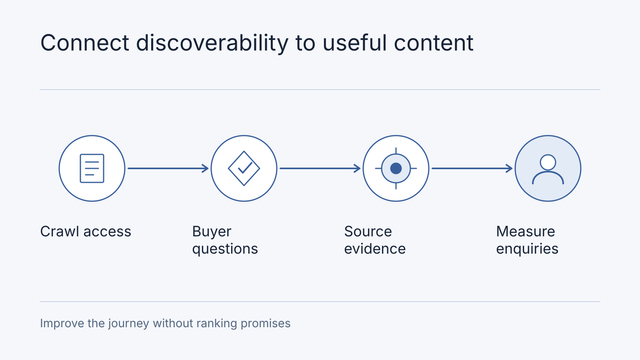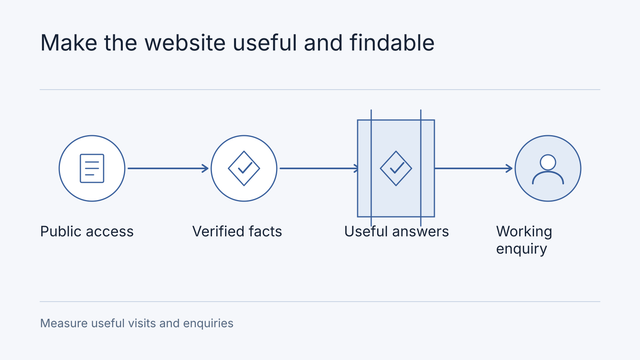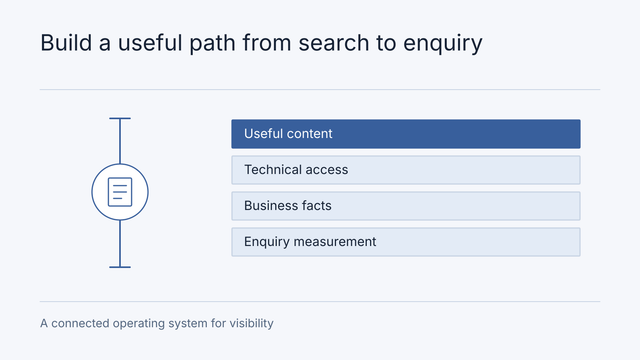
Answer engine optimization (AEO) describes efforts to make content useful when search products present direct answers. It is not a separate technical standard or a guarantee of inclusion. Start with accurate, accessible information that answers a real audience question and can be maintained as facts change.
Keep search and training controls distinct
OpenAI documents OAI-SearchBot for search and GPTBot for potential model-training use. Their controls serve different purposes; allowing a search crawler does not mean you must allow a training crawler. Check the OpenAI bot documentation before editing robots.txt.
Google likewise distinguishes Google Search crawling from Google-Extended controls. Its AI search guidance explains that established search practices apply and that no special AI schema is required. A robots directive cannot guarantee that a page will be selected or cited.
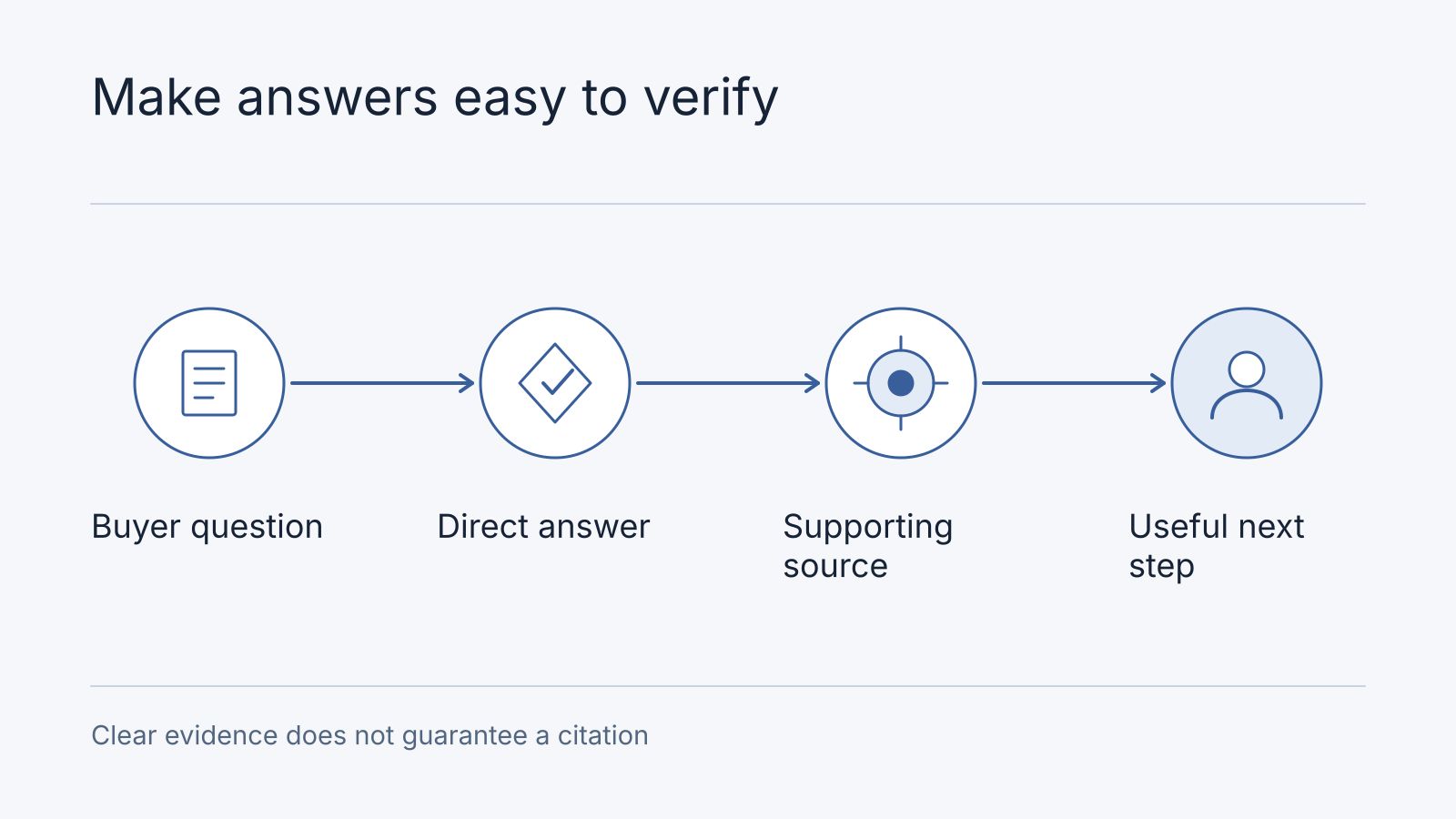
Write answers that readers can verify
Give a direct answer where the evidence permits one, then explain qualifications. State the jurisdiction, product version or review date when it changes the answer. Link to sources that actually support the claim, rather than using a general homepage as apparent evidence for a specific statistic.
Use descriptive headings, readable tables and meaningful internal links. Keep important information available as text and ensure that links can be followed. Structured data should match visible content and the supported schema type. FAQPage markup is not a universal route to stronger rankings or AI citations.
Maintain technical accessibility
Check indexing eligibility, canonical URLs and crawl access. Performance improvements help people use the site, but Interaction to Next Paint (INP) is a user-experience metric, not a measure of crawler capacity. Google’s page-experience guidance does not promise top rankings for passing a performance threshold.
Avoid claims that being cited directly trains a model or creates a predictable ranking feedback loop. Search products differ, and their selection behaviour is not fully disclosed.
Measure outcomes without promising a timetable
An illustrative answer revision changes “We provide complete digital transformation” to “The discovery scope maps one workflow, its system owners and acceptance cases. Implementation is quoted after the unresolved dependencies are reviewed.” The business owner must approve that statement before it becomes website copy.
| Synthetic observation | Evidence and next action |
|---|---|
| Question: “Does the audit include fixes?” | Answer cites a passage separating assessment and remediation; reviewer checks the passage supports it |
| Question: “Can I keep my website?” | Answer has no source; add a source-backed repair-versus-rebuild explanation, without assuming it will be cited |
| Question: “What should I bring?” | Source leads to the preparation page; enquiry attribution remains unknown unless tracking connects the visit |
Record exact product, question, date and saved output when conducting the real audit. The rows above are a form example, not observed search results. A crawler decision record might say: “Permit the search crawler needed for discovery; decide training access separately using the provider’s current documentation.” The website owner approves the change; an engineer verifies the resulting response and robots rules. Never infer training permission from an indexing result.
For a small illustrative answer audit, choose three buyer questions, record the exact wording, product and date, and save any cited URL. Check whether the cited passage supports the answer and whether a reader can reach a suitable service page from it. Repeat with the same method later, but do not call three sampled answers a market-share measure. This narrow crawler-and-evidence task is the focus of this guide; the visibility architecture guide covers the broader website plan.
Track search visibility, qualified visits and business outcomes. Where practical, sample relevant answer queries and record the product, date and wording used; answer outputs can vary. Distinguish observed citations from conversions and from broad claims about brand authority.
There is no substantiated universal four-to-eight-week or three-to-six-month timetable for results. Prioritise factual maintenance and useful coverage over repeated keyword variations. Our visibility architecture guide discusses how content and technical delivery work together.
For a bounded review, bring three buyer questions and the pages expected to answer them. Agree whether the deliverable covers crawl access, source-supported answer edits or enquiry measurement. An architecture audit can investigate technical access without assuming a website rebuild.
Frequently asked questions
Does allowing search access also authorise training?
Do not combine those decisions. Check the relevant provider’s separate controls and document the business owner’s choice for each purpose.
Will FAQ markup create citations, and what if we see none?
Markup must represent visible content and does not promise visibility. Without a citation, you can still evaluate page accuracy, access, qualified visits and recorded enquiries. Label unobserved attribution unknown rather than assigning the outcome to AI.