Legacy modernization should address a concrete problem: unsupported dependencies, costly changes, unreliable operation or a business capability the current system cannot support. Age alone is not evidence that a system must be replaced.
Understand the current system
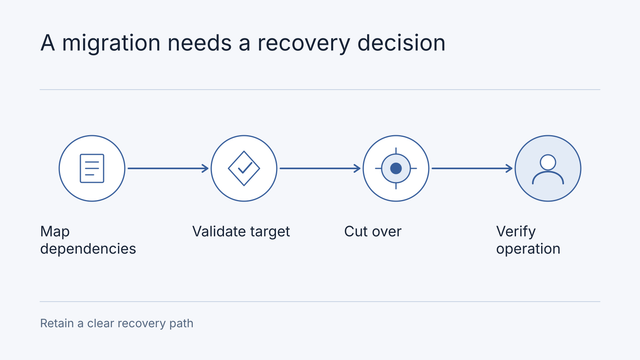
Map business workflows, data ownership, integrations and operational responsibilities. Include informal processes and batch jobs that may not appear in the main application documentation. Identify the changes that are difficult today and why they are difficult.
Use that evidence to compare maintenance, targeted replacement and a broader rebuild. There is no universal timetable or failure percentage that decides the answer for every organisation.
Consider incremental replacement
AWS’s strangler fig pattern guidance describes incrementally replacing functionality while an existing system continues to serve requests. Use the incremental boundary as a planning technique. Nodesify recommends choosing the architecture from your requirements rather than treating microservices, AI, or a particular gateway as prerequisites.
A modular application can be an appropriate target. Choose boundaries that match the business and data model, rather than introducing distributed services simply to label the system modern.
Choose the first boundary carefully
Assess dependencies, data consistency, user impact and recovery options. Reporting may be a useful first boundary in some systems, but it can depend heavily on undocumented business rules. Authentication is not generically a low-risk starting point: it can affect every user and integration.
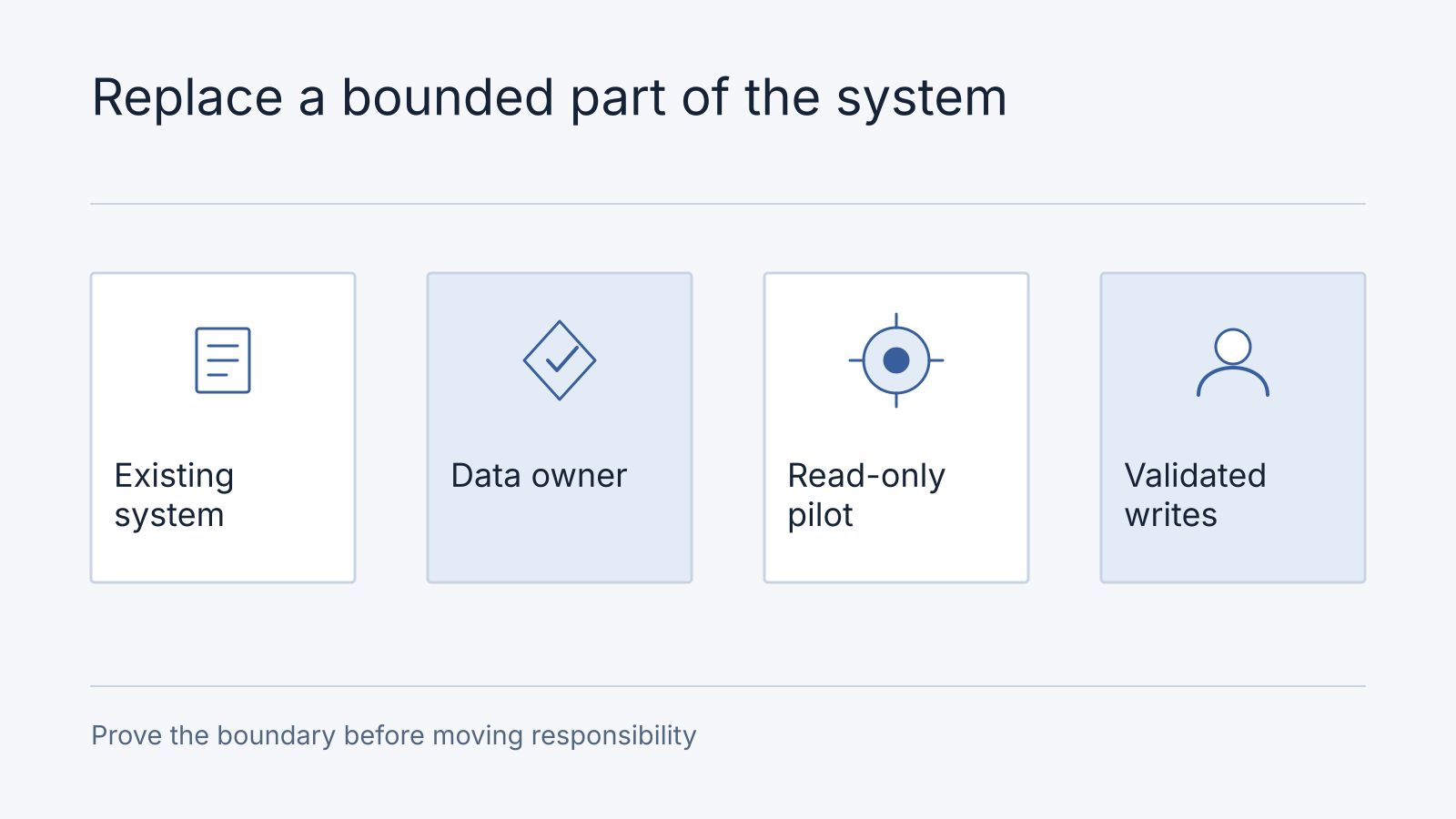
Define which system owns each write during transition. Where data is copied or synchronized, document reconciliation and error handling. Avoid leaving two competing sources of truth without a deliberate resolution process.
Plan cutover and recovery
Specify what must be verified before traffic or users move to the replacement. Determine how an unsuccessful cutover will be handled, particularly when the new system has already accepted writes. A rollback is not always a simple routing change.
Incremental migration can reduce some risks but does not guarantee zero downtime or eliminate the need for operational coordination. Match the method to the tolerated interruption and consistency requirements.
Reconcile one boundary before changing the writer
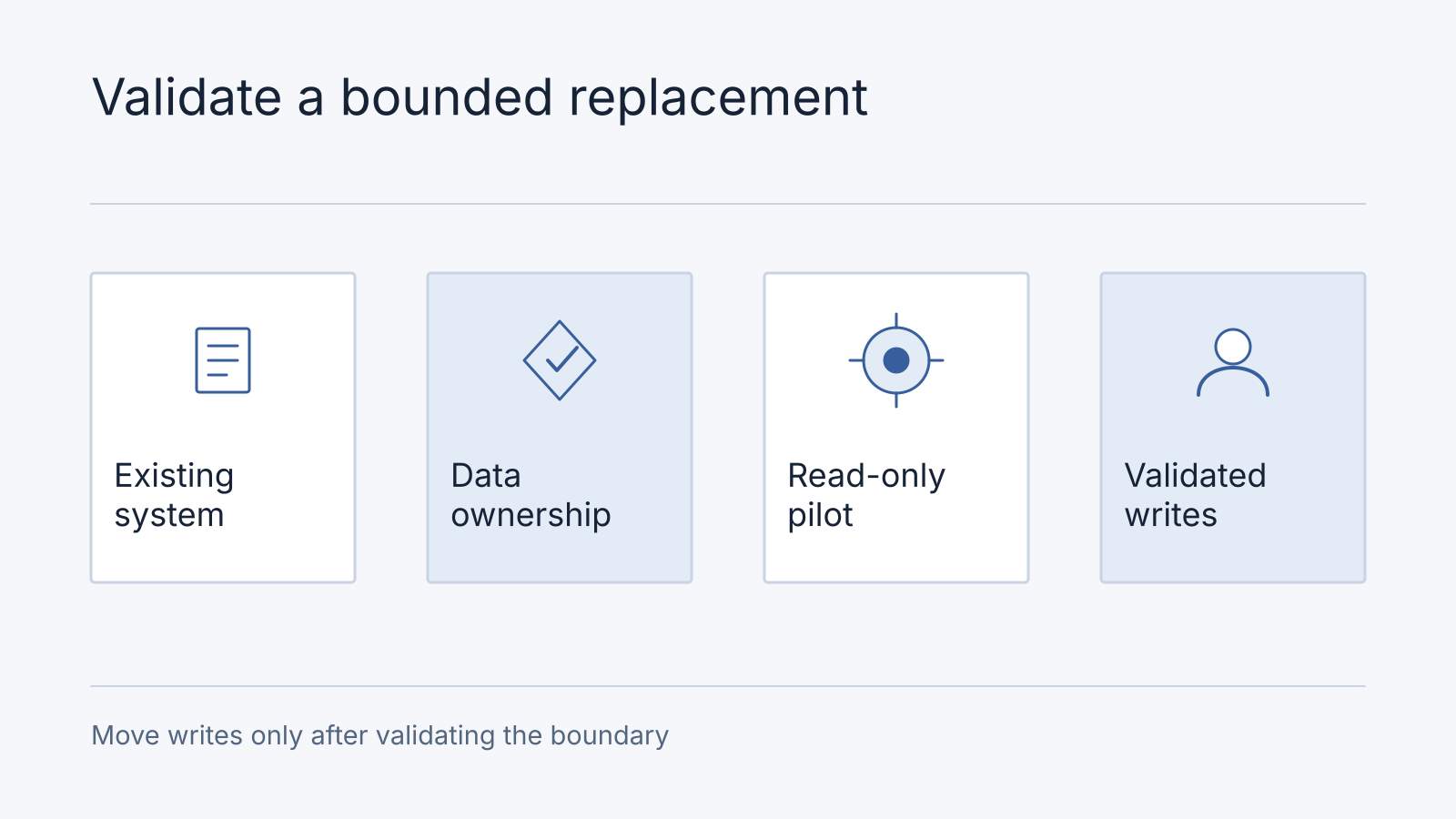
An illustrative stock-modernisation pilot begins with the old system as the stock authority. A new read-only view compares product, location and quantity for a bounded sample. A discrepancy is investigated and recorded rather than corrected in both systems independently. Before switching writes, name the final synchronisation point, accepted discrepancy threshold, transaction reconciliation and rollback decision owner. After the switch, explicitly prohibit the retired write path.
Compare three boundaries: a reporting view has lower write risk but may leave operational pain unchanged; an adapter can protect existing interfaces but needs supported access; replacing the stock ledger addresses deeper constraints and requires stronger reconciliation. Choose the smallest boundary that resolves the actual business problem, not automatically the easiest screen to redesign.
Frequently asked questions
Can work begin without source code or vendor access?
Inventory what is available and obtain permitted export/interface documentation first. Missing access can change the replacement strategy and estimate; do not disguise it as a minor assumption.
What should we request before approving a rebuild?
Ask an architecture audit for dependency and data-ownership evidence, then compare retain, isolate and replace options. Put the chosen cutover and retirement evidence in the delivery record.
Retire completed paths
In a hypothetical stock system, the first boundary might be a read-only inventory view rather than order writes. Map its source data, consumers and refresh delay; then define a comparison report that reveals differences before anyone relies on the replacement. Moving writes is a separate decision requiring reconciliation, failure handling and an owner who can stop the cutover. This example is a planning exercise, not a completed Nodesify migration.
Once a replacement is accepted and required data is preserved, remove obsolete functionality and infrastructure through a controlled process. Record the ongoing owner, documentation and maintenance requirements of the new system.
Our legacy modernization service can assess a bounded first improvement. Migration and ongoing engineering are quoted against the actual systems, data and transition requirements. A useful proposal explains the dependencies, transition criteria and evidence needed before expanding the migration.
The focused Zen-based build band on our pricing page is not a migration allowance or a price cap for replacing a legacy system. Scope data cleanup, reconciliation, cutover, training and external licences explicitly. Where discovery is credited toward a build, include it once in the complete total. Agree on ongoing support separately from the migration and any post-launch defect obligations.
For a programme involving several teams or systems, use the Malaysia digital transformation roadmap to agree phase owners and measurable acceptance gates. If the starting point is an AI-built prototype, the Manus handover planning guide lists the code, hosting and service dependencies to assess before pricing the work.