Logistics transformation begins with reliable information about what moved, where it moved and which action should follow. A new dashboard or prediction model cannot compensate for missing events, inconsistent identifiers or unclear operational ownership.
Establish useful event data
Map shipments, locations, assets and business partners to consistent identifiers. Define which events matter and which system records them. Track timestamps, corrections and missing messages so teams can distinguish a delayed update from a delayed shipment.
GS1 EPCIS provides a standard for sharing visibility event data. It does not require blockchain. A ledger can record submitted information, but its existence does not prove that a sensor reading or manual entry was correct. GS1’s blockchain guidance discusses standards in that broader context.
Connect a bounded workflow
Download the illustrative shipment event map. The fictional rows show a normal dispatch sequence and a delivery event with no matching dispatch. Adapt source identifiers and exception ownership to your systems; this is a planning worksheet, not a client result. An architecture audit can define the integration boundary before a wider rollout.
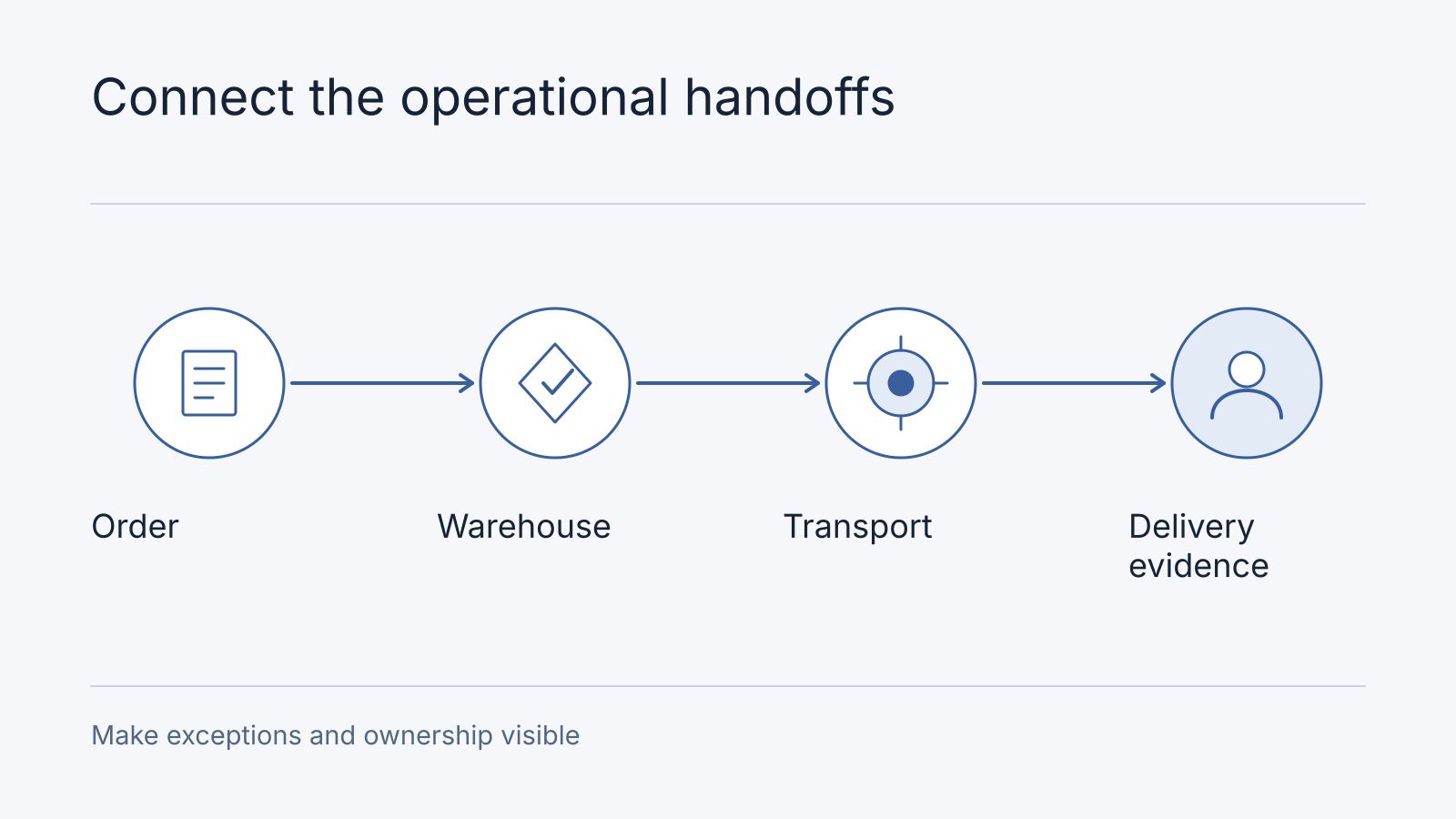
For an illustrative first project, combine an order record, a warehouse dispatch event and a carrier status update to show an operations team which shipments need attention. This is a proposed workflow, not a verified client outcome.
Map three example event fields before designing a dashboard: shipment ID, event time and source system. Add the expected next status and an exception owner. If a carrier reports delivery before the warehouse record shows dispatch, retain both source events and route the mismatch for review instead of silently overwriting one. This is a sample event map, not a demonstrated Nodesify deployment. Measure how many exceptions are found and resolved against the current manual process before claiming improvement.
Check which APIs and data-sharing agreements actually exist. Do not assume a public authority or commercial platform provides live traffic or operational data simply because the information would be useful. Consider latency, access rights and commercial terms for each source.
One shared interface can help users, but it does not require replacing every source system. Clear integration contracts and reconciliation may be more valuable than an immediate platform consolidation.
Evaluate predictions against a baseline
Forecasting and route recommendations depend on data quality, changing conditions and the decisions operators can take. Compare a model with the existing process on representative periods and exception cases. Record error, intervention effort and operational outcomes rather than promising a fixed accuracy or return.
A digital twin is a model of selected aspects of an operation. It is not an exact copy of reality, and simulation results depend on assumptions and calibration. A useful simulation can inform a decision without making that decision risk-free.
Close one exception before expanding
Complete one illustrative delivery exception: shipment S-014 has a planned depot scan at 09:00, a device event at 09:12 and ingestion at 09:35. The dispatcher sees both event time and receipt time, checks the source device and assigns a missing-item investigation. Warehouse staff confirm the physical count; the dispatcher closes the exception with evidence and an updated delivery commitment. A late upload must not silently overwrite a newer confirmed state.
Pilot one depot, one shipment type and one exception owner. Record baseline minutes spent finding a shipment, closure time, correction rate and unresolved exceptions. A useful result reduces the agreed work while preserving accurate status; a faster dashboard with more disputed records fails. Fill the existing event worksheet with source, event ID, event time, ingestion time and correction authority.
Frequently asked questions
Can we start without an API or reliable connectivity?
A controlled import may support a bounded pilot, but record its delay and reconciliation work. Offline devices need local identifiers, queued delivery and a conflict policy; offline collection is not live visibility.
Who decides whether to expand the pilot?
The operations owner signs the workflow outcome and the system owner signs reliability and support readiness. Bring those records to enterprise application development, or investigate an unknown integration first through a scoped review.
Keep people and exceptions in the design
Define who responds to alerts and how incorrect records are corrected. Provide a workable process during connectivity problems and integration outages. For temperature or condition monitoring, set escalation rules and verify sensor handling; software alone cannot guarantee that cargo will be saved.
Measure missed events, reconciliation effort, delivery exceptions and the time needed to resolve them. Expand only when the first workflow provides evidence of improvement. A research and development engagement can establish that evaluation before committing to a larger rollout.