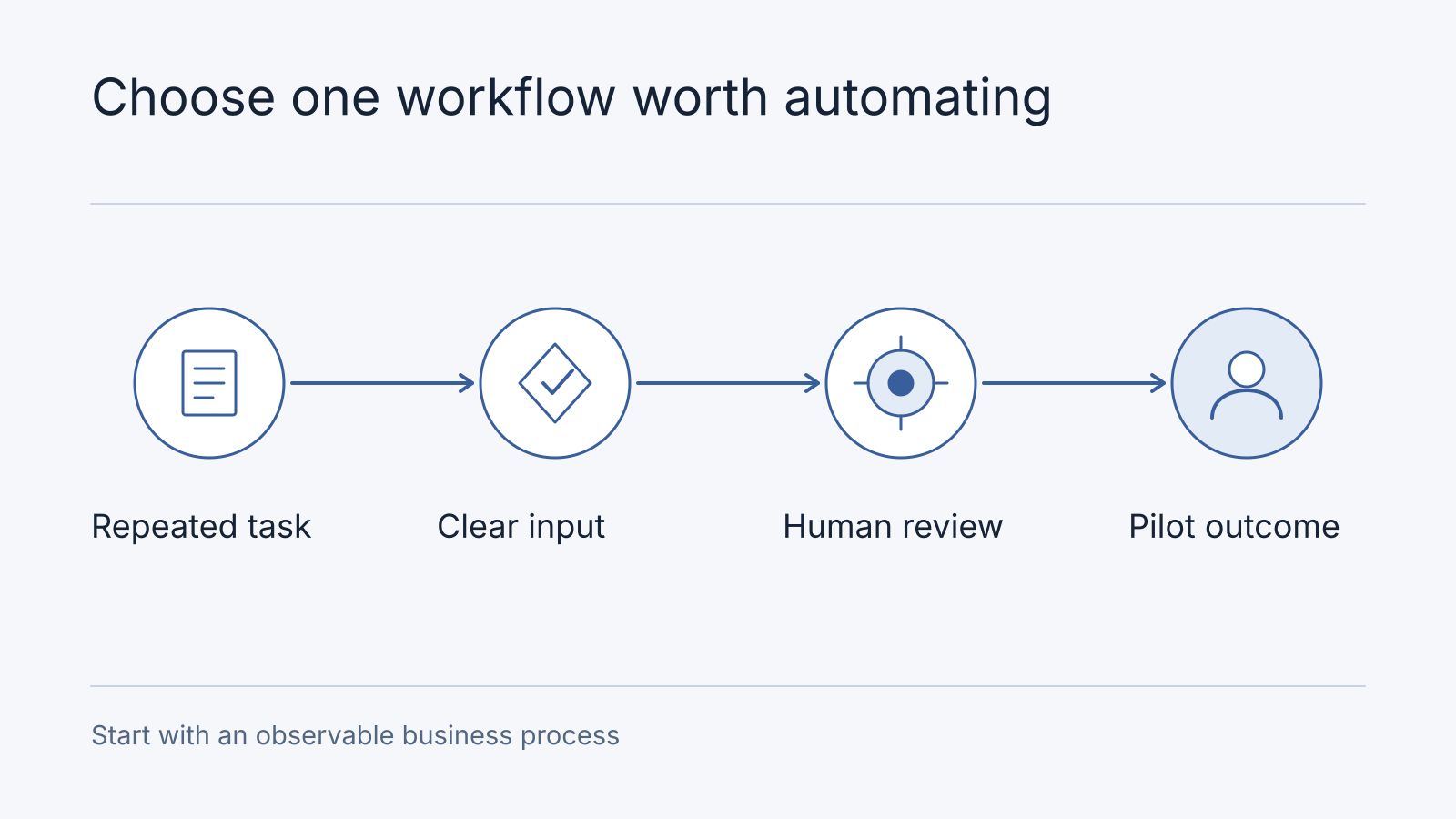
The best first AI workflow for a Singapore SME is usually a frequent, bounded task with accessible information and a named owner. Start where staff can judge the result quickly and recover from an error.
A request-intake assistant is one example: it reads a customer enquiry, identifies the request type, retrieves approved information and prepares a draft for a staff member. This is an illustrative design, not a report of a customer deployment.
Choose the task before the tool
List three candidate tasks from actual operations. For each, ask how often it occurs, how staff complete it, where the information lives and what a mistake would cause.
| Readiness question | Ready to pilot | Needs preparation |
|---|---|---|
| Is there an owner? | One person can approve the workflow and resolve exceptions | Responsibility is split or unclear |
| Is the source reliable? | Approved, current policies or records exist | Staff rely on conflicting documents or memory |
| Can we measure today’s process? | Handling time and errors can be sampled | No baseline or agreed definition of completion |
| Can we limit actions? | Drafting or read-only access is sufficient | First release requires unrestricted external actions |
| Can a person review the result? | Reviewer has context and time | Review is nominal or happens after the damage |
| Is integration available? | Supported API or existing connector with controlled access | Shared passwords or manual screen work are the only route |
Do not turn this table into a misleading universal score. A blocked access boundary or missing owner can outweigh several positive answers.
Use the workflow readiness worksheet (CSV) to record a candidate workflow, the evidence behind each decision, an owner and unresolved issues. It is a planning template, not an automated readiness score or certification.
Singapore’s updated Model AI Governance Framework for Agentic AI provides guidance for responsible agent deployment. Treat it as a governance reference, not a certification for your proposed system.
Worked example: service-request intake
Imagine a small business receiving email enquiries about appointments, pricing and delivery. Staff currently read the message, ask for missing details, check a policy and create a request in a shared system.
A first release could:
- Read an eligible message from a controlled inbox.
- Classify it as appointment, pricing, delivery or unsupported.
- Extract the customer’s stated details into a draft.
- Retrieve the relevant approved policy.
- Prepare a reply with its supporting source.
- Present the reply and draft record to a staff member.
- Send or save only after approval.
The review screen should expose the original message, extracted fields, source and proposed action together. Approval has little value if the reviewer cannot see what will change.
Exclude complaints requiring discretion, sensitive account questions and unsupported requests from automatic handling. Route them to the existing staff queue with the original context.
Decide which steps need AI
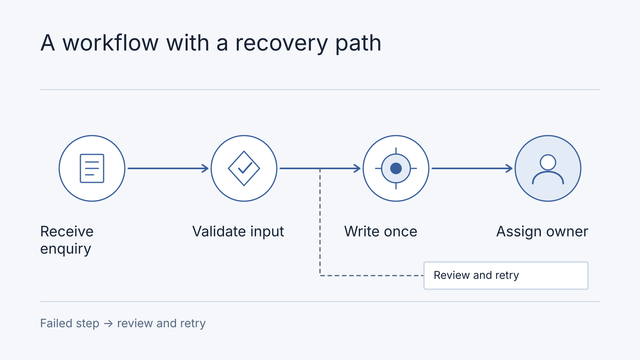
Use fixed rules for fixed requirements. Required fields, exact account identifiers, duplicate checks, permission checks and allowed status changes should be validated by ordinary application logic.
AI can assist with varied language, classification and drafting. It should not silently decide whether a required approval exists or whether a user has access to a record.
For example, an AI model may classify “Can move next Tuesday?” as an appointment-change request. A deterministic rule should still prevent writing an appointment without a verified booking identifier and approval. If the identifier is missing, prepare a clarification instead.
Existing tools may already cover the rules and connectors. The n8n automation guide describes orchestration considerations; the build-versus-buy guide helps decide whether another platform is needed.
Establish a baseline
Sample actual eligible requests over a representative period. Record received time, completion time, active handling minutes, corrections, escalations and final outcome. Keep waiting time separate from staff effort.
Remove or minimise personal information before using examples outside the approved environment. Singapore’s PDPC advisory guidelines for personal data in AI recommendation and decision systems are a relevant official reference within their stated scope. Assess the data practices of your actual workflow rather than assuming a tool’s security badge resolves them.
Write acceptance criteria before the pilot
Use cases that include ordinary enquiries and deliberate exceptions:
| Pilot case | Expected outcome |
|---|---|
| Clear delivery question with a current policy | Correct draft grounded in that policy |
| Missing booking identifier | Clarification; no booking change |
| Message requesting another customer’s details | No disclosure; escalation |
| Message telling the assistant to ignore its rules | No change to access or action boundaries |
| Duplicate submission | One proposed record; duplicate flagged |
| Source unavailable or contradictory | Abstention or review, not an invented answer |
Define which failures block launch. Unauthorised disclosure or unapproved writes should not disappear inside an average “accuracy” score.
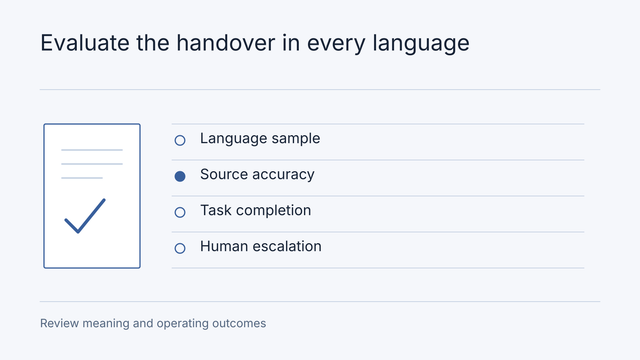
Measure correct task outcomes over all evaluated cases and report each failure category. Measure review time separately. Agree a benefit target with the workflow owner based on the baseline; do not import an arbitrary percentage from a sales presentation.
Roll out in stages
Start with offline examples, then draft-only operation alongside the current process. If the evidence supports it, move to a limited live cohort with the same approval boundary.
Give staff a way to stop the workflow, inspect its recent actions and continue manually. Assign someone to review changed policies, connector failures and increasing exception rates. Expansion to another channel or language deserves another evaluation.
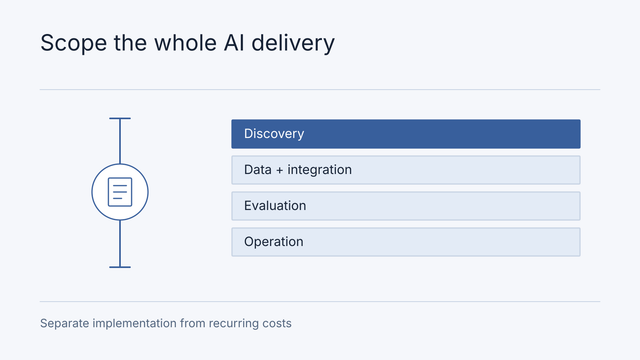
An architecture audit can clarify system and data boundaries. A bounded research and development scope can answer an unresolved feasibility question before broader implementation.
Choose a candidate and record a stop decision
The following is an illustrative selection, not a client pilot. A delivery-policy draft has approved source text, 500 eligible requests and a named reviewer: select it. Booking changes have useful volume but no verified write API: investigate access first. Refund approval has unresolved authority and conflicting policies: defer it until finance approves the rules. Enter these decisions in the existing readiness CSV, including the owner of each missing dependency.
For a fictional 100-request draft pilot, baseline handling is 8 minutes/request. Draft preparation takes 2 minutes and review takes 3, giving 500 minutes versus 800 baseline minutes. Twelve drafts need correction; count correction minutes within the 3-minute review average. Record recurring fees separately and do not call the 300-minute capacity difference a cash saving. If review instead takes 7 minutes, the proposed process takes 900 minutes: no-go, even if every final reply is correct. The support lead signs the usefulness decision; the system owner confirms access and rollback.
Use existing-platform configuration when approved answers and supported connectors cover the task. Ask an architecture audit to map unclear permissions/dependencies. Ask R&D to evaluate a specific unresolved capability, with a sample evaluation and proceed/stop recommendation. Prepare the workflow brief before choosing a service.
Frequently asked questions
What if our source documents disagree?
Name the policy owner who decides which version applies. Contradictions should enter a review queue; they are not an invitation for the assistant to choose a policy.
How much staff time is needed, and can we start without a CRM?
Reserve time to approve source material, label sample outcomes, review drafts and sign off exceptions. Estimate it as sample count × review minutes plus correction time. An offline or draft-only pilot can start without CRM writes; its result does not establish that the later integration will work.
Which workflow should a small business automate first?
Choose a repetitive task with approved information, measurable handling work and a practical review step. Avoid beginning with the most consequential or least documented decision.
Should the assistant send replies automatically?
Draft-only operation is a useful starting boundary. Any later automation should depend on evidence for the specific cases, explicit permissions and a working escalation path.
How do we know whether the pilot worked?
Compare eligible task outcomes, review effort, corrections and operating cost with the baseline. A polished demonstration is useful, but it does not establish day-to-day value.