A customer who pays for a resume expects a usable document. They should be able to inspect it, download it, and return when they need a revision. A successful checkout is one step in that experience. It does not establish that the exported file contains the right content or that the customer can recover access later.
We build and operate ResumeForU, a guided English resume builder. This article explains the engineering decisions behind its document workflow and the questions those decisions raise for other business applications. It is an account of our own product, not an independent review or a client success story.
The implementation observations reflect our source review on October 16, 2026. They describe design and safeguards, not measured production availability, customer conversion improvements, or universal applicant tracking system compatibility.
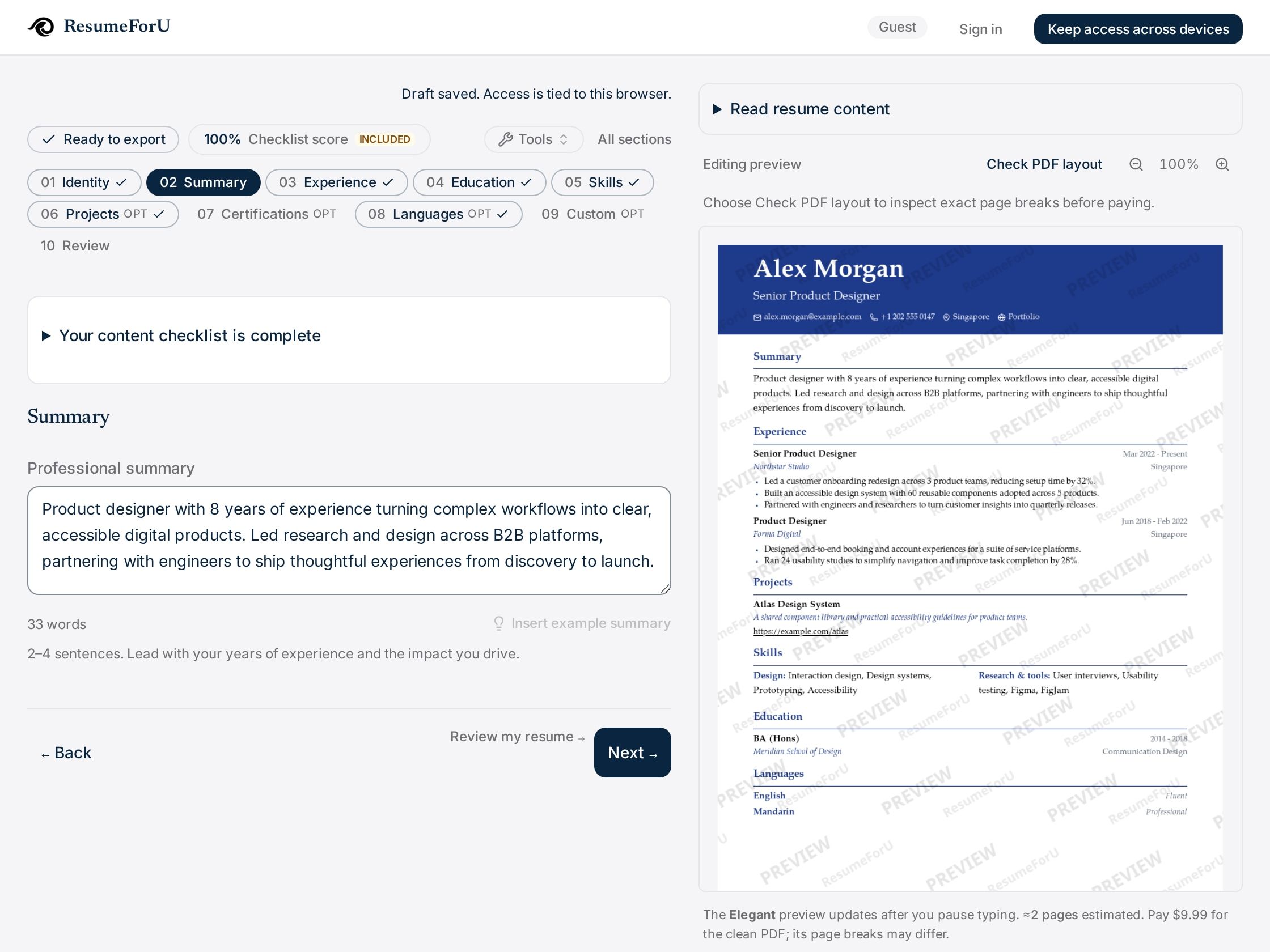
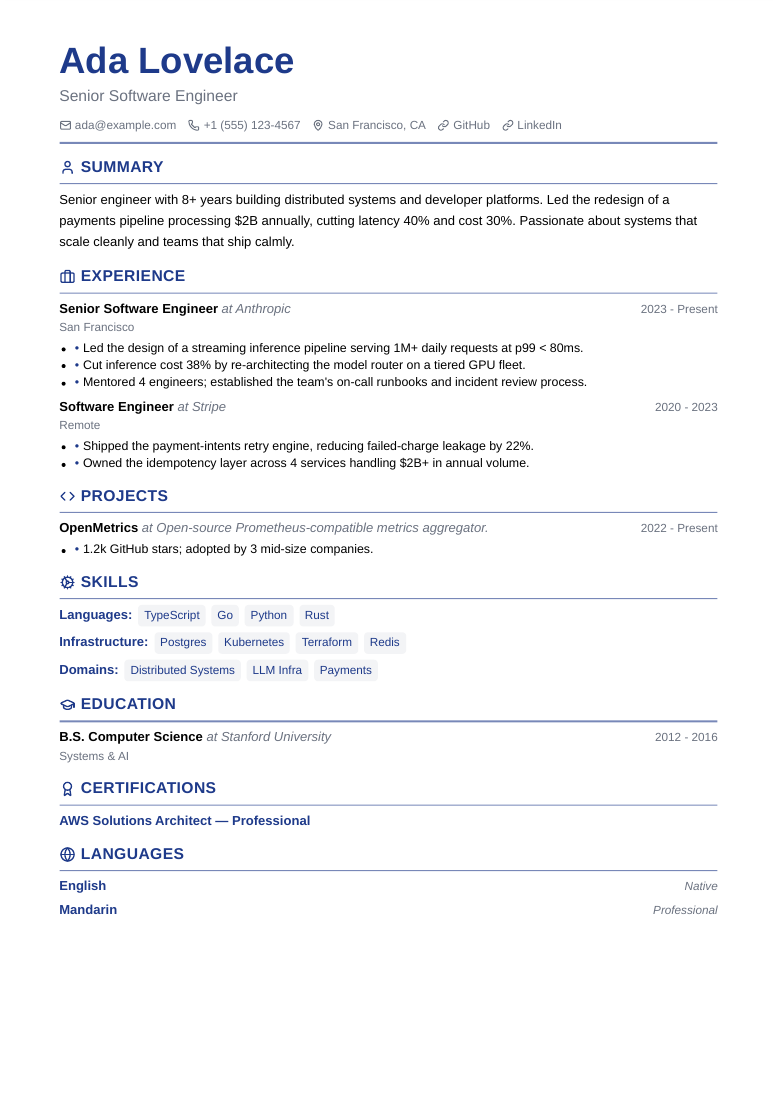
The cover shows the staging editor captured on October 16, 2026 with a populated, fictional senior product designer resume for Alex Morgan. It illustrates the editing workflow and document preview, not a real applicant or a generated final PDF.
Start With What the Customer Is Buying
ResumeForU lets people organize their experience and inspect a preview before purchasing exports for a saved resume. The current pricing and purchase scope explain the included formats, ongoing editing, job versions, and guest access. The core purchase has no recurring subscription. AI writing and human review are not included in that core offer.
Those product rules shape the engineering work. The application must connect a purchase to the correct resume, preserve access when generation fails, and keep subsequent edits separate from the document already being generated.
For a quotation portal, certificate service, or paid reporting tool, the equivalent questions come before framework selection:
- What exactly does a purchase or approval authorize?
- Which version of the information belongs in the delivered document?
- What happens when payment succeeds but generation does not?
- How does the customer recover the result without repeating the purchase?
Our e-commerce payment integration checklist turns similar questions into a supplier brief. Digital documents need a delivery scope just as physical orders need fulfillment rules.
An Editing Preview Is Not the Final Document
An interactive editor needs to respond quickly. A printable document must obey page dimensions, font metrics, and page-break rules. A continuous browser preview can help someone write without proving where the final PDF will break across pages.
ResumeForU separates these surfaces:
| Surface | Purpose | What It Establishes |
|---|---|---|
| Editing preview | Review content and layout while making changes | An approximate view of the working document |
| Watermarked preview | Inspect the resume before purchasing exports | A preview of the selected content and presentation |
| Final PDF preview | Inspect the generated PDF pages | Images derived from the PDF artifact offered for download |
For the final preview, the implementation creates page images from the generated PDF bytes. It does not independently rebuild a second HTML representation and assume the two outputs match. If the user edits the resume, the previous final preview becomes stale and needs regeneration.
We also capture the resume data for a rendering job once. Later edits should not cause one export to combine content from different moments. This matters for business documents too: a report should represent an identifiable set of inputs, rather than changing underneath the export process.
Inspect the File You Intend to Deliver
Producing a PDF buffer is not sufficient evidence of a useful document. The implementation inspects the PDF page tree and extracted text, including page dimensions, empty pages, text positions, and expected text fragments. These checks can identify particular failures before the application offers the artifact.
Consider a synthetic example: a long project URL fits poorly in a narrow section. The editor may still show a plausible page, while the printed text extends past an edge. Inspecting the printed coordinates gives the application a chance to reject that output and ask the user to adjust the content or layout.
These checks have limits. Text extraction does not prove that every glyph looks correct, that all reading order is meaningful, or that no elements overlap. Automated checks and visual inspection answer different questions. Neither should be presented as a guarantee that every employer’s recruitment software will interpret every field correctly.
Our PDF text-extraction research provides historical synthetic examples, retained files, scoring definitions, and limitations. It covers a small July 2026 comparison, not verification of the current release. We link to the original evidence rather than turning its scores into an ATS acceptance claim. The ResumeForU methodology explains the product’s assessment approach and its boundaries.
Give Each Export Format a Clear Job
PDF, Word, and plain text are useful for different reasons. Trying to promise identical behavior across all three would obscure those differences.
| Format | Intended Use | Engineering Concern |
|---|---|---|
| A styled document ready to inspect and share | Pagination, fonts, content preservation, and layout | |
| Word (DOCX) | A document the recipient or owner can edit | Headings, paragraphs, lists, links, and editable structure |
| TXT | Plain content without visual formatting | Clear section boundaries and readable text |
The Word exporter uses document structures rather than trying to reproduce every visual detail of a PDF template. The text exporter has no visual template to reproduce. Both need to respect the user’s section choices and ordering so that a hidden section does not unexpectedly reappear in another format.
This is a useful acceptance question for any business export: should the second format preserve appearance, editable structure, or data? Agree on that before treating a successful download as completion.
Keep Payment and Delivery as Separate States
Payment confirmation, document generation, file availability, and the customer saving a file are different events. A browser return from checkout should not be the sole basis for granting paid access.
ResumeForU’s implementation uses verified payment processing to establish purchase rights and checks those rights before generating paid exports. Document generation can then fail without turning the purchase back into an unpaid order. The recovery path should help the buyer retry or contact support, rather than suggest buying again.
The same distinction applies to emailed reports, downloadable training materials, and certificates. A useful acceptance review includes exceptions:
- Verify purchase rightsConfirm that this customer can export this saved resume.
- Capture the resume versionUse one consistent set of content and layout choices.
- Generate and inspect the fileCheck the resulting artifact before offering it.
- Preview and download the same PDFDerive the final preview from the file being delivered.
- Recover without another purchaseIf generation fails or access expires, preserve purchase rights while the customer retries or gets help.
| Scenario | Outcome to Demonstrate |
|---|---|
| Buyer closes the browser after payment | The purchase can still be confirmed and recovered |
| A payment notification is delivered again | The same payment does not create duplicate purchase rights |
| Export generation fails after payment | The buyer retains the purchase and receives a recovery path |
| The document changes during generation | The result belongs to the captured version, and stale previews are discarded |
| A temporary download link expires | An authorized buyer can request access again |
These are proposed acceptance outcomes for a project review, not a claim that this article independently exercised every production scenario. Choosing a provider is only part of that work. Our Malaysia payment-gateway guide discusses provider and integration considerations separately.
Treat Guest Access as an Ongoing Responsibility
Letting someone begin without an account reduces the number of steps before they can inspect the product. It also creates a responsibility after purchase: the buyer may close the browser, change devices, or lose a temporary access link.
ResumeForU supports guest purchasing and a later account-claim flow. Purchase rights and the lifetime of a claim link are separate concepts. An expired link should lead to access recovery, not a statement that the purchase has disappeared.
For a business portal, ask who owns the purchase or document, what evidence is needed to restore access, and which support route handles an unresolved case. Those rules belong in the product design alongside checkout and sign-in.
Isolate Expensive Work Without Promising Unlimited Capacity
Document generation uses browser and image-processing work that has different resource needs from ordinary page requests. The current source separates that work into a renderer with bounded jobs and deadlines. This allows the application to handle capacity limits explicitly instead of accepting unbounded work.
Separation alone does not establish scale. Capacity needs measurement against representative documents, concurrent requests, and failure recovery. Publishing an architecture diagram cannot substitute for those observations.
For a consulting engagement, the decision is practical: which work can delay other customers, what happens when capacity is exhausted, and what evidence would justify expanding the system? Keep the architecture proportional to those answers.
Apply the Lessons to Your Business Workflow
Translate this into an illustrative quotation portal, not a client success story: a salesperson approves quote revision 4; the export job stores that revision’s inputs; the buyer downloads the file for revision 4 even if a draft revision 5 is later edited. If rendering fails after payment, retain the purchase record, show delivery pending and let the operator retry the same approved revision. Acceptance compares source totals, page layout and downloadable file, then checks duplicate callbacks and access recovery.
Before buying a similar workflow, request a synthetic sample export and a state record showing approved input, payment reference, delivery attempt and recovery owner. This article describes engineering decisions; it does not provide a measured capacity benchmark or a downloadable proof package for every format.
Frequently asked questions
Does payment success prove the document was delivered?
No. Track payment and delivery separately. A renderer failure should trigger a recoverable delivery state, not another charge or a silently different document.
What happens if a guest loses the purchase link?
Define how ownership is verified and access is restored without exposing another person’s document. Link expiry and purchase entitlement need separate rules.
Is this a resume product or a development service?
Use ResumeForU to create a resume. Bring a document, source fields and acceptance cases to enterprise application development when your business needs its own document workflow.
ResumeForU gives us a concrete setting for decisions that also arise in invoices, proposals, certificates, and operational reports. The transferable work is defining what the customer should receive, preserving the correct inputs, checking the output, and assigning responsibility when delivery fails.
For your own project, bring one synthetic or appropriately redacted document, its source fields, the approval or payment rules, and the expected recovery journey. Agree what counts as accepted delivery and who handles exceptions. Our enterprise application development service covers scoped business workflows, while an architecture audit can help examine risks in an existing system.
To explore the product behind this article, visit ResumeForU’s resume builder or read the Nodesify product overview. To discuss a document workflow for your business, contact Nodesify with your example and requirements.