Zero trust is an approach to access decisions that avoids implicit trust based solely on network location or ownership. It is not a product, a promise of perfect security or a requirement to remove every existing network control. The foundational reference is NIST SP 800-207.
Start with resources and access
Identify the applications, services and data that need protection, along with the people and workloads that access them. Establish how identities are verified and what permissions each role needs. Authentication alone is not sufficient: authorisation must determine which actions are allowed.
Use relevant context, such as device state and the sensitivity of the resource, when making access decisions. Access from inside an office network should not automatically confer broad permissions. Equally, a zero trust programme does not mean any device must be allowed to connect.
Use complementary controls
Least privilege, segmentation, credential management and monitoring can work together to limit exposure. Segmentation may reduce lateral movement, but it does not guarantee that an attacker cannot cross a boundary or misuse an authorised account.
Encryption in transit and at rest protect different stages of data handling. Their presence does not by itself establish end-to-end encryption, where the intended endpoints and key access must be examined. Describe the actual protection rather than using these terms interchangeably.
VPNs and perimeter controls can remain part of a broader architecture. Replacing a VPN is not a universal prerequisite, and machine learning is not required for every policy decision. Select controls that match the resources and risks.
Introduce changes gradually
As a hypothetical first-system exercise, map a finance application by user group, service account, device requirement and data action. Record who currently has access, who approves each exception and how an emergency administrator is reviewed afterward. Restrict one group in a reversible pilot, then compare access logs and failed business tasks with the baseline. This does not claim a Nodesify deployment or a particular risk reduction.
Start with a bounded application or user group. Inventory dependencies and service accounts before restricting access so critical processes are not unexpectedly interrupted. Define recovery and emergency-access arrangements with appropriate oversight.
Measure whether permissions are narrower, access is reviewable and suspicious behaviour can be investigated. Include service-to-service traffic and privileged administration, not only employee login screens.
Keep ownership clear
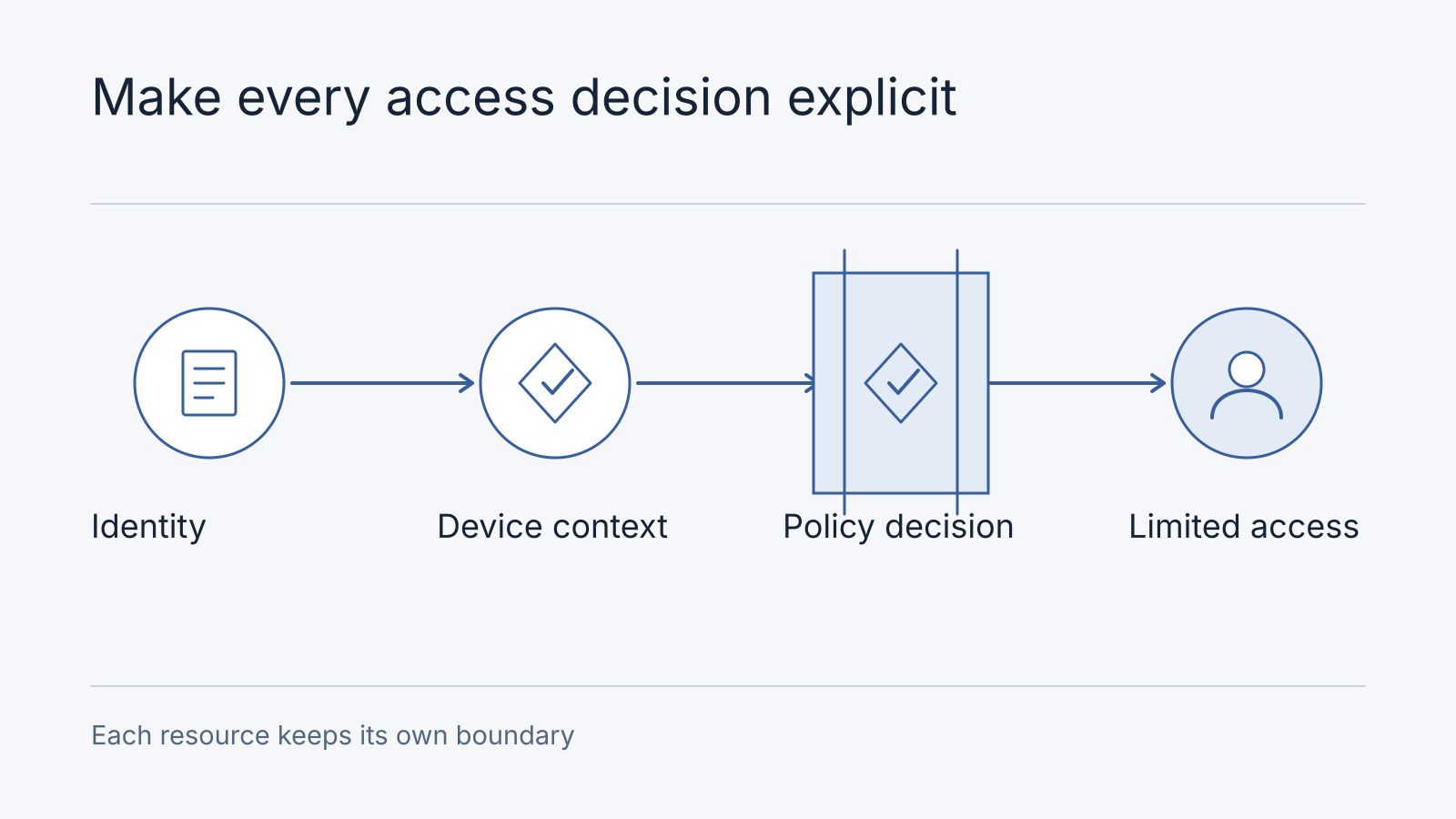
For the hypothetical finance application, authentication answers “which user or workload is this?” Authorisation answers “may it perform this action on this resource under these conditions?” A verified identity can still be denied a payment-export action.
User or service identity + relevant device/workload context
                         |
                   Policy decision
                    /           \
          Permitted action     Denied or exception requested
                 |                       |
          Finance resource       Named approver decides
                 |                       |
                 +--- Logged decision ---+
                          |
                  Access owner reviews
Emergency access needs a named approver, bounded purpose, expiry/revocation and retrospective review. It must not become an unowned permanent bypass. This diagram is a planning example, not a deployed control assessment.
Use the first-application access worksheet. Its synthetic finance-export row records current permission, desired restriction, identity dependency, owner, allowed/denied acceptance and recovery condition. Pilot a bounded change only when the business can recover an incorrectly blocked legitimate task.
Frequently asked questions
Must we replace our VPN, and where can a small business begin?
No universal replacement is required. Start with one application and one excessive or unclear permission, including its service-account dependencies. Verify the actual resource/action boundary before buying another platform.
Who reviews service accounts and emergency access?
Assign an application/access owner, with the relevant security and business approvers. Review purpose, permission, credential lifecycle and exceptional use. Bring that record to an architecture review; certification or penetration testing is not implied by this scope.
Maintain the policy and its evidence
Someone must maintain policies, handle access reviews and respond when a device or identity changes state. Log the information necessary to understand decisions while applying appropriate access and retention controls to the logs themselves.
Zero trust reduces reliance on assumptions about trusted networks. Its effectiveness still depends on implementation, maintenance and the rest of the security programme. An architecture review can map those dependencies before access changes affect production workflows.