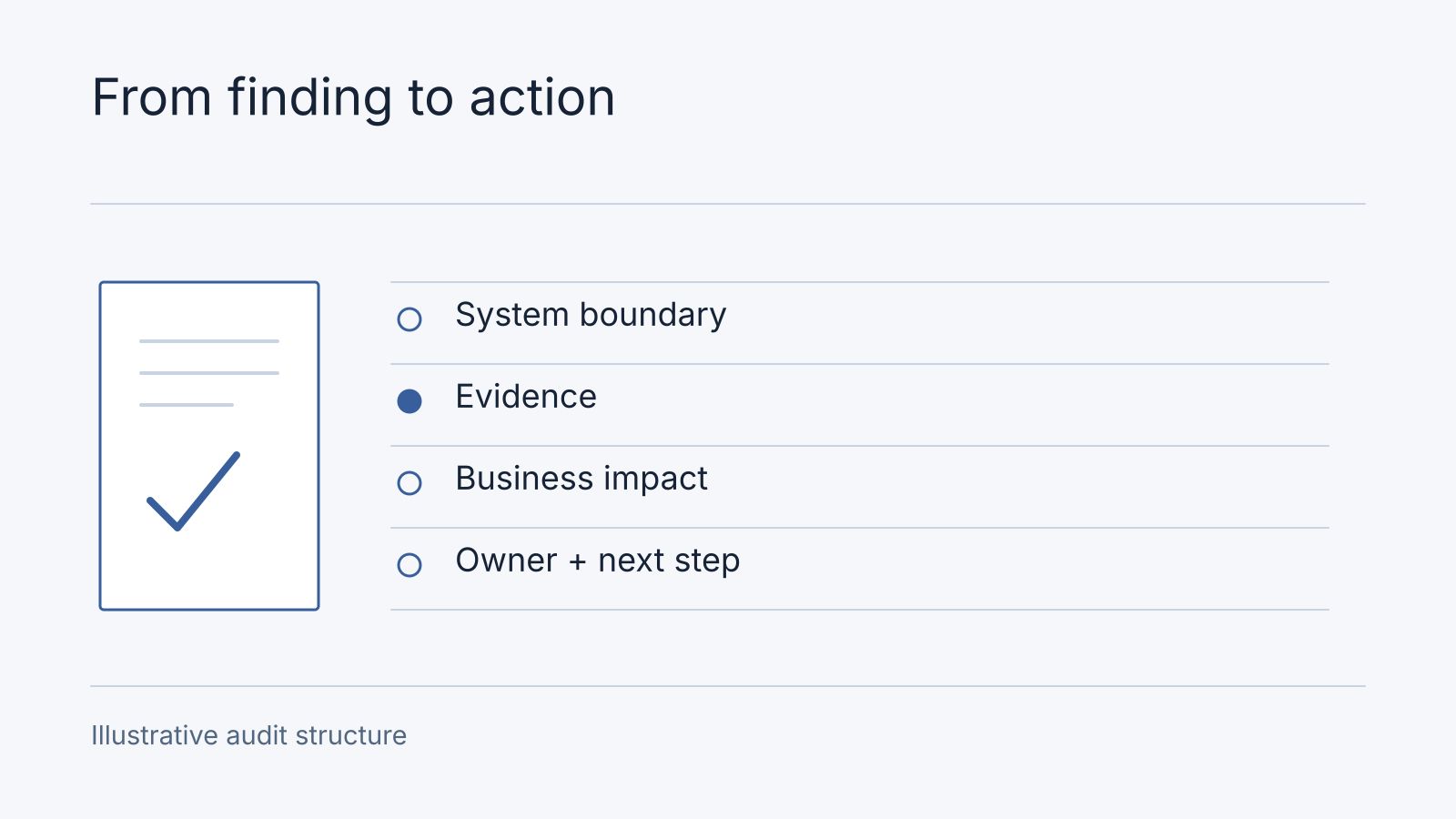
A software architecture audit should help you decide what to fix, what to investigate next, and whether the system can support its intended use. Ask for a report that connects each material finding to evidence, a business consequence, and a practical next action. A diagram alone does not tell a developer what to change or an owner what to fund.
For a business in Malaysia or Singapore, the useful starting point is a concrete concern: customers cannot complete an order, releases are hard to recover, or a prototype is about to accept paying users. State that concern before commissioning a broad review.
The report below is an illustrative planning example. It is not a completed Nodesify client engagement, an executed assessment, or a standard package commitment. Its observations and identifiers are invented to show how evidence and decisions can be recorded. Your engagement scope determines the systems, checks, and deliverables included.
Agree the Decision and Review Boundary
Suppose a fictional booking application accepts payments, reserves a service slot, and sends a confirmation. The owner wants to know whether to open a limited paid pilot. The review follows that one journey, including a customer closing the browser or a payment notification arriving twice.
| Scope item | Illustrative agreement |
|---|---|
| Decision | Whether the booking-and-payment journey is ready for a limited paid pilot |
| System boundary | Web app, application API, booking database, payment webhook, and notification worker |
| Evidence access | Named repository revision, configuration with secrets removed, staging access, and representative records |
| Included work | Trace state changes, inspect account boundaries, and review failure recovery with the developer |
| Excluded work | Penetration testing, legal certification, provider infrastructure, and a full load assessment |
| Remaining uncertainty | Production payment behavior and peak demand have not been demonstrated |
Name the environment and revision in the actual report. A staging observation may not describe production configuration. Mark missing access as a limitation rather than filling the gap with an assumption.
The Deliverables to Request
A useful report can be short if it supports a decision. Request these outputs in the agreed scope:
- Decision summary: the current recommendation, its conditions, and unresolved questions.
- System and data-flow map: the services, trust boundaries, and records involved in the reviewed journey.
- Evidence register: where each observation came from and how another reviewer can reproduce it.
- Prioritized findings: consequence, confidence, affected boundary, and proposed remediation.
- Action plan: an accountable owner, dependencies, and evidence required to close each finding.
Source files and diagrams are useful supporting artifacts. Ask for an editable findings list so your team can track work after the review. Confirm whether a follow-up assessment of the fixes is included or separately scoped.
Sample Report: Booking and Payment Review
Illustrative recommendation: do not start the paid pilot until payment confirmation and duplicate handling have been demonstrated. A developer can continue an internal demonstration using synthetic records. Production behavior and access isolation remain separate decisions.
The example journey is: customer requests slot → application creates pending booking → payment provider processes payment → authenticated server notification updates the booking → worker sends confirmation.
The browser return is helpful to the customer, but it cannot be the only route to completing the booking. This matters when the customer pays and closes the tab before returning.
Sample Evidence Register
The entries below describe the evidence an actual reviewer would collect. They are not results from a running application.
| Evidence ID | Example artifact to collect | What it can establish |
|---|---|---|
| E1 | Booking-state diagram tied to a repository revision | Which component is intended to move a booking from pending to paid |
| E2 | Source trace of the return route and webhook handler | Whether a server-confirmed payment can complete without the browser |
| E3 | Database constraints and worker transaction boundaries | Where duplicate processing is prevented and where it remains possible |
| E4 | Authorized staging replay of one payment notification | Observed booking and notification behavior for that environment |
| E5 | Restore record showing backup, restored records, and elapsed time | What recovery has actually demonstrated, within the measured scope |
A source trace supports a statement about implementation. It does not establish that a production credential, webhook registration, or queue is configured correctly. The report should distinguish inspected design from observed behavior.
Sample Finding: Payment Depends on a Browser Return
Illustrative observation: the return route marks a booking paid, while the server notification handler only logs the event. If the browser never returns, a successful payment may remain attached to a pending booking.
Business consequence: the customer can pay without receiving the reserved service. Support must reconcile the payment and booking manually.
Evidence needed: E2 plus a controlled example where payment succeeds and the browser closes. Record the provider payment ID and booking ID without publishing customer data.
Proposed action: make verified server-side payment status drive the durable booking state. Define what happens if the slot is no longer available when payment completes. The return page should display the recorded state, including a pending state when confirmation is delayed.
Closure evidence: one paid booking and one agreed customer notification are produced even when the browser does not return. A failed payment does not reserve a paid entitlement.
Sample Finding: A Retried Event Can Repeat an Action
Illustrative observation: the notification worker sends confirmation whenever it receives a paid event, without durable protection against repeated processing. Two overlapping deliveries could send two confirmations or repeat fulfillment.
Proposed action: agree which business action must happen once, then enforce that boundary with durable state and the destination’s supported idempotency behavior. A read followed by an unprotected write can still race. Do not assume a queue makes processing happen exactly once.
Closure evidence: repeated and overlapping deliveries preserve one logical booking and the intended notification behavior. A timeout after a successful write can be reconciled without another fulfillment.
Stripe’s webhook guidance documents duplicate deliveries and event identification. The exact event and state rules must follow your chosen provider. This is a design concern to verify, not evidence that every payment system has the illustrative defect.
Turn Findings Into Fundable Work
The boundary can be summarised as browser request → pending booking → provider payment → authenticated server event → durable booking state → notification. The browser return reads the state; it must not be the only route that establishes it. Keep the provider and notification worker boundaries visible when assigning responsibility.
| Completed illustrative finding card | Record |
|---|---|
| Finding | F1: paid booking depends on browser return |
| Priority | Blocks the proposed paid pilot if confirmed |
| Confidence and evidence | Source-level concern from E2; controlled behaviour still unverified |
| Business decision owner | Booking-service owner |
| Remediation owner | Application engineer |
| Next check | Closed-browser staging payment tied to the same booking/payment identifiers |
| Closure | Verified server event establishes one booking; failure and duplicate cases meet agreed rules |
Download the editable sample report and blank template. Its E1–E5 references and sample finding are invented. Agree the actual report format, systems and follow-up review scope before commissioning work.
Prioritize by the consequence and likelihood in your intended use, alongside the confidence of the evidence. Avoid treating an unverified concern as a confirmed critical defect.
| Action | Example accountable owner | Dependency | Evidence needed before closing |
|---|---|---|---|
| Establish server-confirmed payment state | Application developer | Provider credentials and agreed booking rules | Closed-browser payment completes the booking correctly |
| Protect fulfillment from duplicate processing | Application developer | Durable booking identifiers and state model | Repeated and overlapping events preserve the business outcome |
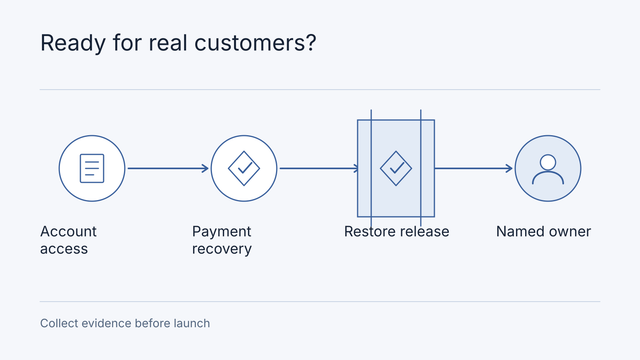
| Demonstrate restoration | Operations owner | Approved backup and recovery environment | Required records are restored and the recovery time is recorded |
| Decide pilot readiness | Business owner | Review findings, completed fixes, and remaining limitations | Explicit acceptance of scope, residual risks, and support ownership |
Estimate implementation work after the owner and dependencies are clear. A finding that needs a provider decision or missing source access is not yet a reliable fixed-price task. Record those dependencies before promising a delivery date.
What the Report Cannot Establish
An architecture review does not automatically certify security, legal compliance, or performance at a particular traffic level. It also does not prove that a proposed fix works. Those conclusions need their own scope and evidence.
Ask the reviewer to identify systems they could not access, checks they did not perform, and assumptions that would change the recommendation. If recovery has not been demonstrated, write “recovery unverified” rather than describing the existence of a backup as proof of recoverability.
This distinction is supported by AWS’s recovery-validation guidance, which recommends exercising recovery paths and verifying the restored state and recovery time against agreed objectives. In an actual audit, request the recovery record and any gaps against those objectives. The sample report structure above is our editorial recommendation, not an AWS-prescribed audit format.
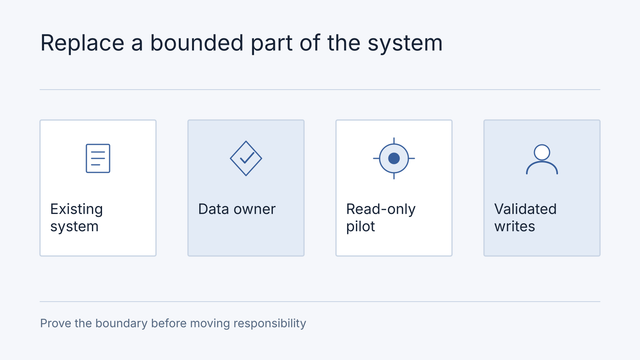
Our ResumeForU document-delivery article discusses a concrete product engineering problem beyond checkout. For a prototype nearing launch, use the AI-built app readiness guide to frame the first review. For an older system, the modernization guide helps identify a smaller change boundary.
Frequently asked questions
Does the review include fixing findings?
Only if implementation is expressly included. An assessment identifies evidence, decisions and next actions; remediation and any follow-up verification need agreed scope and acceptance.
Can a review proceed with partial access?
Yes, when the limited decision remains useful. List inaccessible systems and checks not performed; do not describe source inspection as production verification.
What proves a fix is closed?
Evidence tied to the agreed environment/revision and original failure, including relevant exception cases, accepted by the named owner. A code change or a “done” status alone is insufficient.
Prepare the review boundary
Bring one user journey, the symptom or decision you need help with, the systems involved, and the access you can authorize. Include the current developer or operations owner if possible. Do not send production secrets or customer records through the initial contact form.
Read the architecture audit service and book a Strategy Session to agree the review boundary. Use the sample above to discuss the evidence and handover you need. The written engagement should confirm the actual deliverables, exclusions, and responsibility for implementing and reviewing fixes.