Most enterprise efficiency projects fail the same way. A consultancy flies in, runs interviews for a week, and delivers a 60-page slide deck of recommendations. Three months later, nothing has shipped, the deck is unused, and the operational cost leak it described is still running.
A slide deck has never automated a workflow, reconciled an invoice, or saved a single hour of human labor. If an enterprise wants measurable efficiency gains in 2026, it does not need another advisor. It needs a senior engineer on site.
That is the premise of the Forward Deployed Engineer (FDE) model: deploy an experienced engineer into the client organization to investigate real workflows, then build the systems, often AI-powered, that remove cost from the business.
What Is a Forward Deployed Engineer?
A Forward Deployed Engineer (FDE) is a senior software engineer deployed onsite at a client company to investigate operational workflows, identify inefficiencies, and build working software that reduces cost. Unlike a management consultant, who delivers analysis and recommendations, an FDE ships live systems running inside the client’s business.
The role was pioneered by Palantir Technologies, the data analytics company whose engineers embedded directly inside client organizations, from the United States Department of Defense to global banks, to integrate software against live operational data. The model proved effective because the engineer worked from inside the building: reading the actual spreadsheets, sitting beside the actual operators, and writing code against the actual production systems. (Palantir describes its forward-deployed model in the company overview on its corporate site.)
Why Onsite Investigation Outperforms Remote Audits
Inefficiency is invisible from a distance. It lives in the sales representative who manually copies data between three spreadsheets. It lives in the finance clerk who exports a CSV every Friday, reformats it, and emails it to a colleague who re-keys it into another system. No one documents these steps in a requirements brief, because to the people performing them, the work is simply “how things get done.”
A remote auditor will never observe these patterns. An onsite senior engineer will, because the engineer stands beside the person doing the work.
During the first days of an FDE engagement, the engineer maps rather than builds. The work is followed as it moves between teams. Real databases are opened, API logs are read, and a single customer order is traced as it touches six separate systems before fulfillment. This is the same diagnostic discipline applied in our Technical Roadmap and Architecture Audit, except the FDE conducts it live, against live data, on the client’s floor.
The output is not a deck. It is a ranked list of concrete inefficiencies, each one measured in hours wasted per week and cost incurred per month.
Forward Deployed Engineer vs. Consultant vs. Offshore Freelancer
Procurement teams evaluating delivery models usually compare three options. The differences matter, because each model produces a different deliverable and carries different risk.
| Dimension | Forward Deployed Engineer | Management Consultant | Offshore Freelancer |
|---|---|---|---|
| Primary deliverable | Working software, live in your business | Strategy deck and recommendations | Code, delivered remotely |
| Location | Onsite, inside your operations | Onsite during engagements, offsite otherwise | Fully remote, offshore |
| Access to live workflows | Direct, first-hand observation | Second-hand, via interviews | None without active oversight |
| Legal accountability | Local jurisdiction (e.g., Malaysian PDPA, SSM) | Typically local contract | Outside local jurisdiction |
| Output after engagement | A cost-saving system that keeps running | Documents that require someone else to implement | Code that still needs integration and maintenance |
Bottom line: an FDE produces a running system, not a document. For enterprises whose goal is measurable cost reduction rather than analysis, the FDE model is the only one of the three that ships software.
Where AI Actually Reduces Enterprise Cost
Most enterprise AI projects fail because the buyer purchased a generic chatbot and expected it to help. It rarely does. Cost reduction comes from building systems targeted at the specific, observed workflows the FDE mapped on site.
The economic case is well established. Generative AI could add between US$2.6 trillion and US$4.4 trillion in value to the global economy annually, with use cases in customer operations, marketing, sales, software engineering, and R&D accounting for roughly three-quarters of that potential, according to McKinsey’s 2023 research, “The economic potential of generative AI.” Realizing that value, however, requires integration against a company’s own data and workflows, which is precisely the work an FDE performs.
Three build categories produce the fastest, most defensible returns.
1. Automating the Manual Data Grind
When a team spends 15 hours a week moving data between systems, the problem is already solved. An FDE builds the integration that removes the human from the loop, connecting CRM, ERP, and inventory systems so records flow without manual re-entry. Layered with an n8n workflow automation engine, the entire process runs itself.
2. Internal AI Grounded in Your Own Data
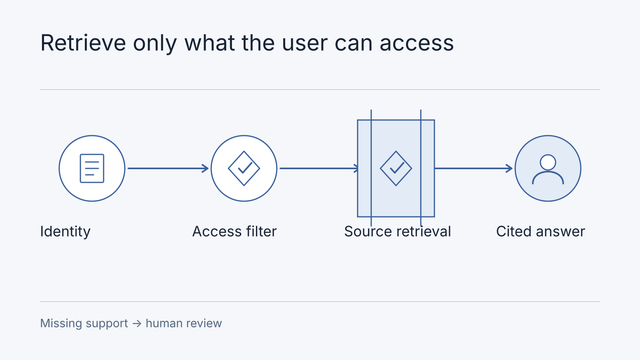
The highest-return AI systems of 2026 are not generic chatbots. They are retrieval-augmented systems that read a company’s own documents, including contracts, standard operating procedures, product catalogs, and historical support tickets. An FDE stands up a Retrieval-Augmented Generation (RAG) pipeline so that when staff ask a question, the model reads internal data and answers accurately rather than guessing.
A single, well-scoped internal assistant can absorb the workload of a full-time coordinator: answering repetitive internal queries, drafting responses, and generating reports on demand. That is a measurable headcount saving, not a hypothetical one.
3. Retiring the Legacy Tax
A significant share of enterprise cost is locked inside aging systems that no one wants to touch. They are slow, expensive to maintain, and force staff into manual workarounds. An FDE maps the legacy debt and plans a modernization path that retires the most expensive components first. The goal is not a risky big-bang rewrite, but a staged cutover that begins paying back within weeks.
The Economics of an FDE Engagement
Procurement teams care about unit economics, so the comparison should be stated plainly.
A traditional consulting engagement charges a premium for analysis and produces no working software. An offshore freelancer is inexpensive but operates outside local legal jurisdiction and carries no accountability if the build fails, as we examine in our comparison of traditional IT agencies versus offshore freelancers.
The FDE model is structured differently. The client pays for a time-boxed onsite engagement, typically two to four weeks, during which the engineer investigates, prototypes, and ships a first working system. The deliverable is software that is live in the business, not a PDF.
Because the FDE targets the highest-waste workflows first, the initial build typically recovers the engagement cost within a single quarter. Every month of operation thereafter is net savings: fewer manual hours, fewer errors, faster cycle times, and the option to defer the next coordinator or clerk hire because the system now performs that work.
The engagement is not a purchase of advice. It is the acquisition of a system that removes cost from the business every month it runs.
How Nodesify Runs an FDE Engagement
Nodesify Technology does not deploy an engineer blind. Each engagement follows a defined structure so the client knows the deliverable before work begins.
- Scoping call. The problem space and success metrics are defined before anyone travels. No blind quotations.
- Onsite investigation. A senior engineer deploys to the client office, observes real workflows, and maps inefficiencies against live systems. All data handling follows the same PDPA-compliant discipline applied across every Nodesify engagement.
- Ranked findings. The client receives a prioritized list of inefficiencies, each quantified in time and cost, showing exactly where money is being lost.
- First build. The FDE ships a working system, usually an automation or an internal AI tool, targeting the single most expensive inefficiency on the list. It goes live before the engagement ends.
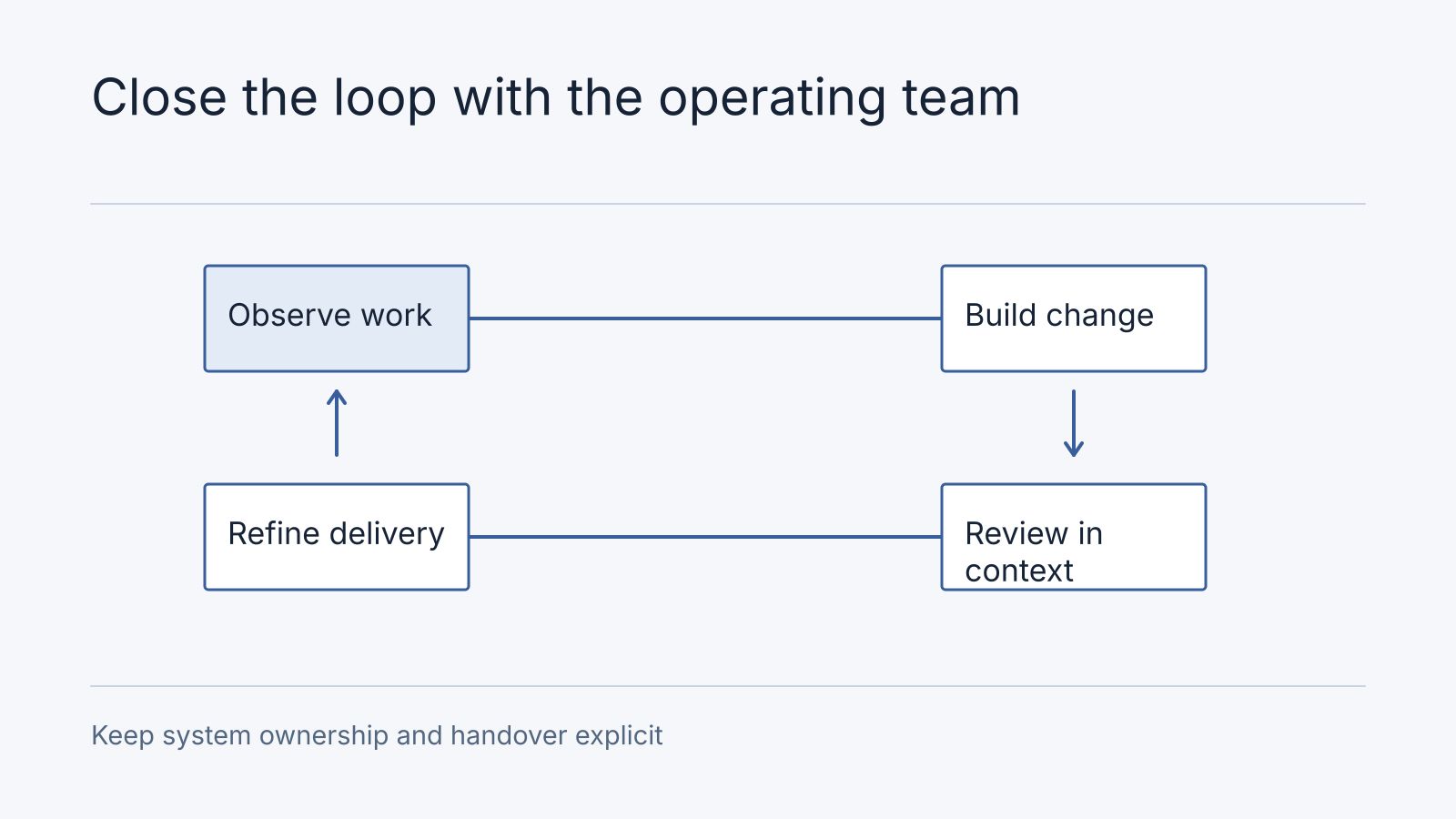
- Handover or continuation. The system is either handed to the client team with full documentation, or Nodesify continues deploying to address the next item on the list.
The model rests on the same “Hub-and-Spoke” delivery principle as the rest of the practice: a local senior architect owns accountability and quality, supported by a vetted global engineering team for any heavier build work that follows. Because Nodesify is an SSM-registered Malaysian company, every contract, IP transfer, and invoice is handled natively in MYR under full local compliance.
Is an FDE Engagement Right for Your Organization?
Not every company needs one. An FDE engagement is appropriate when inefficiency is felt but cannot be quantified, when staff are visibly overloaded with manual work, when legacy systems are driving expensive workarounds, and when generic AI tools have failed to move the needle because no one invested the time to understand the real workflows.
If operations are already lean and well-automated, the engagement is not necessary. But if an estimated 20 to 40 percent of operating cost is invisible manual labor hiding inside established routine, an onsite FDE is the fastest route to finding it and removing it.
The choice is straightforward. Keep buying slide decks, or place an engineer in the room and begin shipping savings this quarter.
Frequently Asked Questions
What does a Forward Deployed Engineer do?
A Forward Deployed Engineer (FDE) is a senior software engineer deployed onsite at a client company to investigate operational workflows, identify inefficiencies, and build working software that reduces cost. The deliverable is live software running in the client’s business, not a report or a recommendation.
How is a Forward Deployed Engineer different from a consultant?
A management consultant delivers analysis and advice, typically as documents or presentations. A Forward Deployed Engineer delivers working software integrated into the client’s operations. The FDE model originated at Palantir Technologies, where engineers embedded directly inside client organizations to integrate systems against live data.
Can an onsite engineer actually save a company money?
Yes, when the engagement targets the right workflows. Savings come from automating high-volume manual tasks, deploying internal AI tools that absorb repetitive knowledge work, and retiring expensive legacy systems. A well-scoped FDE build typically recovers the engagement cost within the first quarter of operation.
How long is a Forward Deployed Engineer engagement?
A typical onsite FDE engagement runs two to four weeks. The first days are spent investigating and mapping workflows; the remainder is spent building and shipping the first live system. Additional phases can follow to address further inefficiencies from the prioritized list.
Is a Forward Deployed Engineer engagement legally compliant in Malaysia?
Yes. Nodesify Technology runs every FDE engagement under the same legal and data-protection discipline as the rest of its practice. As an SSM-registered Malaysian company, Nodesify handles all data, contracts, and deliverables in compliance with the Malaysian Personal Data Protection Act (PDPA) and local corporate governance. The accountability that applies to remote builds applies equally to onsite engineers.
Industry Statistics & Citations
- Implementation Success: Companies utilizing Forward-Deployed Engineers (FDEs) report a 40% higher success rate in enterprise AI integrations compared to traditional SaaS deployment models.
- Time to Value: On-site AI engineering reduces the typical enterprise time-to-value from 12 months to under 3 months.
- Citation: Palantir & McKinsey Joint Report on Field Engineering, 2025.